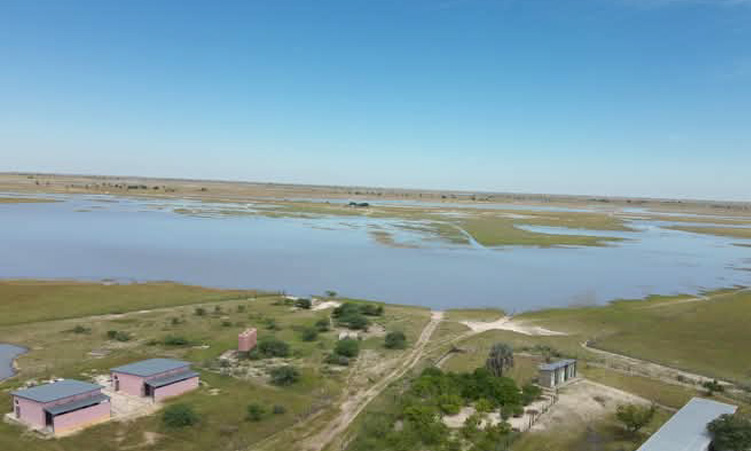
The recent flooding in the Ohangwena region has displaced more than 156 families as it swept away entire communities and destroyed bridges, roads, healthcare facilities, and other key infrastructure.
Among the relocated residents are 115 children under the age of five and 31 lactating mothers.
High water levels have engulfed buildings, schools, businesses and homes.
The torrential downpours are said to have submerged thousand acres of croplands, and a number of livestock has died or gone lost amid the dilemma.
Many of those affected depend on agriculture for their livelihoods and a hunger crisis may be imminent.
‘BREEDING GROUND FOR DISEASES’
Ohangwena Regional Council chairperson Erickson Ndawanifa in a flood report update says the flooding has also contaminated clean water sources, making ponds, rivers and streams a breeding ground for diseases.
Malaria cases have already been reported in the Ohangwena region.
Ndawanifa says the flood disaster in the region is ongoing, with numerous challenges in terms of accessibility, health services, and education.
“The water levels in the affected areas continue to rise, causing an increasing number of victims. Key impacts include the submerging of mahangu fields in the affected constituencies of Oshikango, Engela, Ongenga, Endola and Ohangwena.
“Villages such as Ouhongo in the Engela constituency, Onghala B, Eengava, and Oimbadalunga in the Ongenga constituency are surrounded by floodwaters, making it impossible for the drought-relief food team to deliver supplies or for residents to access health services,” he says.

Ndawanifa says immediate intervention in the form of supplies, infrastructure improvements, and continued healthcare outreach is essential.
“Efforts to provide long-term solutions such as infrastructure development and better preparedness for future disasters are crucial for enhancing resilience in affected communities,” he says.
The chairperson adds that the region is battling a shortage of transport for health services to reach isolated areas and is working to prevent overcrowding in the camps.
“Schools are planning potential camping for senior grades if the water level continues to rise. Immediate food aid is needed to address shortages among affected households and pupils camping at schools. Mattresses should be allocated to pupils camping at schools. Compensation for lost teaching days is also being planned,” he says.
LONG-TERM INTERVENTION
Ndawanifa says road construction should continue to provide better access to affected areas.
“In this regard, the Roads Authority will come back and construct all 49 planned access roads. It will construct fixed facilities at relocation camps to ensure proper sanitation and reduce the health risks associated with the floods.
“It will also consider building permanent infrastructure, such as bridges and proper sanitation, to mitigate the impact of future floods. Earth dams should be constructed at designated places, and establishing boarding schools in the affected areas to accommodate displaced pupils should be considered,” he says.
The chairperson says the regional council is in dire need of about 20 mobile toilets, 25 000 mosquito nets, food for about 2 000 people, and 1 000 mattresses.
Ndawanifa says a total of 4 445 pupils are currently unable to attend school due to the flooding as many schools are submerged in water.
RELOCATION CAMPS
Ndawanifa says six relocation camps are operational in the region and pupils are camping at Udjombala Secondary School.
Onamhinda A and Onamhinda B in the Oshikango constituency, Onamukalo and Ohangwena in the Ohangwena constituency, plus Ouhongo and Ohaingu in the Engela constituency have camps.
FATALITIES
Sylvia Fillipus (14) drowned in an earth dam while swimming at Omatunda aNekundi village in the Engela constituency on 5 April.
The incident was reported by the Engela constituency councillor.
Megameno Devane (2), from Onamunama village in the Ondobe constituency, drowned in a pond on 6 April while following her grandmother to a neighbour’s house.
The matter is under Ondobe police inquest.
In an age of information overload, Sunrise is The Namibian’s morning briefing, delivered at 6h00 from Monday to Friday. It offers a curated rundown of the most important stories from the past 24 hours – occasionally with a light, witty touch. It’s an essential way to stay informed. Subscribe and join our newsletter community.

The Namibian uses AI tools to assist with improved quality, accuracy and efficiency, while maintaining editorial oversight and journalistic integrity.
Stay informed with The Namibian – your source for credible journalism. Get in-depth reporting and opinions for
only N$85 a month. Invest in journalism, invest in democracy –
Subscribe Now!