



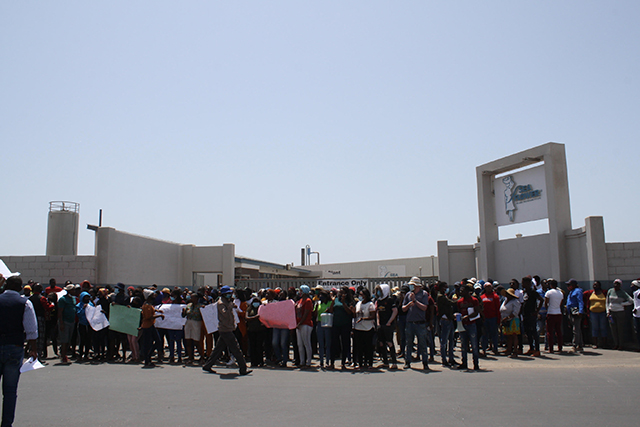
Employees of Seaflower Pelagic Processing (SPP) at Walvis Bay on Monday staged a demonstration at the company premises to demand a minimum wage if SPP starts processing a temporary quota of 4 000 metric tons of horse mackerel.
The quota was awarded to the company in August as part of the government’s efforts to maintain 600 jobs until the end of the fishing season on 31 December.
The Namibian understands the quota has not been caught because of bad weather conditions at sea, but that the company has in the past two weeks started plans to catch the quota.
According to SPP shop steward Mathew Simasiku, employees of the company’s processing plant have not started to work as the company refused to offer them a monthly housing allowance of N$1 500 for the months of November and December.
“For now due to the availability of the quota the workers are only demanding a housing allowance of N$1 500 as a basic salary and they can top up with the hours worked,” said Simasiku.
Seaflower Pelagic Processing is in a tussle with the state-owned National Fishing Corporation of Namibia (Fishcor), which has a 40% stake in SPP. Last month SPP board of directors chairperson Adriaan (‘AJ’) Louw, who is also the majority shareholder of the company, rejected Fishcor’s proposal to terminate their partnership.
The Namibian fishing industry, which is the country’s second largest industry after mining and the third largest contributor to Namibia’s gross domestic product, generates an estimated income of N$10 billion for the national economy annually.
The industry employs about 16 000 people in land-based processing factories and at sea. Depending on the number of days fishing sector employees work in a month, low-level employees in land-based processing factories are paid between N$1 300 and N$4 000 a month, while seafarers can earn from N$7 000 to N$25 000 a month.
Fishing sector employees say these salaries do not match up with the cost of living at the two fishing towns of Walvis Bay and Lüderitz.
Aina Malakia has been a packer at a Walvis Bay fishing company for the past five years. She says because there is no basic entry wage in the industry she cannot even demand a plot to build a house as her net salary fluctuates and can at times be as little as N$900 in a month.
“I don’t even have money to set aside for any eventuality. I have not left Walvis Bay for three years because I can’t afford to miss a day of work else I will not be able to afford the shack where I am living,” says Malakia.
Veteran seafarer Shuumbwa Shilombweleni, who has been in the industry for more than 16 years, says a good month of about two fishing trips out at sea and a weekend of offloading fish could easily earn him up to N$22 000. Today he is accommodated by family members at Walvis Bay’s Tutaleni location because he could not keep up his rent payments for a backyard flat.
“At one point I saved up about N$70 000 to put down as a deposit for a house that was on sale for N$210 000, but the bank turned my application down before I could fill in a form. Why are we treated differently as if the price of bread for fishermen is different from the rest of the country?” said Shilombweleni.
The Namibia Food and Allied Workers Union’s Walvis Bay branch coordinator, Johannes Shayuka, says the matter of minimum wages has been an ongoing issue and proposals on it have been sent to the labour ministry, but nothing has come of it to date.
“The workers have a valid point. Other industries such as farmworkers, domestic workers and [other] workers all have a minimum wage. Why not the fishing industry? Even the government has a minimum wage for any civil servant position,” Shayuka says.
Last year the Ministry of Labour, Industrial Relations and Employment Creation held a tripartite workshop involving the state, employers’ organisations and organised labour, including non-governmental organisations, aimed at achieving consensus on the matter for the majority of workers in the country.
In an age of information overload, Sunrise is The Namibian’s morning briefing, delivered at 6h00 from Monday to Friday. It offers a curated rundown of the most important stories from the past 24 hours – occasionally with a light, witty touch. It’s an essential way to stay informed. Subscribe and join our newsletter community.

The Namibian uses AI tools to assist with improved quality, accuracy and efficiency, while maintaining editorial oversight and journalistic integrity.
Stay informed with The Namibian – your source for credible journalism. Get in-depth reporting and opinions for
only N$85 a month. Invest in journalism, invest in democracy –
Subscribe Now!