




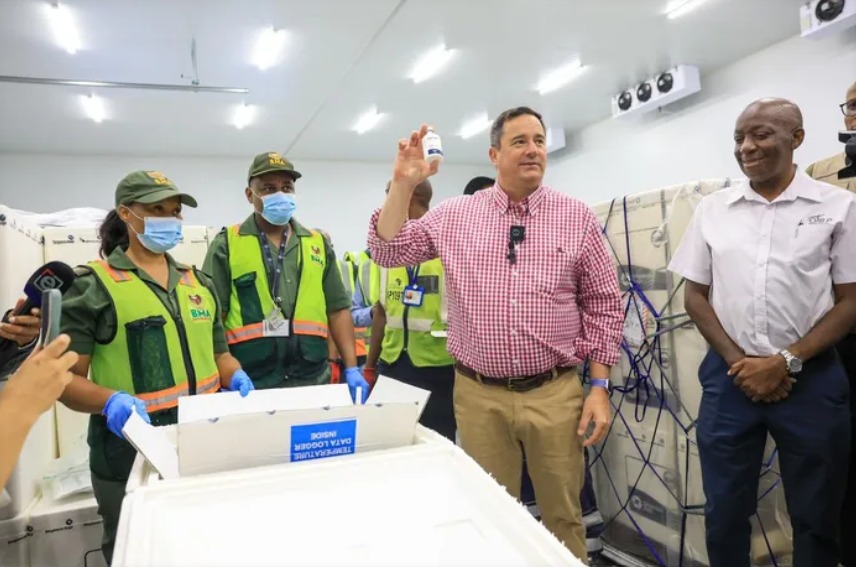
South Africa’s minister of agriculture, John Steenhuisen, has officially received the first shipment of one million high-potency foot-and-mouth disease (FMD) vaccines.
Steenhuisen received the vaccines at OR Tambo International Airport on Saturday.
The vaccines, sourced from Biogénesis Bagó in Argentina, mark a decisive step in protecting the country’s livestock industry.
Steenhuisen said the delivery is the first phase of an extensive roll-out, with an additional five million doses scheduled to arrive in March.
The programme forms part of the department of agriculture’s new 10-year eradication strategy, which aims to vaccinate the national herd of over 14 million cattle and secure what he described as “FMD-free status with vaccination”.
He emphasised that achieving this status is vital for reopening lucrative global export markets and ensuring the long-term biosecurity of South Africa’s farming sector.
A week ago, during the state of the nation address, president Cyril Ramaphosa declared FMD a national disaster.
He said the outbreak was causing severe economic damage, with export bans and trade restrictions affecting farmers and threatening jobs.
“We have decided to vaccinate the entire national herd of 14 million cattle. This requires 28 million vaccines over the next few months,” Ramaphosa said.
He said the government would ensure commercial, private, and communal farmers have immediate access to vaccines and that a task team of farming organisations and experts would report monthly on progress.
Ramaphosa placed the vaccination programme in the broader context of economic recovery, stating: “We are crunching the numbers on a daily basis, seeking to protect the jobs that could be lost through the decline of these industries that are now facing fierce competition.
”We are working with businesses and workers to close loopholes in our tariff structure and develop additional measures to protect and grow our manufacturing base.”
He highlighted agriculture as a key growth sector.
“We know we can create millions of good quality jobs in sectors like agriculture, mining and services industry, as well as in the green economy.
“These are areas where we can be more than competitive. We can be the best in the world,” he said.
He also emphasised centralised regulation of the vaccination programme, noting: “Like during Covid, many people felt tempted that they wanted to acquire vaccines for themselves.
“But because we are a regulated economy and country, we wanted everything to be approved by our authority, Sappra.
“Similarly, in this case, with cattle vaccines, Sappra, our authority, will be the one single organisation that will give approval.”
Ramaphosa said the government would ensure that commercial, private, and communal farmers have immediate access to vaccines and that a task team of farming organisations and experts, working with the minister of agriculture and the department, would report to him every month on progress.
“We do this because we’ve got experts; we’ve got people with great knowledge. We need to mobilise them. We need to bring them to work with the government because they have the know-how and the wisdom,” Ramaphosa said.
He noted that classifying FMD as a national disaster would allow the government to mobilise all necessary state capacity to respond to the crisis.
Steenhuisen welcomed Ramaphosa’s declaration, saying it would unlock a coordinated response and support the new national strategy.
He explained that South Africa lost its vaccine production capability in 2005 and had since relied primarily on imports from the Botswana Vaccine Institute.
Under the new strategy, additional international suppliers had been secured.
For the first time in more than 20 years, the Agricultural Research Council had produced a batch of vaccines for operational use.
The facility had been capacitated to produce 20 000 doses a week initially, with plans to scale up to 200 000 doses a week by 2027.
“In total, by the end of March, we anticipate receiving more than five million vaccines from three different suppliers,” Steenhuisen said.
He said more than 2 million doses had already been administered nationwide, with daily vaccinations continuing.
Steenhuisen also announced that, under the Animal Diseases Act, private veterinarians would be allowed to register to administer vaccines as part of the national roll-out.
The target is to vaccinate 80% of the national herd by December.
“Protecting agriculture is not only about farmers. It is about protecting economic growth, jobs and stability,” he said. – IOL News
In an age of information overload, Sunrise is The Namibian’s morning briefing, delivered at 6h00 from Monday to Friday. It offers a curated rundown of the most important stories from the past 24 hours – occasionally with a light, witty touch. It’s an essential way to stay informed. Subscribe and join our newsletter community.

The Namibian uses AI tools to assist with improved quality, accuracy and efficiency, while maintaining editorial oversight and journalistic integrity.
Stay informed with The Namibian – your source for credible journalism. Get in-depth reporting and opinions for
only N$85 a month. Invest in journalism, invest in democracy –
Subscribe Now!