


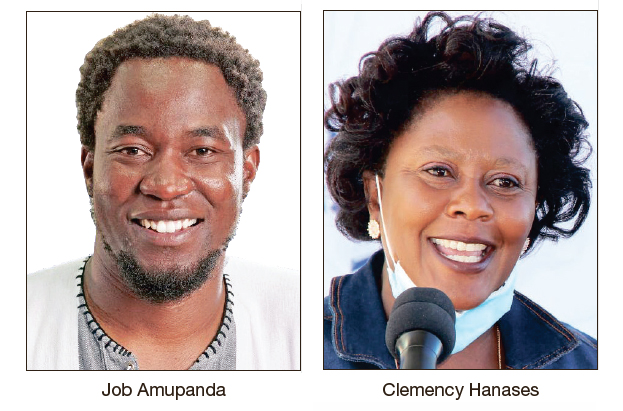
SHELLEYGAN PETERSEN and SAKEUS IIKELAWINDHOEK mayor Job Amupanda is set to be paid a monthly allowance of more than N$70 000 – at least N$5 000 more than his predecessors.
Amupanda will also be entitled to numerous perks, including an annual entertainment allowance of N$50 000 as part of his compensation for his part-time services at the city.
Amupanda is a full-time lecturer at the University of Namibia.
His deputy, Clemencia Hanases’ allowances of N$798 000 translate to more than N$66 000 a month.
These allowances and other expenditure for the municipality’s employees will be funded by a proposed increment in residents’ electricity and household tariffs.
The municipality plans, for example, to increase electricity tariffs by 3,7 % and household refuse tariffs by 5%.
The municipality will, however, not increase property tax, and tariffs for water and sewerage during the current financial year.
The Windhoek municipal council’s annual allowances of about N$850 000 paid to its mayor is the highest paid by a local authority in Namibia, with other local authorities, such as Walvis Bay and Swakopmund paying their political heads between N$35 000 and N$50 000 per month.
Overall, the Windhoek municipality will pay its councillors a combined amount of about N$8 million, of which N$2,8 million is for management committee members, while N$5,3 million goes to ordinary council members.
The councillors’ allowances and benefits were revealed in the municipality’s budget documents for the current financial year, which were made public at a media briefing yesterday.
In total, the municipality will pay more than N$1,5 billion in the salaries and wages of about 2 300 of its employees.
This includes excessive salaries and benefits for executive managers, who earn between N$1,5 million and N$3 million annually.
The city’s wage bill also includes more than N$266 million towards housing allowances for its employees.
The Namibian reported in 2019 that former Windhoek chief executive officer Robert Kahimise was paid more than N$3,7 million annually.
Windhoek’s finance executive, Jennifer Comalie, yesterday said “there will be no increase in the allowances paid to councillors” this year.
This came to light after the minister of urban and rural development, Erastus Uutoni, rejected a proposal to increase councillors’ allowances by 5% earlier this month.
The Association of Local Authorities (Alan) earlier this year proposed a 50% increase on the allowances of other municipalities, town councils and settlement councils.
The municipality expects to record a deficit of N$213 million for the current financial year.
The city’s expenditure is estimated to be at N$4,9 billion and its income at N$4,6 billion.
The two biggest expenses of the municipality are employee costs of N$1,5 billion and electricity purchases of N$1,5 billion.
Comalie said the city’s ‘social budget’ of about N$454,5 million is preventing the city from being profitable.
“This has got a significant impact on our ability to really balance our budget and to always work on a surplus, and that priority areas like actual service delivery, which is our prime mandate, is getting the necessary progress,” she said.
The municipality’s social budget includes N$299,7 million for the Windhoek City Police, N$68 million for public transport, N$105 million for fire and emergency services, N$25,5 million for economic development, N$14 million for social and youth development, and N$6,4 million for disaster management.
The City of Windhoek received grants from the government worth N$41 million of which N$39 million goes towards the upgrading of informal settlements, while N$2 million is budgeted for services at Groot Aub.
The Road Fund Administration also gave the city a N$435 million grant for traffic-related projects.
The municipality has increased the electricity tariff by 3,7%, subject to the approval of the Electricity Control Board.
Further, the municipality has also increased the household refuse tariff by 5% and introduced an additional fire brigade levy.
In an age of information overload, Sunrise is The Namibian’s morning briefing, delivered at 6h00 from Monday to Friday. It offers a curated rundown of the most important stories from the past 24 hours – occasionally with a light, witty touch. It’s an essential way to stay informed. Subscribe and join our newsletter community.

The Namibian uses AI tools to assist with improved quality, accuracy and efficiency, while maintaining editorial oversight and journalistic integrity.
Stay informed with The Namibian – your source for credible journalism. Get in-depth reporting and opinions for
only N$85 a month. Invest in journalism, invest in democracy –
Subscribe Now!