



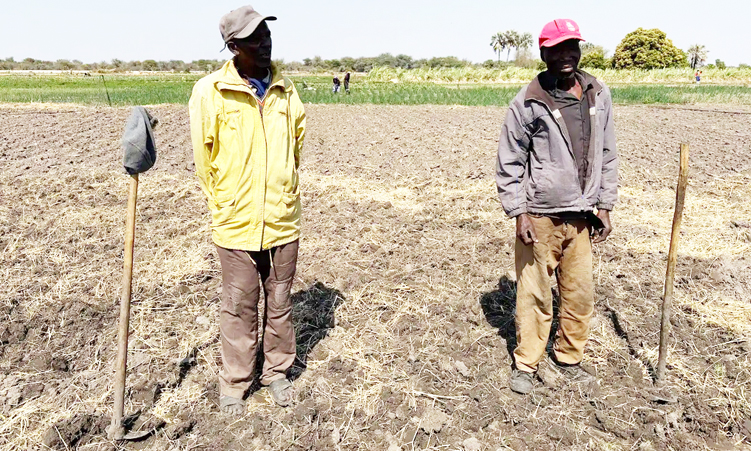
Every morning at 07h00, Abreu Antonio (62) makes his way to the Salem Horticultural Farmers’ Cooperative, a 53-hectare orchard located at Kaisosi at Rundu.
The cooperative comprises 43 farmers who grow a variety of crops, including cabbage, carrots, spinach, tomatoes, avocados, and bananas.
Here, the father of five begins his daily routine, planting, weeding, or watering crops belonging to the farmers.
Speaking to The Namibian while tilling the land, Antonio says he earns N$50 for a full day’s work, knocking off at 18h00.
“If I work from 07h00 to 12h00, I’m paid N$30,” he says.
“This is only enough to buy salt and bread. But the cooperative’s committee has decided on this rate. There’s nothing we can do,” he says, pausing to rest on the handle of his hoe.
Antonio says his daily earnings are not enough to buy a bag of maize meal for his household.
“But we continue, because we have no choice,” he says.
This has been his only source of income for the past three years.
Antonio is accompanied by his younger brother Shiyaka Antonio (59).
Both men, originally from Angola, have been working at Salem, doing back-breaking manual labour for long hours and little pay.
They say many workers feel exploited but are afraid to speak out for fear of losing the little work they have.
“Even if we’re tired, we must go. If we don’t go, there’s nothing at home,” Shiyaka says.
MINIMUM WAGE
In August last year, the Namibian government approved new minimum wages for agricultural workers.
These set the minimum wage for farmworkers at N$10 per hour, effective from 1 January 2025, rising to N$14 per hour in 2026, and N$18 per hour by 2027.
The two brothers are among a growing group of vulnerable workers at Rundu.
They are part of a team of men and women working in the orchard that supplies fresh produce to the town, yet they themselves often go hungry.
Antonio says he arrived in Namibia in 1992 after fleeing war in Angola, while his brother followed in 1993.
More than three decades later, neither has acquired Namibian citizenship, and they therefore do not qualify for state pensions.
“We are nine family members living in a house at Tumweneni. Only one of us has a formal job, working at a local supermarket,” he says.
Another temporary worker, Japhet Kandara (27), is weeding the orchard weeding during The Namibian’s visit.
He says he earns between N$30 and N$50 per day, depending on his hours.
“I use the money to buy stationery and bread for my children,” Kandara, the father of six, says.
He says working until 18h00 earns him N$60.
According to him, farmers do not allow rest breaks, even during lunch hour.
“If you rest, the bosses threaten to deduct N$10 from your pay. You don’t eat, even if you’re tired. All they care about is the work being finished,” he says.
Kandara believes N$50 is unfair and insufficient.
“They should at least pay N$80 for a full day’s work.”
He says he once dreamed of becoming a doctor, but had to abandon this ambition.
“I got 24 points in Grade 12 in 2019. My parents couldn’t afford to pay for my studies. I took up a job as a security guard, but later resigned. My plan was to work, save money and return to school.”
Despite concerns over low wages, none of the workers have formally asked the cooperative’s committee to consider increasing their pay.
‘VIABLE SOURCE OF INCOME’
Chairperson of the Salem Horticultural Farmers’ Cooperative, Magdalena Simuketa, says some farmers have two permanent workers whom they pay a fixed monthly salary as agreed by the committee, usually between N$1 000 and N$1 500.
“We sell our produce to Amta, OK Foods, Choppies, and street vendors at Rundu,” she says.
“Sometimes I make N$400 or N$1 000 a day. Sometimes it goes up to N$10 000. If we sell as a group, we can make up to N$50 000 a day. For example, Amta might order 100kg of carrots.”
Simuketa says farming is a viable source of income.
“With farming, you make money every day, not just at the end of the month,” she says.
RIGHTS VIOLATIONS
Labour expert Herbert Jauch says agricultural workers experience several labour rights violations, including long hours of work without overtime payment and no paid annual or sick leave.
He says they often do not receive the minimum wage, which is compulsory.
Jauch says farmworkers who are injured or grow old are often retrenched without compensation.
“Paying N$50 for 11 hours of work is a violation of Namibian’s minimum wage. Migrant workers enjoy the same protection under the Labour Act as Namibian workers.
“However, if they do not have a work permit, they might not report workers rights violations for fear of being deported. This places them in a very vulnerable position, which some employers exploit,” he says.
‘LIVING LIKE WILD ANIMALS’
Former unionist Evilastus Kaaronda says undocumented workers fall prey to most of the unscrupulous employers in the agricultural industry.
He says no employer is allowed or permitted to require any worker to work for more than nine hours on any given day.
“The established minimum wage in the agricultural industry must dictate the pay to which the workers are entitled,” he says.
Kaaronda says the government is quick to issue permanent residency to Asians and Europeans in the name of attracting foreign direct investments, but fails to issue the same documents to Africans who are forced to live “like wild animals on their own continent”.
In an age of information overload, Sunrise is The Namibian’s morning briefing, delivered at 6h00 from Monday to Friday. It offers a curated rundown of the most important stories from the past 24 hours – occasionally with a light, witty touch. It’s an essential way to stay informed. Subscribe and join our newsletter community.

The Namibian uses AI tools to assist with improved quality, accuracy and efficiency, while maintaining editorial oversight and journalistic integrity.
Stay informed with The Namibian – your source for credible journalism. Get in-depth reporting and opinions for
only N$85 a month. Invest in journalism, invest in democracy –
Subscribe Now!