


Ideas may be described as gold mines waiting to be discovered and the Windhoek Prefabricated Laboratory is just the place to bring these ideas to life.
Called Fab Lab for short, this creative hub for innovative entrepreneurs was officially opened in February but has been operating for about four years.
Situated at the Polytechnic of Namibia’s Business Innovation Centre, the lab offers a wide range of computer-controlled tools that can produce “almost anything”. These ‘super’ machines can be used by the members who range from furniture producers, food producers, fashion designers, etc.
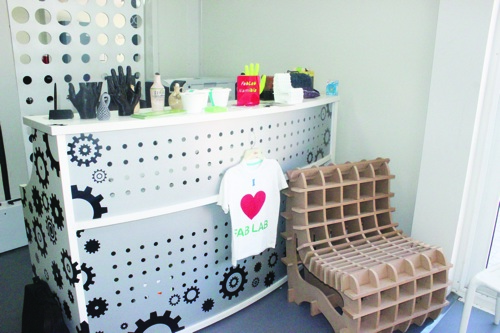
A tour of the lab, which is housed in double storey stacked containers, is a marvel to the eye. Everything that you set your sights on is virtually excitingly new, different or made with material that you never would have imagined could be used in a different way.
Developed by Massachusetts Institute of Technology (MIT) Professor Neil Gershenfeld, the Fab Lab concept was created in an attempt to create a chain of confident, forward-thinking entrepreneurs. He did this by building a small lab with all machines needed to ‘produce virtually anything’.
Fab Lab not only gives intensive mentoring to its members, it also continuously comes up with innovative methods of production. Here, members have access to fantastic tools such as a 3D scanner, a laser cutter and a vacuum forming machine, amongst many other facilities.
Having got the idea to start the lab in Namibia way back in 2009, husband and wife duo Bjorn and Kirstin Wiedow knocked on countless doors before someone took a chance on them. “We met in Cape Town where I was working as a fashion stylist. We eventually came to Namibia together, we worked separately but both of us had a passion for working with people and helping them,” says Kirstin. Their shared wish to help people led to the foundations of a Namibian Fab Lab being set. “It took a long time to finally set up. We pitched the idea all over and finally pushed through,” she says. The idea was eventually supported by GIZ and Namibia Business Innovation Centre (NBIC) with members receiving financial support from the Ministry of Trade. The ministry funded all the machinery while giving registered SMEs support in co-operation with the Polytechnic of Namibia.
The Wiedows, who can only be described as a dynamic power couple, then drew up the building plans for the lab and built most of the machines housed in the lab from scratch. “It was a lot of work but all worth it. It felt like we had given birth. A true labour of love,” Kirstin says.
As part of the Polytechnic of Namibia’s internship programme, some students intern at the lab. One of them is currently employed as an apprentice at the lab.
The lab has been gaining headway with more SMEs wanting to make use of its services. At the moment, the lab has 75 members while 200 more are waiting in line. This long waiting list is mainly due to a strict entry requirements. “We look at SMEs that stand out,” says Kirstin, who emphasises that a solid business plan, registration with the Ministry of Trade and a company name and logo are some of the few things that are a prerequisite, although some take it for granted.
Some of the challenges faced by the lab include capacity. “Finding passionate staff members who are not arrogant and are willing to work all day can be difficult,” says Kirstin. At the moment, they employ four permanent staff members. With a balance of success stories and challenges, the lab is a great initiative in the pursuit of creativity in entrepreneurship. This will be a great helping hand for Namibian entrepreneurs to bring their ideas to life in a time when everyone seems to be doing the same thing.
One of the most promising projects at the lab right now is the wool campaign which recycles discarded Namibian wool into an array of things including clothing, bags and gardening goodies.
Hafeni Frans, one of the country’s promising fashion designers, is the junior ambassador of the campaign. As the face of the campaign, he is tasked with finding new ways of using this wool. “I am involved in researching different techniques on felt making. I also help to facilitate workshops and also come up with new, creative ways of what to do with the wool,” he says.
The project makes use of some of the 300 tonnes of wool that was largely untapped in an effort to regenerate the wool industry. The campaign is a brilliant way for producers to use a natural resource instead of solely relying on imports which are not always readily available and can be expensive. At the moment, students at the University of Namibia (Unam) and College of the Arts (Cota) were brought into the project and have received training on wool felting and will later put those skills to practice.
In an age of information overload, Sunrise is The Namibian’s morning briefing, delivered at 6h00 from Monday to Friday. It offers a curated rundown of the most important stories from the past 24 hours – occasionally with a light, witty touch. It’s an essential way to stay informed. Subscribe and join our newsletter community.

The Namibian uses AI tools to assist with improved quality, accuracy and efficiency, while maintaining editorial oversight and journalistic integrity.
Stay informed with The Namibian – your source for credible journalism. Get in-depth reporting and opinions for
only N$85 a month. Invest in journalism, invest in democracy –
Subscribe Now!