



DESSYLA VAN WYKAFTER her mother died of cervical cancer last year, Stacey Pinto (34) wanted to promote women’s health in the community.
This prompted her to open a spa focusing specifically on vaginal health in Windhoek on 18 August, specialsing in vaginal or ‘V’ steaming.
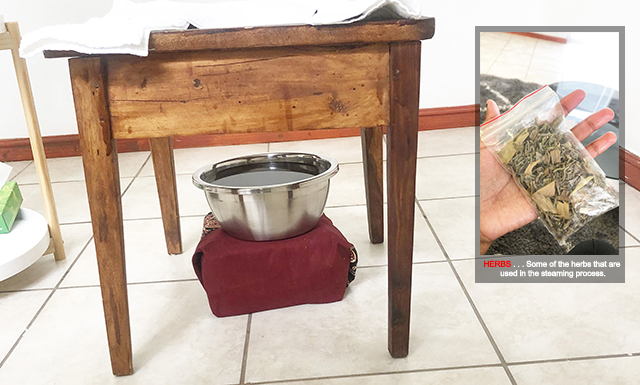
This type of treatment, also known as ‘yoni steaming’, is an alternative treatment involving a woman squatting over a bowl of hot water containing herbs such as mugwort, rosemary, wormwood and basil.
Yoni steaming is practised in Africa, Asia and Central America.
The Namibian visited Yoni Day Spa and was welcomed by a spicy aroma filling the room.
Pinto claims she has a certificate in a yoni health and yoni steaming, and says: “My training and certification has been a two-year journey. I realised this was an unexplored service which Namibian women would benefit from.
The idea stalled for a little, but after losing my mom to cervical cancer last year – I became more resolute about setting up the spa to not only help with women’s issues, but also create a safe space for women to be themselves, speak freely, and get the help they need.”
Pinto says the benefits of yoni steaming are both cosmetic and holistic.
“The cosmetic benefits include reducing the amount of acne on the vulva that many women experience. Yoni steaming herbs infuse the skin with antioxidants which help promote clear skin,” she says.
Other benefits include reducing menstrual cramps and helping women heal from womb trauma after childbirth or miscarriage, Pinto claims.
“Each steam is complemented with a massage and a yoni tea to enhance the steaming experience and ensure ultimate relaxation,” she says.
Lucy Pinto, the manager of the spa, says they offer three types of steam packages, but recommend the detox steam for first-timers.
“The other packages are the wellness package and the rejuvenate package. After consultation, you are let into a room with two yoni stools with an oval-shaped hole in the centre of the stool,” Lucy says.
The client is given a satin gown and is brought the hot bowl of herbs cooked in water.
The bowl is placed under the seat and the client steams for about 30 minutes.
“You can feel it is hot, but it will not burn you, and the first 10 minutes are probably the hottest, but after that your brain starts to ignore it and it may even seem like the steam has stopped, but it has not,” Lucy says.
The client’s lower body is then wrapped in a gown which helps trap the heat inside, Lucy says.
A client says she was expecting immediate results, but staff members explained to her the process takes time.
“I am looking forward to my next session, because I want full results. I would recommend ladies to try this with trained professionals rather than doing it by yourself,” the client, who wants to remain anonymous, says.
Pinto claims the steaming sped up the healing process after the birth of her second child.
She says the practice has existed for centuries, originating in Africa before eventually spreading to the Western world.
“Medical research has shown that cervical cancer is contracted through the human papillomavirus, but the perception that one can get it from yoni steaming still exists.
This is far from the truth. Yoni steaming actually helps to remove excess waste and surplus from the uterus and cervix, which may contribute to cervical cancer when in contact with HPV,” she claims.
Windhoek-based gynaecologist John Keiseb says vaginal steaming is an ancient natural remedy which claims to cleanse the vagina, uterus, regulate menstruation, ease period cramps, bloating, hormonal imbalances, stress, depression, haemorhoids, infertility, fatigue and generalised pain.
He says the treatment has been increasing in popularity on social media platforms.
There are definitely alternatives to the perceived benefits of vaginal steaming mentioned above, Keiseb says.
He says if a woman has a gynaecological concern, she should consult her general practitioner or gynaecologist for an evaluation as vaginal steaming may worsen their problem.
In an age of information overload, Sunrise is The Namibian’s morning briefing, delivered at 6h00 from Monday to Friday. It offers a curated rundown of the most important stories from the past 24 hours – occasionally with a light, witty touch. It’s an essential way to stay informed. Subscribe and join our newsletter community.

The Namibian uses AI tools to assist with improved quality, accuracy and efficiency, while maintaining editorial oversight and journalistic integrity.
Stay informed with The Namibian – your source for credible journalism. Get in-depth reporting and opinions for
only N$85 a month. Invest in journalism, invest in democracy –
Subscribe Now!