




New Oshiwambo book digs into past and present social norms
“Women were burnt to ashes.”
This is how Oshiwambo professor and local writer Petrus Mbenzi describes the way some Aawambo communities historically dealt with women who fell pregnant before marriage or traditional initiation.
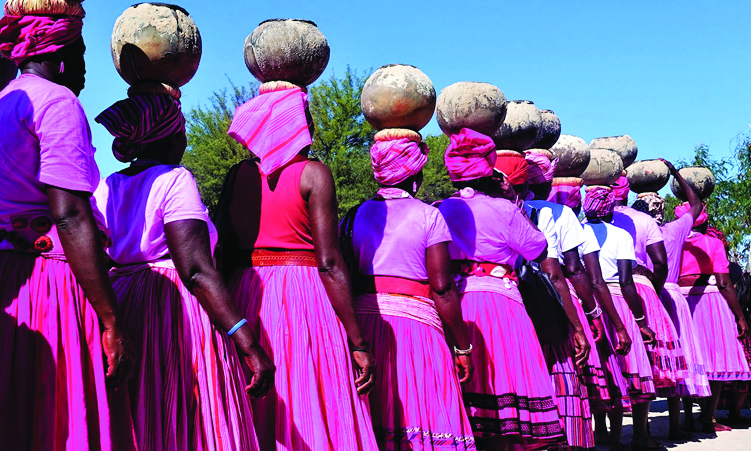
In his latest book, ‘Okumita Nokumitika Eyono?’, which loosely translates to ‘is it a crime to fall pregnant or impregnate someone out of wedlock or before a traditional initiation?’, the writer aims to educate younger generations on the role traditional laws play in a changing world.
“Killing was the only way to deal with any kind of wrong-doing back then. People were killed for stealing and witchcraft suspicion, among many other things,” Mbenzi says.
Mbenzi says such harsh practices, once common among groups like the Aakwanyama, Aambadja and Aandonga, show how influences such as Christianity and legal frameworks have shaped the current narrative.
Today, the conversation has shifted significantly, shaped by changing social norms, legal systems and the influence of religion.
“As time moved, the narrative changed,” he says, noting that modern communication and exposure to the outside world have influenced attitudes.
The writer says he expects his latest offering to spark engagement between the government, the church and traditional authority leaders on a standardised approach to the matter.
Mbenzi explains why different people may end up having children before marriage or their traditional initiation.
“We are all equalised by the fact that we are sinners,” he says. “Some women resort to this because they grow older without getting married and feel they are racing against time, as they lose the ability to bear children at a certain stage.”
In the book he also leaves room for those who explore scientific options of conception, such as artificial insemination.
Mbenzi says in the past, the law dictated that Aawambo women who fell pregnant before marriage or their traditional initiation would be killed, adding that this culture was strongest among the Aakwanyama, Aambadja and Aandonga.
With increasing exposure to the outside world and the development of legal systems, Mbenzi says the discussion around women who have children outside wedlock or before initiation began to change slowly but steadily.
He highlights the effect of the church when the first Finnish missionaries arrived in northern Namibia in the 1800s.
According to him, the church played a vital role in shaping a new approach, encouraging families and traditional authorities to ease measures taken against those who found themselves on the other side of that law.
The church took a restorative approach to discipline to help those involved reintegrate into their communities.
Alliance of Christian Churches in Namibia member Dolly Nangushe calls for a more compassionate and balanced approach to out-of-wedlock pregnancies, urging communities to prioritise dignity, responsibility and restoration over stigma.
Nangushe says Christianity’s core teaching on sexuality is often misunderstood as punitive, when it instead promotes accountability alongside compassion.
“The Bible emphasises sexual relations within the framework of marriage, promoting the idea that family stability benefits both children and society. At the same time, the faith stresses compassion and forgiveness,” she says.
She notes that churches have increasingly moved away from harsh disciplinary approaches of the past, adopting support-based interventions. “The modern church uses this approach to offer counselling, social support and spiritual guidance to members and families, as opposed to harsh punishments in the past,” Nangushe says.
Historically, however, both religious and cultural systems often reinforced stigma, particularly for women. Nangushe says this shift reflects lessons learned from earlier practices.
“The switch was necessary as in the past social exclusion was still rife, and gossip within the community could lead to lasting shame for the mother and child,” she says, adding that “men often escaped responsibility, fuelling gender inequalities”.
The issue remains deeply rooted in Namibia’s social and cultural history.
Long before the influence of Christianity, communities such as the Aawambo and Ovaherero had established systems to manage pregnancies outside marriage. These included mediation by elders and processes aimed at restoring family cohesion and protecting the child’s place within the community.
While such systems promoted accountability and social order, they were not without harm. Women often bore the brunt of social judgement, with some facing fines, forced marriages or exclusion.
At the same time, traditional approaches also emphasised reintegration and guidance, reflecting a balance between discipline and support.
Nangushe says modern approaches should build on these strengths while addressing past shortcomings. “Out-of-wedlock pregnancies are not inherently a moral failing but a social reality,” she says, emphasising the need for constructive responses.
She adds that communities should prioritise practical support systems. “Communities are encouraged to focus on education, mentorship, counselling and social support,” Nangushe says.
As Namibia continues to navigate evolving social norms, she argues that combining faith-based values with cultural understanding could help reduce stigma while strengthening families.
Ondonga Traditional Authority spokesperson Frans Enkali echoes these sentiments, emphasising the need for culture and tradition to be preserved amid rising social trends that suggest otherwise.
Enkali says it is important to preserve progressive traditional norms, while doing away with negative practices from the past.
“As times changed, traditional laws started to align with new government structures and our forefathers agreed that the past punishments were too cruel, which was when penalties were introduced – paying with cattle or other fines,” Enkali says.
Asked about the traditional law’s approach today, Enkali says fines still apply and all eight Aawambo traditional authorities have agreed on uniform penalties for those who find themselves on the other side of this law.
“If the lady is a person with a disability, fell pregnant while pursuing her studies or there was some form of agreement between the two parties, these are all factors taken into consideration when determining a fitting fine in today’s setting,” Enkali says.
According to him, this is a reflection of a more fair approach that speaks to healthy communities, dispelling old derogatory practices.
In an age of information overload, Sunrise is The Namibian’s morning briefing, delivered at 6h00 from Monday to Friday. It offers a curated rundown of the most important stories from the past 24 hours – occasionally with a light, witty touch. It’s an essential way to stay informed. Subscribe and join our newsletter community.

The Namibian uses AI tools to assist with improved quality, accuracy and efficiency, while maintaining editorial oversight and journalistic integrity.
Stay informed with The Namibian – your source for credible journalism. Get in-depth reporting and opinions for
only N$85 a month. Invest in journalism, invest in democracy –
Subscribe Now!