




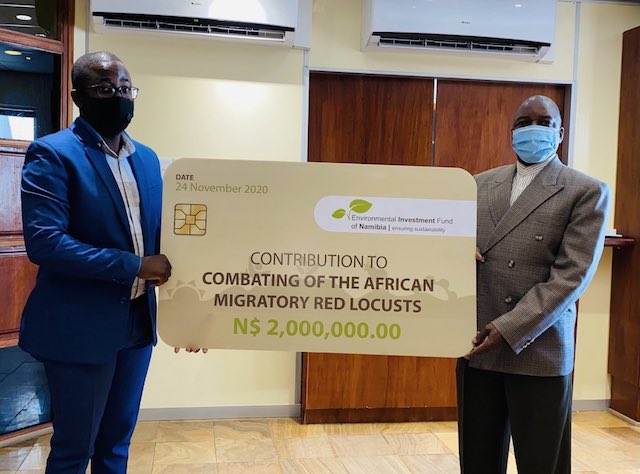
THE Environmental Investment Fund on Tuesday handed over N$2 million to the Ministry of Agriculture, Water and Land Reform to fight the African migratory locust.
The locust invasion was reported in Namibia for the first time in February this year and the second outbreak was reported in August along the Chobe River and the Zambezi plains in the Zambezi region.
Since August, there has been a resurgence of locust outbreaks in other parts of the Zambezi region.
Deputy executive director of agriculture development Sophia Kasheeta said the pest has spread from its traditional breeding areas in the Okavango delta, Chobe wetlands and the Zambezi plains into the Kavango East and Kavango West regions.
“The growing number of locust hotspots is of great concern given their threat to irrigated crops and to the main planting season, which is imminent,” she said.
She further said the country’s agricultural potential, as a tool to promote food security and fight poverty, is at risk from the effects of the locust outbreaks and the Covid-19 pandemic.
She added that the threat from these locust outbreaks will worsen the region already precarious food and nutrition security situation.
“Locusts cause serious food and nutrition insecurity and loss of livelihoods through damage to crops and grazing. The locust outbreaks are exacerbating economic challenges Namibia is already facing, including resource constraints posed by Covid-19 response mechanisms,” she said.
The fund’s head of communication and corporate services, Lot Ndamanomhata, said since the second outbreak in early August, the locusts have destroyed 500 hectares of grazing land in the Zambezi region.
Ndamanomhata said the outbreak is a food security threat. “This outbreak poses a great [threat], especially to farmers, as they begin preparations for ploughing. The situation is worse, as the rainy season has begun, and Namibia has just experienced a seven-year drought dilemma whose impact continues to be felt to this day,” he said.
In addition, Ndamanomhata said the locusts like to lay their eggs on soft moist soil, making many flood-prone areas in the Zambezi region ideal breeding grounds for the locusts.
The fund hopes this assistance will go a long way in enabling and assisting the various stakeholders involved in curbing the spread of the locusts to do their work in an environmentally sound and sustainable way.
He added that sustainable interventions must include procuring environmentally friendly equipment to curb the spread of the locusts and the engagement of the communities and farmers, especially because livestock is involved, as pesticides could harm them.
The University of Namibia is a strategic partner in curbing the outbreak and is helping through research to help understand the behaviour of the locusts, as well as tracking and mapping the locusts to identify hotspots and their movement patterns.
They are also helping study the locusts’ behaviour patterns to point out precise locations for aerial spraying as well as predict their next location and how to effectively curb them and look at natural methods of curbing the spread.
In an age of information overload, Sunrise is The Namibian’s morning briefing, delivered at 6h00 from Monday to Friday. It offers a curated rundown of the most important stories from the past 24 hours – occasionally with a light, witty touch. It’s an essential way to stay informed. Subscribe and join our newsletter community.

The Namibian uses AI tools to assist with improved quality, accuracy and efficiency, while maintaining editorial oversight and journalistic integrity.
Stay informed with The Namibian – your source for credible journalism. Get in-depth reporting and opinions for
only N$85 a month. Invest in journalism, invest in democracy –
Subscribe Now!