






MORE trees are coming into flower – take the time to appreciate their beauty and to enjoy their colours, shapes and scents.
Around Windhoek almost all camelthorn trees (Acacia erioloba) A. kameeldoring, D. Kameldorn, H. omumbonde are densely covering their large spreading crowns in golden yellow, ball-shaped flowers and sprouting intensely green leaves.
Their lush crowns provide a very welcome relief during the hot and dusty months before the rains hopefuly start. These iconic trees occur all over Namibia, especially on sandy soil and along river courses.
The tallest of our acacias, the monkey thorn (Acacia galpinii), D. Affendorn; A. apiesdoring, is also now very visible because it is covered entirely in dark red flower buds opening into a profusion of cream coloured flower spikes. This high tree is found in a number of gardens in Windhoek and particularly along the double lane section of Mandume Ndemufayo Avenue between Academia and Pionierspark.
In nature it only occurs along rivers in the Zambezi region. The fever tree (Acacia xanthophloea) D. Fieberbaum; A. koorsboom does not occur naturally in Namibia but is planted in many gardens and along streets. It is easy to recognise by its smooth, pale green bark and is now studded with numerous golden yellow ball-shaped flowers.
In nature the sausage tree (Kigelia africana) D. Leberwurstbaum; A. worsboom only occurs north of the veterinary fence in the Kavango and Zambezi regions. However, it adapts well to growing in Windhoek where it is found in several gardens, on the northern grounds of the parliament buildinsg and at the National Botanical Garden.
Its dramatic, large deep red and crinkly flowers with yellow stripes on the outside can now be seen on the trees and scattered below.
Northwards of a line from Buitepos to Otjjiwarongo the velvety grey buds of the Kalahari apple-leaf (Philenoptera nelsii) D. Apfelblatt; A. Kalahari-appelblaar; H. omupanda will be turning into clouds of softly scented, pale mauve flowers humming with bees and bumblebees.
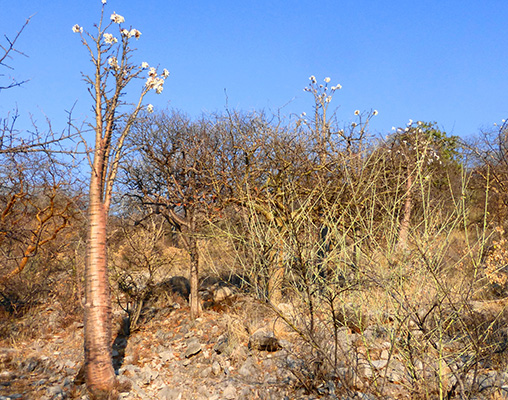
The Bottle tree (Pachypodium lealii) D. Flaschenbaum; A. bottelboom; H. ohwanga, named for the shape of its thick trunk, occurs from the vicinity of Outjo into the Kunene region and is also found in the Karstveld. Currently it can also be admired in full flower on the eastern hilltop of the National Botanical Garden.
Look out for it on the hill slope east of the A1 when driving down the Ten-mile-pass towards Tsumeb and in the Kunene region.
The Mexican green-hair tree or Jerusalem thorn (Parkinsonia aculeata) D. Mexikanischer Gruenhaarbaum, A. Mexikaanse groenhaarboom is very beautiful when covered in its hanging sprays of bright yellow flowers among its long, thin compound leaves the leaflets of which are often missing – hence the common name ‘greenhair tree’.
It is related to our indigenous wild green-hair tree (Parkinsonia africana) D. Langnadelstrauch; A. wildegroenhaarboom found all along the escarpment and all over the country south of Windhoek.
The so-called Orchid tree (Bauhinia variegata) is native to northern India, Vietnam and south-eastern China. Before its bilobed leaves, shaped similar to a cow’s hoof print appear, it is covered in showy orchid-like flowers variegated in shades of magenta, lavender or purplish blue. It can be seen in Zoo Park close to Fidel Castro Str, in gardens and on the grounds of Unam.
A very common tree now appearing as a cloud of tiny but very pretty and sweetly scented pale mauve flowers with darker stripes is the seringa (Melia azedarach) D. Kapflieder, Fliederbaum; A. maksering.
Among the exotic trees in Windhoek currently is the silky oak (Grevillea robusta) D. Kapeiche, Silbereiche; A. silwereik from Australia is starting to produce masses of bright orange flowers. This tree is a member of the Protea family and not at all related to real oak trees.
Its orange flowers and silvery grey foliage form a lovely contrast to the purple flowers of the jacaranda trees which will open in a couple of weeks time.