







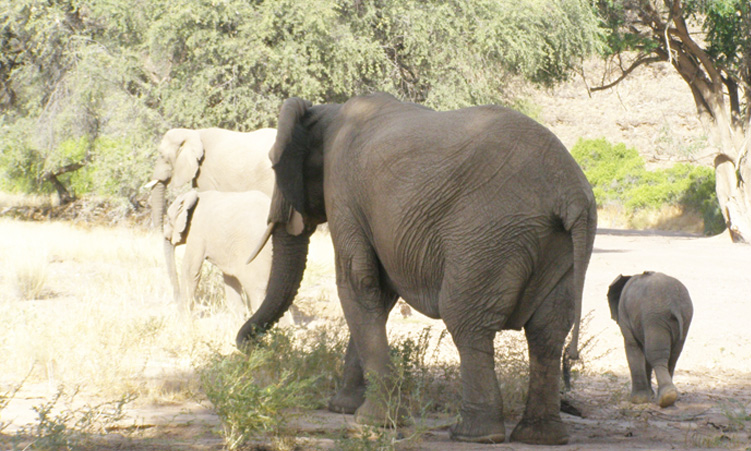
Smallscale farmers in the Sorris Sorris conservancy say roaming elephants are destroying crops, water infrastructure and livestock, leaving their safety and livelihoods increasingly at risk.
The farmers in a letter sent to The Namibian last week, say it has been 30 years since they last harvested from their backyard gardens, and growing and harvesting crops in the Kunene region conservancy has become almost impossible due to the animals’ presence.
This has even pushed some of them to give up on farming. They say farm Wolfa, for example, located about 8km from the Ugab River, has been without water for the past seven months.
“Determined to survive, the farmers dug deep into their pockets to install a water pump system. Unfortunately, the pressure created by the pump system was not sufficient to supply water to the elephants. As a result, the animals became aggressive, damaging vital infrastructure,” the farmers write.
They say a 10 000 litre water tank was destroyed, and 50cm pipes pulled out in this incident, while cattle and goat kraals were trampled.
“Tragically, several goats were injured and some killed. We are now back to square one. Not only have we lost our hard-earned investments, but our safety is also at risk,” the farmers write.
They say they have called on the Ministry of Environment and Tourism, and the Ministry of Agriculture, Fisheries, Water and Land Reform to urgently intervene, as well as on Elephant-Human Relations Aid (Ehra) and the Sorris Sorris conservancy bodies to collaborate with local communities to solve the issue.
The farmers say they respect nature and wildlife, but their lives and livelihoods matter too.
“We seek a sustainable solution that protects both people and animals before the situation becomes worse,” they write.
Ehra managing director Rachel Harris says elephants move seasonally, and due to good rains received in the area this year, their movement has increased in the conservancy.
This, she says, has led to some elephants destroying smallscale gardens and water infrastructure.
“But they are now off the farms and have returned to the river,” Harris says.
She says Ehra’s advice to farmers is to ensure the protection of their gardens, water tanks and kraals by erecting electric fences and protective walls.
Bennet Kahuure, the director of wildlife and national parks in the environment ministry, says the affected farmers should report human-wildlife conflict issues at the ministry’s Outjo office.