



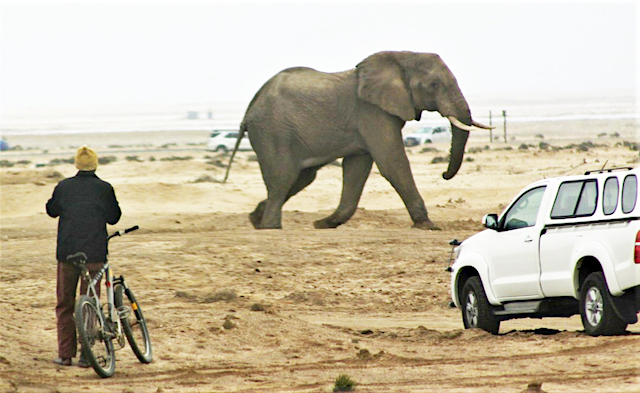
WHILE an elephant bull roamed through Erongo to Swakopmund on Christmas Eve, an elephant calf was born to the desert-adapted Huab herd in Kunene.
Both are considered wonderful events as there is no record in modern history of a lone elephant walking towards the ocean near Swakopmund, and it is the first time in two years a desert elephant calf was born as part of a free-roaming herd which wanders through the dry Huab River in Namibia.
“Christmas miracles do still exist with the birth of an elephant calf in the world’s oldest desert,” said Sabine Kuhn of Elephant-Human Relations Aid.
With an increase in elephant poaching, human-wildlife conflict and global warming, the birth and survival of this elephant calf is
miraculous given the extreme conditions it was born into.
According to Kuhn, the two-week-old calf was discovered in December during a routine elephant patrol with a group of Elephant-Human Relations Aid conservation volunteers.
“As heart-melting as all baby animals are, the calf was seen diligently following her mother and trying to hide in her shadows to avoid the harsh sunlight.
The team continued to monitor the herd for a full week to ensure the calf’s well-being and overall welfare of the herd,” she said.
Despite ongoing drought in the region and increasing human-wildlife conflict, free-roaming African desert elephants have managed to survive in the semi-arid desert of Namibia for several decades. Temperatures here can reach 45°C in summer, which adds pressure on expecting cows.
“The calf mortality rate in the southern Kunene is very high, with most calves unable to survive in these extreme living conditions of diminishing water and food resources. Most calves that are born in this particular part of Namibia die within a few days after birth, however, recent rainfall in the area and a determined spirit may be the reason why this calf is managing to persevere and is on her way to becoming a healthy, playful young elephant,” said Elephant-Human Relations Aid MD Rachel Harris.
According to her, Namibia is one of the few countries that still tolerate free-roaming desert elephants, and together with local conservancies and conservation partners, such as Elephant-Human Relations Aid, the country aims to foster peaceful relationships between communities and their elephant visitors.
Elephant-Human Relations Aid has been a key player in the region for over 15 years by helping to mitigate conflict situations by offering practical solutions to rural communities who have been negatively affected by elephant visits.”Seeing this newborn desert elephant roam freely together with her mother, is the greatest Christmas gift. We hope she will survive through the summer,” said Harris.
Together with neighbouring lodges, tour operators and the Elephant-Human Relations Aid field team, the calf and its herd are monitored regularly to ensure it is doing well and adapting comfortably to its environment.
As for the lone bull that had a distinct tear in its left ear, it is a mystery how it ended up near Swakopmund, which caused a stir with hundreds of visitors flocking to see it and take photos and videos. It was walking towards the salt pans and nearby residential areas.
“We think he came down the Omaruru River, and do not recognise him as one of the desert elephants from Ugab. He was apparently seen near Henties Bay the day before, and we believe that he followed the riverbed in search for water,” she told The Namibian.
News of the elephant spread like wildfire and Elephant-Human Relations Aid, the environment ministry, Swakopmund municipal services, and other law-enforcement agencies had their hands full in ensuring the animal was redirected to the wilderness for its own safety and the safety of residents.
“We tried to organise water for the elephant and received support from the municipality to provide water, which was provided by the fire brigade.
Unfortunately, due to many spectators and the elephant’s rising stress levels, he did not access the water in the first instance,” explained Harris.
After the bull was encouraged further away from the community and growing crowds, and had moved further inland, he appeared calmer and more at ease.
The environment ministry continued to stay behind the elephant to ensure his safety, and members of the public were supportive by providing assistance by offering lucerne and water, which were strategically placed on the route we wanted him to take, a kilometre ahead.
The efforts were successful as the elephant drank around 100 litres of water once he reached the water point.
In an age of information overload, Sunrise is The Namibian’s morning briefing, delivered at 6h00 from Monday to Friday. It offers a curated rundown of the most important stories from the past 24 hours – occasionally with a light, witty touch. It’s an essential way to stay informed. Subscribe and join our newsletter community.

The Namibian uses AI tools to assist with improved quality, accuracy and efficiency, while maintaining editorial oversight and journalistic integrity.
Stay informed with The Namibian – your source for credible journalism. Get in-depth reporting and opinions for
only N$85 a month. Invest in journalism, invest in democracy –
Subscribe Now!