


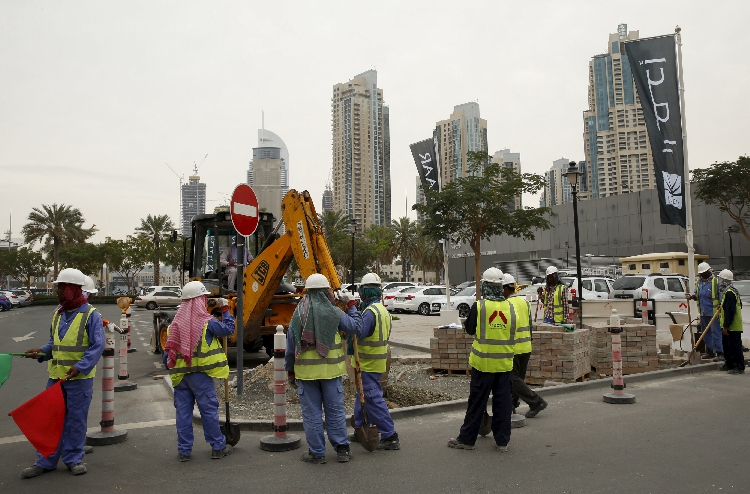
DUBAI – Dubai developers are pressing ahead with their construction plans, despite expectations that property prices will fall yet further this year, undaunted by memories of a 2008 crash.
Industry consultants say while sales volumes have slumped in the emirate, structural changes to the market such as tighter regulations together with fewer speculators and developers should ensure a much softer landing this time.
But others worry about ripple-effects from the dive in oil prices, even though Dubai is a small crude producer, compared with fellow emirate Abu Dhabi, and wonder how all the projects which are being announced will be funded.
Residential prices in the emirate fell 50% from a third-quarter 2008 peak to mid-2009, suffering a second downturn in early 2010, industry consultant Cluttons estimates.
Prices then rebounded from 2011 following an influx of money and people displaced by uprisings in several Arab countries, recovering to within 18% of 2008 peaks.
But values slipped again from late 2014. Cluttons reckons they fell 3-5% in 2015 and forecasts a similar drop this year; rivals CBRE says prices declined about 15% last year, and predict another 10% drop in 2016. This seems to have swayed developers little.
Property markets can be driven as much by sentiment as supply and demand, so such overt bullishness is perhaps understandable. However, it ignores a 19% decline in Dubai unit sales and a 24% drop in the combined sales’ value in 2015, CBRE estimates.
It also echoes 2008 when that October, the developer Nakheel announced plans to build a kilometre-high tower, which at almost 200 metres more than the Burj Khalifa would be a global record.
Barely a year later, Nakheel sought to restructure about US$11 billion in borrowings, and property prices were in free fall. Today, a Dubai metro station is named after the lofty project, but the tower has yet to materialise.
Dubai has doubled property transaction fees and imposed tougher deposit requirements for mortgage borrowers. While this has helped to prompt the current downtrend, inflicting such short-term pain may ultimately lessen volatility by minimising speculative trading.
This marks a significant change from 2008. “The dynamics of the market this time around are vastly different. The fundamentals are a lot stronger,” said Faisal Durrani, partner and head of research at Cluttons.
In an age of information overload, Sunrise is The Namibian’s morning briefing, delivered at 6h00 from Monday to Friday. It offers a curated rundown of the most important stories from the past 24 hours – occasionally with a light, witty touch. It’s an essential way to stay informed. Subscribe and join our newsletter community.

The Namibian uses AI tools to assist with improved quality, accuracy and efficiency, while maintaining editorial oversight and journalistic integrity.
Stay informed with The Namibian – your source for credible journalism. Get in-depth reporting and opinions for
only N$85 a month. Invest in journalism, invest in democracy –
Subscribe Now!