






SIMON SCARR and MARCO HERNANDEZAround the world, almost one million plastic bottles are purchased every minute.
As the environmental impact of that tide of plastic becomes a growing political issue, major packaged goods sellers and retailers are under pressure to cut the flow of the single-use bottles and containers that are clogging the world’s waterways.
Plastic production has surged in the last 50 years, leading to widespread use of inexpensive disposable products that are having a devastating effect on the environment. Images of plastic debris-strewn beaches and dead animals with stomachs full of plastic have sparked outrage.
Polyethylene terephthalate (PET) bottles are commonly used for soft drinks and mineral water, but can also be used in other household or personal care products. Data from Euromonitor International shows that more than 480 billion of these bottles were sold last year alone. That’s almost one million every minute.
Every hour, 54,9 million plastic bottles are sold. These bottles would make a pile higher than the Christ the Redeemer statue in Rio de Janeiro.
Every day, 1,2 billion plastic bottles are sold. This would be the equivalent of a bottle pile half the size of the Eiffel Tower in Paris.
In one month, 40 billion bottles are sold around the world. When put together, this amount of bottles would make a mountainous pile that would dwarf the Eiffel Tower.
In a full year, 481,6 billion plastic bottles are used by consumers around the planet.
If all of the plastic bottles sold in 2018 were gathered in a pile, it would be higher than the world’s tallest building, the Burj Khalifa in Dubai.
Over the past 10 years, four trillion bottles were produced and sold.
These bottles would tower above New York’s Manhattan Island if collected together in one gigantic pile of plastic, which would be about 2,4 kilometres high and would dwarf the glittering skyscrapers of the financial district at the tip of lower Manhattan.
Data from Euromonitor International shows that more than 480 billion of these bottles were sold last year alone. The 2018 annual figure of almost 482 billion is up more than 50% since 2009.
Drinking bottles are one of many types of plastic pollution currently causing environmental problems.
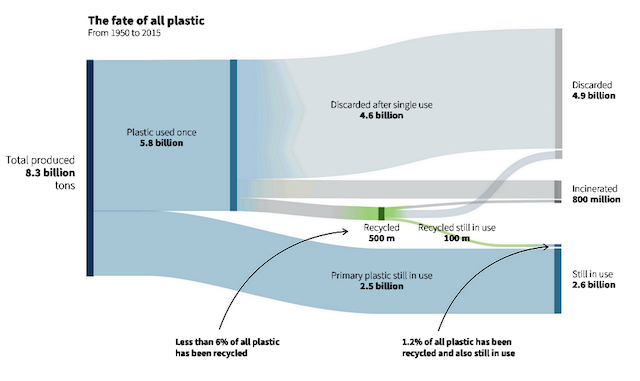
Half of all plastic produced is designed to be used only once. The world produced about 380 million metric tons of plastic in 2015, according to research published in the journal Science Advances. About 55% of that plastic waste was discarded, 25% incinerated and 20% recycled, meaning the majority of plastic bottles would likely end up in the environment, landfill sites, or oceans around the world.
The amount recycled is even smaller when calculated over the past 65 years. Globally, 8,3 billion tons of plastic was produced from 1950 to 2015. Most was single-use plastic, now discarded, and only 6% of the cumulative total has been recycled, the Science Advances study shows.
Rosemarie Downey, global head of packaging research at Euromonitor International, told Reuters that adopting circular design principles in packaging, which considers the entire life cycle of a product, including use and reuse, is one way for brands to address surplus waste at the outset and can assist recovery, recycling, and reuse in order to reduce the damaging impact of plastic waste in the environment.
However, the responsibility to address the problem goes beyond the manufacturers. “Ultimately, mindful consumption of plastic is a global duty of everyone. Consumers have their part to play to help realise zero-litter, as do corporate players in their use and handling and governments in providing the necessary, optimised waste management infrastructure,” Downey said.
The European Union has voted to outlaw 10 single-use plastic items, including straws, forks and knives, by 2021. It has also set targets for all plastic packaging, the top source of plastic waste, to be recyclable by 2030.
Such moves are setting up a showdown with the oil industry, which is pouring billions into new facilities to produce more plastic and other petrochemical products, particularly in Asia, the world’s biggest producer of the material and its waste.
Despite environmental concerns, plastic output seems poised to increase.
– Nampa-Reuters

