


COMMUNAL farmers in the Kunene region have observed a significant drop in the predation of livestock by lions in their area since last year due to the use of ‘lion-proof’ kraals, but there are fears this may not be enough to prevent all attacks due to the drought.
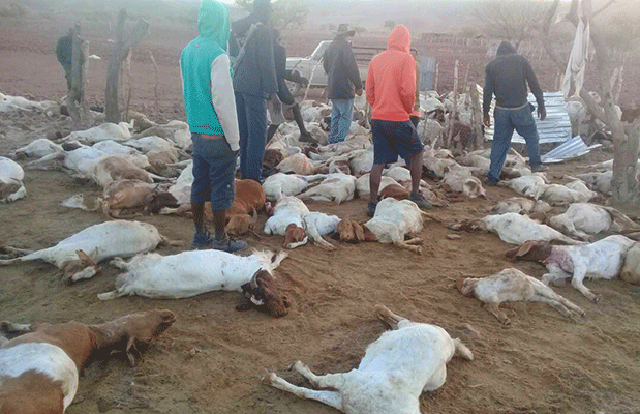
Euphrasius Dawids, a communal farmer who lost 25 of the 44 goats killed by lions in the area earlier this month, said although the mitigation measures introduced by the ministry of environment last year have been helpful, wildlife may become desperate as a result of climate change.
Two days after lions killed 25 goats in the Torra Conservancy in Kunene, more goats were killed in the same area. Communal farmer Desmond Tsuseb lost those 19 goats.
“The lions are hungry, and are becoming desperate. They will now ignore the alert systems, and even attempt to break through the nets,” Dawids stressed.
“They are also learning that livestock are taken out during the day, so they will wait for the day and attack when the animals are out of the kraals.”
Reflecting on his loss of N$40 000 worth of livestock, Dawids sympathises with farmers in the area who are not certain that the ‘lion-proof’ measures are sufficient.
“People lose, and this makes them angry. We do not support the killing of lions, but to strike a balance between the concerns of the farmers and the need to protect the lions is not easy,” he explained.
He suggested that other measures should be implemented as well, “such as moving the lions away, or separating their area from ours with high fences which they cannot leap over”.
Dawids said although many farmers in the conservancies have agreed to conserve lions because the ministry highlighted the advantages, these types of attacks hurt them substantially.
“There has been success in conservation, but those [farmers] who are helping to conserve believe they are not gaining much from it. Lion tourism is not so big here, and the lions are also killing the livestock,” he added.
Furthermore, many farmers feel the ministry does not respond earnestly to their plight when there is conflict, and that compensation for livestock losses is slow.
“[The ministry] needs to come here and see for themselves, and sit down with us, otherwise the farmers will take matters into their own hands,” Dawids reasoned.
Between the end of 2017 and mid-2018, struggling Kunene communal farmers lost about 250 sheep and goats to lions, which resulted in significant financial losses to them.
As a result, many lions were shot and others poisoned. This resulted in their forced relocation to other regions to protect them from ‘revenge’ killings.
In 2017, reported the loss of 86 small livestock worth about N$150 000 in the Kunene region by communal farmer Samuel Gawiseb.
At the time, communal farmers in the region were infuriated by the loss through predation of their livestock by wild animals. According to the chairperson of the Palmwag Concession in the region, Tomi Adams, recurring instances of this nature encouraged the ministry of environment to put measures to mitigate the attacks and losses.
Before these measures were in place, lion attacks on livestock were frequent.
Palmwag comprise the Torra, Sesfontein and Ananbeb Conservancies, which have taken the brunt of livestock losses to hungry lions prior to 2018, but are now seeing a significant reduction due to ‘lion-proof’ kraals.
Although Adams called these the “sorest” attacks in more than a year, he added that the mitigation measures put in by the ministry were helpful.
“The mitigation measures are really helping,” he told . “We have about 60 communal farmers, and most of them are putting up shade nets, lights and sound alerts which keep most of the lions away.” From last year to date, there have only been two major attacks — both of which were reported in the last two weeks.
Environment spokesperson Romeo Muyunda told that although the ministry had invested a lot in these mitigation strategies in the region, it is important for farmers to recognise that human-wildlife conflict cannot be fixed overnight.
“What we are trying to do is just to mitigate them by putting in measures: early warning systems, the provision of water to both people and camps, building protective kraals, and having public education campaigns,” he said.
“It’s important for farmers to recognise that human-wildlife conflict will not be solved by the ministry alone. If you are a farmer, you should also put in mitigation measures yourself.”
He added that the measures to mitigate human-wildlife conflict put in place a year ago were strategically put up in areas prone to this type of conflict, but do not cover everyone or everything.
In an age of information overload, Sunrise is The Namibian’s morning briefing, delivered at 6h00 from Monday to Friday. It offers a curated rundown of the most important stories from the past 24 hours – occasionally with a light, witty touch. It’s an essential way to stay informed. Subscribe and join our newsletter community.

The Namibian uses AI tools to assist with improved quality, accuracy and efficiency, while maintaining editorial oversight and journalistic integrity.
Stay informed with The Namibian – your source for credible journalism. Get in-depth reporting and opinions for
only N$85 a month. Invest in journalism, invest in democracy –
Subscribe Now!