



Our guide around Borobudur, the largest Buddhist temple in the world, says rice is the barometer of the Indonesian economy.
“My parents, grandpa and grandma have a principle: No money is okay, but no rice is dangerous,” says Mura Aristina as our golf cart pulls away from the magnificent, ninth century temple in central Java.
Aristina is a wealth of such insights, of Indonesian folklore and economic indicators. In 2017, he accompanied former United States president Barack Obama through the famed Unesco World Heritage Site. A CNN article summarises Aristina’s passion and rank-rising hard work in a headline that reads ‘Mura, the Former Sweeper Who Became Obama’s Guide to Borobudur’.
Back then, the andesite stone temple, situated approximately 42km north-west of the city of Yogyakarta, welcomed around 10 000 visitors a day. Recently, that number has dwindled to 1 200 visitors, not due to waning interest but as a matter of preservation.
On a recent familiarisation trip organised by the embassy of the Republic of Indonesia in Windhoek, Asti, my chaperone, cautions me about the steep temple stairs. As we explore Yogyakarta, a colourful and lively Indonesian city celebrated for its arts and culture, Asti regularly issues a warning: “Wednesday! Borobudur! Just be ready for the stairs!”
The steps are steep and protected from deterioration by everyone’s matching footwear. Traditional woven Upanat sandals are compulsory and issued at the site’s reception area. Humorous, recurring yells of “Wow, I love your shoes!” can be heard as visitors ascend the temple’s nine stacked platforms, offering a friendly distraction from the glaring heat.
Borobudur was built 1 200 years ago. The temple originally featured 504 Buddha statues, 72 in bell-shaped stupas, and more than 2 670 bas reliefs depicting the lives of Buddha, his teachings as well as daily life in ancient Java.
“The first reason Borobudur was built is for study. So, this is like the university of Buddhism,” says Aristina. “The 504 Buddha statues have six different hand positions (mudra) so it looks like a dance.”
Aristina explains that Buddha means awareness.
“Life is turning. Morning, evening, health, sickness, rich, poor, life and death,” he says. “How rich we are, how big our power, nobody can stop the turning of life. Buddha is not actually a religion, only the way of life.”
Although Borobudur is a popular Yogyakarta-adjacent attraction, the temple was lost for hundreds of years, buried under thick jungle growth and volcanic ash after an eruption of Mount Merapi.
The active volcano forms part of another Indonesian wonder, the Cosmological Axis of Yogyakarta. The axis, a six-kilometre north-south line that links Mount Merapi, the Indian Ocean and the Kraton (the Palace of Yogyakarta), is a symbol of Javanese cosmology and the cycles of life.
Our exploration is connected to this axis as we visit the karst cliffs, blue ocean and sandy beaches of Gunung Kidul as well as the fascinating Kraton in Yogyakarta city.
Yogyakarta is a monarchy within the Republic of Indonesia and its sultan resides in what is effectively a living museum of Javanese culture. The nearby Taman Sari Water Castle and lunch at Bale Raos, a restaurant serving the sultans’ favourite dishes, are also of note, but the bulk of our time is spent at the palace.
Taking a Delman, a traditional horse-drawn carriage, from near our stylish and hospitable lodgings at The 101 Yogyakarta Tugu, we arrive at the sultan’s palace within minutes.
Inside, school tours and tourists from around the world marvel at the Abdi Dalem (royal courtiers), who must not be photographed, and at the musicians playing gamelan music at a central stage. A sprawl of museums exploring Javanese culture, life stages, ceremonies, traditional attire and royal history are illuminated by our guide, who keeps a leisurely pace.
A few hours away on the Gunung Kidul coastline, our guided experience is a little more hair-raising. We clamber into a jeep driven at ludicrous kilometres per hour as we sightsee around Pantai Sepanjang and Mesra Beach. The latter’s striped umbrellas, seaside eateries and dramatic rock formations are picturesque and tease lazy afternoons as do other beaches’ ocean-facing, overnight tents.
The drive back to Yogyakarta city is a languid one, peppered with enchanting excursions.
As visitors are prohibited from photographing within its chambers, Ullen Sentalu Museum is a place that exists mostly in memory. The private museum is a treasure trove of Javanese history, art and culture and includes paintings of the royal families of Java, their handwritten letters, poetry, attire and some of their most prized possessions.
The next stop on our trip home is Wukirsari Tourism Village, where local artisans teach batik-making in their breezy, open-air workshops.
The process is harder than it looks – a light balance of filling a copper or brass tjanting (wax application tool) with molten wax before tracing one’s design on a piece of fabric. Indonesia is famed for its batik which differs according to region, occasion, purpose and social status.
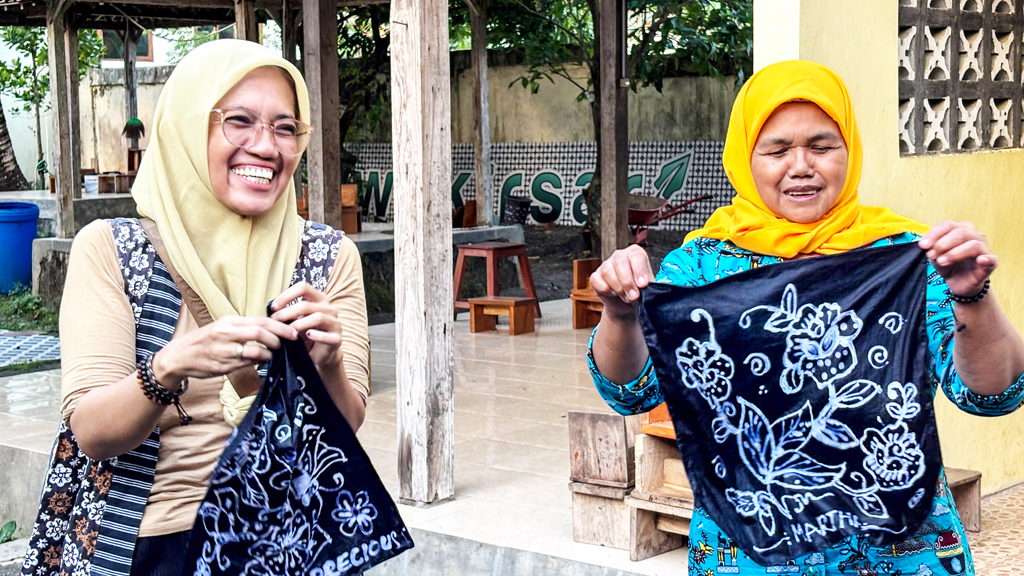
Unesco recognised Indonesian batik as a masterpiece of oral and intangible heritage of humanity in 2009. If one wants to dig deeper into traditional batik-making, Wukirsari offers retreats where visitors can immerse in Javanese life and in this cherished craftmanship.
As Yogyakarta city draws nearer, a final stop at Kopi Notodamar at Mangunan Pine Forest offers a spiritual experience. Like much of Indonesia, the people of Yogyakarta are mostly Muslim and the Islamic call to prayer, echoing over a lofty view of the forest at sunset, is something I’ll never forget.
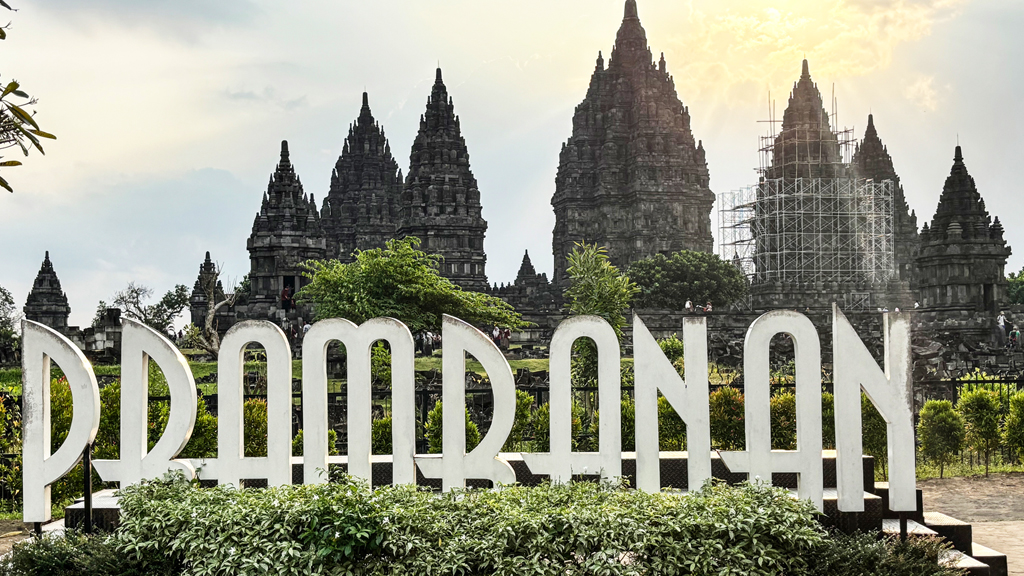
Ironically and contrary to its majority Muslim population, two of Yogyakarta’s major touristic attractions are the Buddhist Borobudur and the Hindu Prambanan. These relics recall Indonesia’s prevalent religions before the country’s presumably trade-driven conversion to Islam over 700 years ago.
The stunning ninth-century temple honours the Hindu Trimurti of Brahma the Creator, Vishnu the Preserver and Shiva the Destroyer. The Unesco World Heritage Site is the largest Hindu temple in Indonesia and the second largest in South-east Asia after Cambodia’s Angkor Wat.
Prambanan once comprised 240 temples, the largest housing statues of Hindu gods, but a likely eruption of Mount Merapi destroyed many of the lesser buildings, which lie in heaps of rubble around the temple complex, patiently awaiting intricate restoration. Like Borobudur, Prambanan’s reliefs tell stories such as the Hindu epic Ramayana and the Bhagavata Purana.
We leave Prambanan near its golden hour when its ancient spires are said to be bathed in godly light.
Our familiarisation trip’s tagline is ‘Discover Indonesia Beyond Bali’ and now I know why. Bali is beautiful, but Yogyakarta is a whole other world.
Malioboro Street beckons in a whirlwind of bustling markets, horse-drawn carriages and delicious Indonesian cuisine. The region’s ancient temples are no less than spiritual time travel and the kind people, lest I forget them, are some of the world’s welcoming best.
The Namibian’s Martha Mukaiwa travelled to Yogyakarta on a trip hosted by the embassy of the Republic of Indonesia in Windhoek. The embassy will continue to share Indonesian culture in ‘Unity in Diversity: Cultural Harmony of Indonesia and Namibia’, a grand cultural showcase, at the National Theatre of Namibia on 24 November. Tickets are free but limited, the show starts at 18h00 and bookings can be made via WhatsApp on 081 124 9745.
– martha@namibian.com.na; Martha Mukaiwa on Twitter and Instagram; marthamukaiwa.com
In an age of information overload, Sunrise is The Namibian’s morning briefing, delivered at 6h00 from Monday to Friday. It offers a curated rundown of the most important stories from the past 24 hours – occasionally with a light, witty touch. It’s an essential way to stay informed. Subscribe and join our newsletter community.

The Namibian uses AI tools to assist with improved quality, accuracy and efficiency, while maintaining editorial oversight and journalistic integrity.
Stay informed with The Namibian – your source for credible journalism. Get in-depth reporting and opinions for
only N$85 a month. Invest in journalism, invest in democracy –
Subscribe Now!