



I SOMETIMES get so irritated with my six-year-old daughter, Oluhle, when she sniffs her day away. I tell her to blow her nose, and instruct her to carry tissues with her or to wear a jersey. I do this, thinking that she might come down with a cold.
Sometimes, I ask myself, what cold is this that does not end? There are times when I have given her medication.
Everytime she blows her nose, a thick yellow-greenish phlegm comes out. At first I made nothing of this, thinking she was just recovering from the cold. Her nose would also be blocked sometimes, as if she had caught a heavy cold.
Two weeks ago, her body started heating up. She was drowsy. She slept the whole day, and complained of a sore throat and headache.
I panicked, and rushed her to the doctor, who referred us to a paediatrician, Dr Landulani Benjamin.
At first, the suspicion was that it was early–stage meningitis. Tests were conducted – a spinal tap (lumbar puncture), magnetic resonance (MR) scans of the head, and blood tests.
Then, we spent five days in hospital before another test to confirm that we were out of danger, and that it was not meningitis. It turned out Oluhle had a sinus infection.
A sinus infection is when the nasal passages become infected. Viruses, bacteria, or even allergies can cause sinus infections.
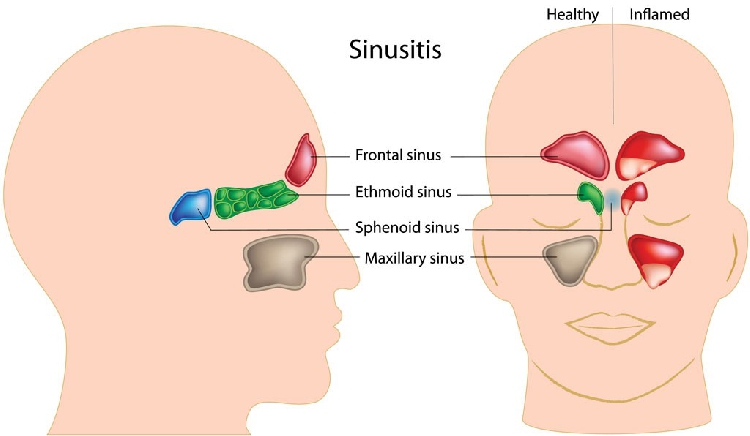
The paediatrician explained that paediatric sinusitis is the inflammation of one or more of the sinuses which drain into the nose.
“Every person has four sets of sinuses. In children, the maxillary [behind the cheek] and the ethmoid [between the eyes] sinuses are present at birth, and are more commonly affected. The frontal [above the eyes, in the centre of the forehead], and sphenoid [back of the nose and the nasal cavity] sinuses develop later in life,” Benjamin explained.
He also said there were non-specific signs of paediatric sinusitis, and that common sinus infection symptoms include a cold lasting 10 to 14 days.
“Sometimes it will be low-grade fever, post-nasal drip, sometimes leading to or exhibited as sore throat. You also get bad breath, nausea and/or vomiting. There is the swelling around the eyes,” he added.
He said other symptoms included coughing, irritability or fatigue, facial pain or facial pressure, while “headaches are usually common in children aged six or older, along with nasal congestion”.
Dr Benjamin explained the difference between acute sinusitis and chronic sinusitis.
“With acute sinusitis, the sinus infection lasts less than four weeks, and one gets better with appropriate treatment. Chronic sinusitis is a type of infection which happens with repeated acute infections, or with previous infections which were inadequately treated. Symptoms last 12 weeks,” he stated. When sinusits becomes chronic or reaches acute stages, surgery should only be done after a careful examination and recommendation by a specialist.
“Some of the recommendations include severe or persistent symptoms, despite medical therapy. Severed adenoidal hypertrophy [obstruction of the back of the nose] and complicated sinusitis also occurs,” he explained.
Children are more prone to infections of the nose, sinus and ears, especially in their early years. The most common cause is viral infections [colds], which might be aggravated by allergies.
Parents should reduce the risk of sinus infections by reducing a child’s exposure to cigarette smoke, the time spent at daycare, and by treating stomach acid reflux, Benjamin advised.
In an age of information overload, Sunrise is The Namibian’s morning briefing, delivered at 6h00 from Monday to Friday. It offers a curated rundown of the most important stories from the past 24 hours – occasionally with a light, witty touch. It’s an essential way to stay informed. Subscribe and join our newsletter community.

The Namibian uses AI tools to assist with improved quality, accuracy and efficiency, while maintaining editorial oversight and journalistic integrity.
Stay informed with The Namibian – your source for credible journalism. Get in-depth reporting and opinions for
only N$85 a month. Invest in journalism, invest in democracy –
Subscribe Now!