



N$8.1 billion and counting and not a dollar earned
Almost immediately after independence, the government started thinking about the construction of an irrigation dam on the Fish River.
However, it was not until 2010 that the government finally completed the feasibility study for the dam with an initial estimated cost of N$2.4 billion.
The dam would provide water for irrigation of some 5 000 hectares of fruit and vegetable farms.
Salini, the Italian company that was eventually given the tender has a long history of malfeasance allegations and has had court cases all over the world, including both before and after the Neckartal contract scandal. Salini (now renamed Webuild) has been involved in numerous litigations about its contracts in Morocco, Jordan, Romania and Italy.
In 2023, Salini was investigated by Italian anti-corruption authorities for bid rigging in the construction for a dam project in Genoa. In Africa, Salini pleaded guilty to ‘defeating the course of justice’ in a corruption trial in Lesotho involving the Lesotho Highlands water project in 2006.
Shortly after the awarding of what Namibian scholars have termed the nation’s ‘most infamous tender’, the losing bidders filed a High Court case against the government, alleging irregularities.
The company that had the highest score in the tender process was not Salini but rather Vinci-Orascom and while it had a strong case against the government, it mysteriously decided to drop its complaint at the beginning of the High Court deliberations.
The company that came third continued with the case and eventually the High Court ordered the tender board to review the revised tender of N$2.8 billion.
It was, at the time, the biggest tender in Namibian history.
According to High Court documents, “the ministerial submission did not disclose to the tender board that its own recommendation was entirely different to that of the external expert consultants”.
Construction finally began at the dam in 2014, and immediately Salini demanded N$600 million extra from the government because of the delays caused by the High Court case. This was paid by the Namibia Water Corporation and raised the cost of the dam to N$3.4 billion.
By the time the dam was completed in 2018, the cost to the government had more than doubled from the original government estimate of N$2.4 billion to N$5.7 billion.
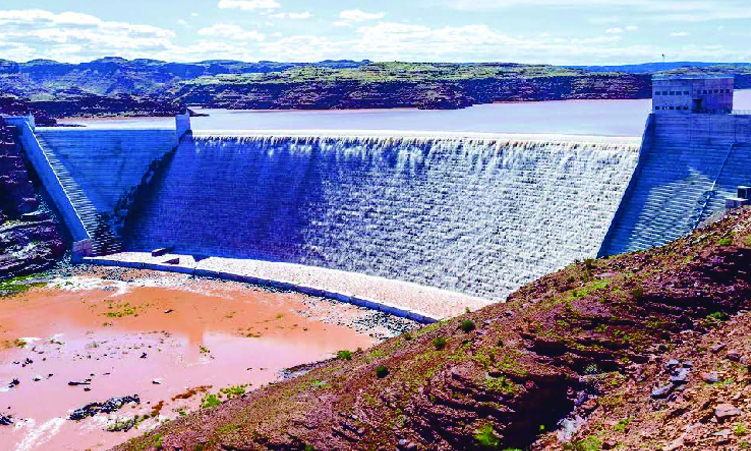
Neckartal depends on inflows from the ephemeral Fish River, and it was widely expected that it would take two to three years for the dam to fill. Of course, nature plays havoc with the plans of men and Namibia got an exceptional rainfall in 2019. On 19 January 2019 the dam overflowed, much to the excitement and delight of Namibians.
It has now been six years since the dam filled, but nothing has been produced and no agricultural project commenced.
The Ministry of Agriculture, Water, and Land Reform was supposed to have been allocated N$2.4 billion in the 2023/24 financial year for stage two, which requires building canals, spill points and booster pump stations. However, this allocation did not eventuate.
This brings the total estimated cost to the taxpayer to complete the Neckartal dam to a staggering N$8.1 billion.
The agriculture minsitry has said that it has not yet sought expressions of interest from potential investors. It has been suggested in 2022 that a further investment of US$200 million (N$3.8 billion) is required by the investor to start production of agricultural products.
So what is going to eventually be produced?
The government has estimated that of the 5 000 hectares it has acquired or is expected to acquire, some 4 300 are for irrigation. The remainder is to be used for feed lotting.
The government has said it is up to investors to decide what to produce, but it primarily expects the land to be used for grape and date production, supplemented by vegetable cultivation and alfalfa growth for local cattle feedlots.
However, the most profitable and propitious of exports are table grapes, which are 82% water, which now comes from the Orange River region.
It appears to be a strange export from a desert country, but Namibia has several commercial advantages that are not obvious.
First, it can get high quality table grapes to the European Union (EU) market in November, in time for Christmas, which is not possible from many producers, including South Africa.
Namibia also has concessional market access provisions from the EU as well as the United Kingdom (UK).
Importantly, the water taken from the Orange River for growing grapes has no cost to farmers apart from the cost of applying for a permit from the agriculture ministry.
In 2023, the farmers on the Namibian side of the Orange River basin used 2 270 hectares of land to produce N$1.3 billion in grapes, most of which went to The Netherlands and UK (via Cape Town).
This produced a total volume of 42 000 tonnes of grapes.
The industry in 2023 created an estimated 10 000 full-time and seasonal jobs.
If all 4 300 hectares of irrigable land in the Neckartal Dam irrigation scheme were planted with grapes, it would take producers at least two to three years to reach full vine capacity. Based on current grape export prices, this could generate N$2.5 billion in exports and employ 20 000 part-time and full-time workers.
None of these economic benefits to Namibia should be expected before 2030 when the grape vines reach maturity.
Neckartal is Namibia’s biggest dam by far and has stood virtually full and unused for over six years.
There has been no stage two study undertaken. The consultant who will design stage two has not even been chosen yet.
The agriculture ministry has optimistically assured The Namibian that stage two will be ready in 2026, and production will start by 2027.
The failure to move to stage two expeditiously means that Neckartal now stands as a testimony to one of the most visible and expensive failures of planning and implementation of government in the post-independence history of the country.
– Roman Grynberg was a professor of economics at the University of Namibia and is adjunct profesor at Griffith University in Australia.
In an age of information overload, Sunrise is The Namibian’s morning briefing, delivered at 6h00 from Monday to Friday. It offers a curated rundown of the most important stories from the past 24 hours – occasionally with a light, witty touch. It’s an essential way to stay informed. Subscribe and join our newsletter community.

The Namibian uses AI tools to assist with improved quality, accuracy and efficiency, while maintaining editorial oversight and journalistic integrity.
Stay informed with The Namibian – your source for credible journalism. Get in-depth reporting and opinions for
only N$85 a month. Invest in journalism, invest in democracy –
Subscribe Now!