



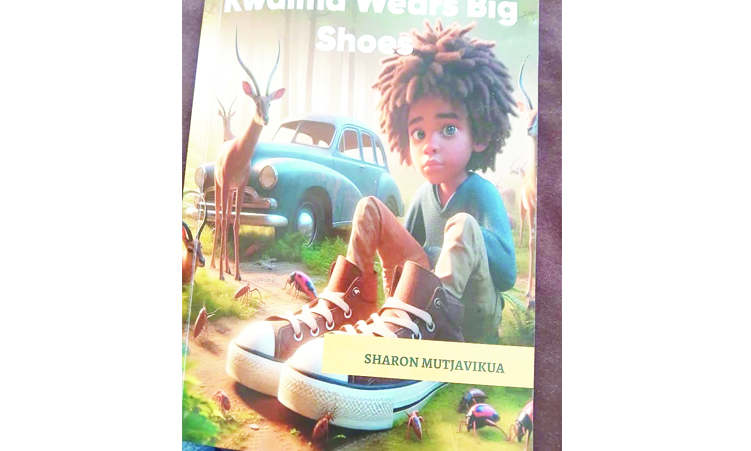
Sharon Mutjavikua’s new book continues to detail the adventures of the inquisitive Kwaima, a Grade 6 pupil living in a village named Little Calabash.
After good rains, the bush is bright and green and the air is fresh and clean, but the appearance of locusts that threaten to destroy the crops causes Kwaima to worry that God may be punishing his village like he punished the Egyptians in the Bible.
Following ‘Kwaima and the Mysterious Tree’, published in 2023, this time around ‘Kwaima Wears Big Shoes’ as he prepares for his moment in the spotlight at his school’s annual prize-giving ceremony.
Miss Joy, Kwaima’s English teacher, thrills the young boy when she announces that his name is among those of the pupils who did very well and behaved exceptionally.
“I was tempted to run to the tall pawpaw trees in the plantation on either side of the road that led to our school, and scream at the top of my lungs […]I also thought about glueing the prize to my forehead so that everyone who saw me would know that I am not just a talkative busybody.”
Kwaima also prepares to travel to the city, where he will be responsible for guarding the food and drinks at his uncle’s wedding.
“Uncle John told my father he had found the woman of his dreams, which was strange […] I wondered whether he had found a woman he had dreamt about, or the woman he had been searching for?”
“I did not think I would dream about women, like my uncle […] I dreamed of having lots of money and becoming a great chief […].”
On Kwaima and his father’s way to the city they meet an elderly woman in a faded yellow car who gives them a lift.
The kind woman, with lips painted bright orange and a thick brown clayish paste smeared on her face, begins to chat with Kwaima as his father nods off along the journey.
Kwaima shares his worries about the locusts and his fears that if the chief and councillor don’t do something soon, there will be famine and the whole village will starve.
“You should always look at the positive side first before you fill your head with spider webs that block your peace,” says the old lady. “Instead of spreading fear among the villagers.”
Through Kwaima’s character, Mutjavikua shares important insights about living in harmony with nature and not allowing the worries of tomorrow to overshadow the enjoyment of today.
The book also explores the trials of residents of Little Calabash, who grapple with challenges of dowry lists requiring, among many other things, “seven white cows without spots or stripes”, as well as fierce winds, bats flying into the women’s room and “snakes that go into huts to warn people that something terrible will befall them”.
“My readers wanted more of Kwaima. I didn’t think I would write a sequel but the demand was too loud to ignore,” says Mutjavikua, who describes herself as a “student of life” who is inspired to write by people and nature.
“When I am around people I listen, I observe quietly. I love to see people grow and evolve. I love to see graduates run to their parents with the joy of a young calf. I love to see celebrations of all sorts – big or small. “Moreover, I spend a lot of time with children and old people, and somehow they inspire my writing,” she says.
The book features themes such as great ambition, fearlessness, optimism and compelling discipline, she adds.
“Kwaima doesn’t consider the obvious odds in his life, he goes for the big catch, he envisions greatness, and that is his motivation.”
Mutjavikua wrote the book over a period of eight weeks, and says she was challenged by the act of personifying a 12-year-old boy and designing a plot that speaks to the imaginations of both teens and more mature readers.
She also worked hard to create relevant supporting characters with interesting educative dialogues, and come up with thought-provoking idiomatic expressions and proverbs.
“I have witnessed people crush their big dreams because life gives them hard blows, but I believe in the innate strength of human nature to get up again and again. It’s never too late to fulfil your dreams.
“Kwaima comes from a poor background in which his parents have defined the value of their lives according to their circumstances. However, this is not the case for Kwaima, he sees himself in a different quality of life and that is what fuels his ambition.”
So far, the response to the new book has been wonderful, she says.
“Shortly after launching the book, Namibians called from the north, south, east and west. It was such a fulfilling and encouraging time. I sold 80 copies in just two days.The reviews have been wonderful, too. Aden, a 10-year-old, told me he wants to meet Kwaima and he wants him to be his friend.
“Namibians enjoy storytelling, especially about characters they can relate to or who inspire them to do better and be better,” she adds.
In terms of future projects, Mutjavikua is working on an anthology of poetry and prose tackling issues such as mental health, suicide and gender-based violence, as well as a non-fiction collection titled ‘The Women’s Eyes’, which will be launched in November.
‘Kwaima Wears Big Shoes’ is available from Africa Blossom Publishers in Windhoek for N$270.
In an age of information overload, Sunrise is The Namibian’s morning briefing, delivered at 6h00 from Monday to Friday. It offers a curated rundown of the most important stories from the past 24 hours – occasionally with a light, witty touch. It’s an essential way to stay informed. Subscribe and join our newsletter community.

The Namibian uses AI tools to assist with improved quality, accuracy and efficiency, while maintaining editorial oversight and journalistic integrity.
Stay informed with The Namibian – your source for credible journalism. Get in-depth reporting and opinions for
only N$85 a month. Invest in journalism, invest in democracy –
Subscribe Now!