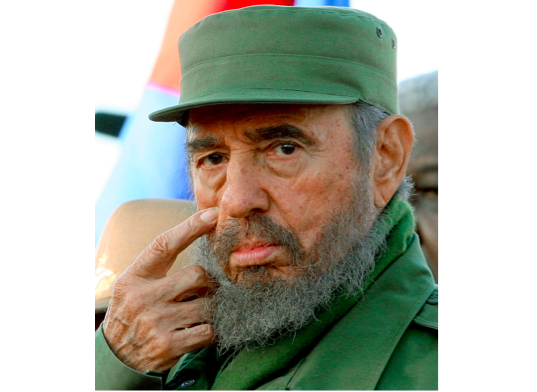
Cuba’s socialist icon and father of his country’s revolution Fidel Castro died Friday aged 90, after defying the United States during a half-century of ironclad rule and surviving the eclipse of global communism.
One of the world’s longest-serving rulers and modern history’s most singular characters, he defied 11 US administrations and numerous assassination attempts.
His younger brother, President Raul Castro, announced the news shortly after midnight (0500 GMT Saturday) but gave no details of the cause of death.
During half a century in power, Fidel Castro crushed opposition at home to lead the communist Caribbean island through the Cold War before stepping aside in 2006 after intestinal surgery.
For defenders of the revolution, he was a hero who defended the ordinary people against domination.
For his opponents, including thousands of Cubans resident in the United States, he was a cruel tyrant.
He eventually lived to see the historic restoration of diplomatic ties with Washington last year.
“The commander in chief of the Cuban revolution died at 22:29 hours this evening,” the president announced on national television just after midnight Friday (0500 GMT Saturday).
“In compliance with Comrade Fidel’s expressed will, his remains will be cremated early in the morning” on Saturday, said Raul Castro, who took power after his elder brother Fidel was hospitalized in 2006.
“The funeral organizing commission will provide detailed information to the people on the holding of a posthumous homage that will be paid to the founder of the Cuban Revolution.”
Venezuelan President Nicolas Maduro, Cuba’s main ally in the region, said on Twitter: “It is up to us to continue his legacy and carry his flag of independence.”
The leaders of Mexico and El Salvador hailed Castro in messages on Twitter in the hours after the announcement.
Indin Prime Minister Narendra Modi sent his “deepest condolences” to Cuba. “India mourns the loss of a great friend,” he wrote on Twitter.
Other powers had yet to react early Saturday.
In Cuba, news was just getting around.
Car washer Marco Antonio Diez, 20, said he was out at a party in Havana when the music stopped and he heard the news.
“I went home and woke up everyone, saying: ‘Fidel has died.’ My mother was astonished,” he told AFP.
The bearded, cigar-puffing leader, renowned for trademark army fatigues and hours-long public tirades, grabbed power in a January 1, 1959 revolution.
Living by the slogan “socialism or death,” he kept the faith to the end, even as the Cold War came and went.
He endured hundreds of assassination attempts, according to his aides, and the disastrous US-backed Bay of Pigs invasion attempt in 1961.
“If I am considered a myth, the United States deserves the credit,” he said in 1988.
Castro was at the center of the Cuban Missile Crisis in 1962, as the world stood on the brink of nuclear war until the Soviet Union blinked in its bid to station strategic missiles on Cuban soil.
Well into his old age, Castro unleashed furious diatribes against Washington until he was slowed by surgery in July 2006.
An energetic symbol of defiance for developing countries and a driving force behind the Non-Aligned Movement, Castro proved even a small sovereign nation could thumb its nose at the world’s biggest superpower.
Born August 13, 1926 to a prosperous Spanish immigrant landowner and a Cuban mother of humble background, Castro was a quick learner and a keen baseball player.
His political path was set when he formed a guerrilla opposition to the US-backed government of Fulgencio Batista, who seized power in a 1952 coup.
“History will absolve me,” he said.
After he was jailed for two years by the Batista regime, he went into exile in Mexico and organized followers for their ultimately triumphant uprising.
It was launched when, on December 2, 1956 they sailed to southeastern Cuba on the ship Granma. Twenty-five months later, they ousted Batista and Castro was named prime minister.
In an age of information overload, Sunrise is The Namibian’s morning briefing, delivered at 6h00 from Monday to Friday. It offers a curated rundown of the most important stories from the past 24 hours – occasionally with a light, witty touch. It’s an essential way to stay informed. Subscribe and join our newsletter community.

The Namibian uses AI tools to assist with improved quality, accuracy and efficiency, while maintaining editorial oversight and journalistic integrity.
Stay informed with The Namibian – your source for credible journalism. Get in-depth reporting and opinions for
only N$85 a month. Invest in journalism, invest in democracy –
Subscribe Now!