




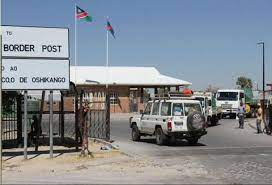
The police in the Ohangwena region are faced with a high number of cross-border crimes along the Oshikango border.This is due to rampant illegal crossing by citizens from both Namibia and Angola.
The permeability of the border is said to make it much easier for smugglers of illicit goods to cross borders.
Ohangwena regional police commander commissioner Elizabeth Sibolile revealed this during a working visit by Angola’s Cunene province governor Gerdina Didalelwa at Eembaxu this week.
“Hence, the police on both sides have established posts and ambushes along the borderline to control and prevent illegal crossing of people from and into both countries.
“However, members of the public from both countries still find ways to cross the border illegally and smuggle items into both
countries,” she says.
Prevalent cross-border crimes include the theft of motor vehicles, drug smuggling, stock theft, human trafficking, and fuel smuggling.
Sibolile says the theft of motor vehicles is on the increase in the region and criminals mostly target Toyota Corolla and Toyota Hilux 4×4 vehicles.
Some 64 Angolan nationals are currently in police custody awaiting trial at five police stations in the region.
Sibolile says the police in the region are faced with challenges such as vast and porous borders, a borderline encroached by bushes, and tracing victims’ parents or guardians.
She is therefore recommending the two governments to set up at least four points of entry to cover the distance and minimise illegal border crossing, border clearance, and to re-demarcate the borderline according to international standards.
Meanwhile, many Angolan nationals, who fled the severe drought in their country and are in need of medical attention in Namibia, are unable to access public healthcare facilities due to being charged exorbitant fees.
Angolan nationals, as well as other non-Namibians, are made to pay much higher fees than Namibian patients at these facilities.
This is despite the fact that healthcare services are available to foreign nationals as per government policy, said John Hango, the health director of the Ohangwena region.
“This is absurd, because most of these people visiting our hospitals are from poor backgrounds, and as a result many of them are unable to pay such exorbitant fees. These people are already suffering, yet they are made to pay so much when seeking medical attention. Where will they get the money from if they are already unable to feed themselves?” he asked.
Hango said non-Namibians are charged N$60 at local clinics, while Namibian nationals are charged N$4 only.
Non-Namibian nationals at local public hospitals are charged N$100, while Namibians are charged N$8.
He added that non-Namibians admitted to public hospitals are charged N$400 per day, while Namibian nationals pay only N$20 once-off.
Hango is therefore appealing to the government to review the fees for foreign nationals at public healthcare facilities.
He said the language barrier is also a challenge as many local healthcare officials are unable to communicate with foreign patients, and as a result they end up receiving the wrong medication.
“The health directorate has started to train nurses in basic Portuguese to ease the language barrier. We also have the challenge of unclaimed bodies of Angolan nationals staying in hospital mortuaries too long, and discharged Angolan patients not coming back for follow-ups,” Hango said.
In an age of information overload, Sunrise is The Namibian’s morning briefing, delivered at 6h00 from Monday to Friday. It offers a curated rundown of the most important stories from the past 24 hours – occasionally with a light, witty touch. It’s an essential way to stay informed. Subscribe and join our newsletter community.

The Namibian uses AI tools to assist with improved quality, accuracy and efficiency, while maintaining editorial oversight and journalistic integrity.
Stay informed with The Namibian – your source for credible journalism. Get in-depth reporting and opinions for
only N$85 a month. Invest in journalism, invest in democracy –
Subscribe Now!