


KUSHLINA Sibiya says she will never forget the look on the doctor’s face just before she told her that her toddler had cancer.
Sibiya’s only child, Merwin Serstianus (2), was diagnosed with stage four neuroblastoma in early 2016.
Sibiya (23) is a single mother who works as a waitress at a Windhoek restaurant.
When we met, she looked tired, but hopeful.
Sibiya told The Namibian that it all started when her mother bathed Merwin sometime early last year, and discovered a lump on his stomach. They took him to the Katutura Intermediate Hospital’s emergency room.
“They told us that it was an infection, and they gave him antibiotics. The more he was taking the medication, the worse the lump got. My mother and I took him back, and we were told the same thing, until my mother insisted that they do a scan on my son,” she said.
Sibiya noted that after several tests, they were called back, and the doctor told her it was not good news.
“On my way to the doctor, I was trying to keep calm. But the inner voices were telling me all kinds of things, and I was close to becoming crazy. I was not strong enough or ready for the results, but it was time to face reality,” she added.
Sibiya said her worst fears were confirmed by the doctor. “My mouth was so dry; I could not feel my feet, and my hands were trembling,” she recalled.
She furthermore described how it all felt so unreal as the doctor was explaining what neuroblastoma was. The doctor informed her that neuroblastoma was the most common type of cancer in infants.
“When I looked at my son’s big bright smile, he was not aware what was happening, and what hell we were about to enter. I had to pull myself together for him,” she said as tears welled in her eyes and rolled down her cheeks.
According to the chief executive officer of the Cancer Association of Namibia (CAN), Rolf Hansen, most people have never heard of neuroblastoma.
He said this disease was a solid tumour (a lump or mass caused by uncontrolled or abnormal cell growth) which is formed by special nerve cells called neuroblasts.
“Neuroblastoma most commonly starts in the tissue of the adrenal glands, the triangular glands on top of the kidneys which make hormones that control the heart rate, blood pressure, and other important functions,” Hansen explained.
He said although neuroblastoma sometimes formed before a child was born, it usually wasn’t detected until later when the tumour begins to grow and affect the body. When neuroblastoma is found and treated in infancy, the chance of recovery is good.
Sibiya said what stressed her the most at the Windhoek Central Hospital’s cancer ward was that so many children died there.
“It is scary to hear that a child who was walking and playing had died the previous evening, but the doctor told me that Merwin’s condition is under control, and he is recovering. But I rather not let my guard down because anything can happen.
“The last time when I took him home, he got an infection because we are 15 people living in a two-bedroom house. Thus, I don’t take him home. We are just at hospital for his own safety. I also see that the hospital atmosphere is depressing him sometimes,” a teary Sibiya stated.
She said as a single mother, it was very tough, especially with a child who had cancer. There were bad days and good days, and on bad days, she prayed a lot, and on good days she just wished these could last forever.
“I wish I was the one going through that pain every day. There are days when I spend hours crying, knowing it will not help, but I have learned to cope with this enemy within my precious son,” she muttered tearfully.
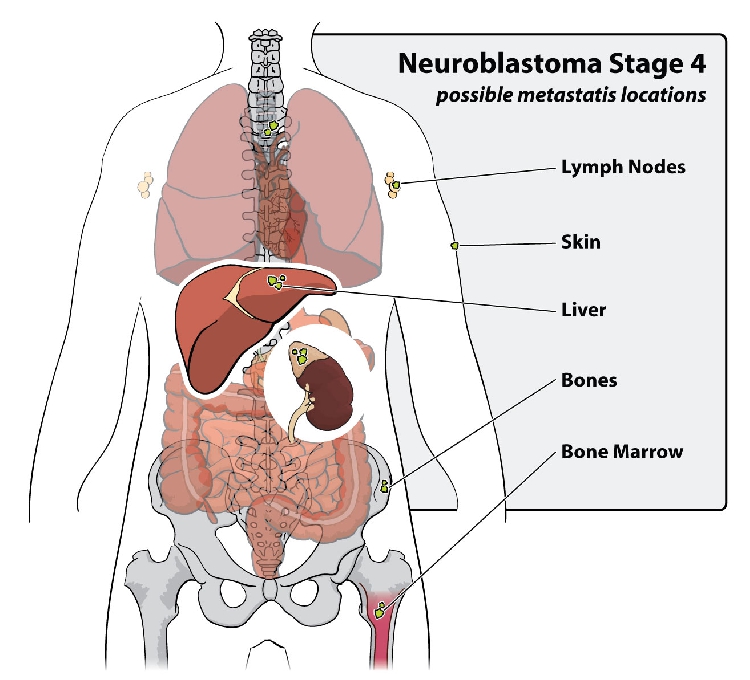
Neuroblastoma
Causes
Neuroblastoma happens when neuroblasts grow and divide out of control, instead of developing into nerve cells. The exact cause of this abnormal growth is not known, but scientists believe a defect in the neuroblast allows it to divide uncontrollably.
Signs and Symptoms
The effects of neuroblastoma can be different, depending on where the disease first started, how much the cancer has grown, and how much it has spread to other parts of the body.
In young children, neuroblastoma is often discovered when a parent or doctor feels an unusual lump or mass somewhere in the child’s body, most often in the abdomen, though tumours also can appear in the neck, chest, and elsewhere.
For example, a child may have a swollen stomach, abdominal pain, and decreased appetite (if the tumour is in the abdomen); bone pain or soreness, black eyes, bruises, and pale skin (if the cancer has spread to the bones or bone marrow); weakness, numbness, inability to move a body part, or difficulty walking (if the cancer presses on the spinal cord); drooping eyelids, unequal pupils, sweating, and red skin, which are signs of nerve damage in the neck known as Horner’s syndrome (if the tumour is in the neck); difficulty breathing (if the cancer is in the chest), as well as fever and irritability. cancerassociationofnamibia
In an age of information overload, Sunrise is The Namibian’s morning briefing, delivered at 6h00 from Monday to Friday. It offers a curated rundown of the most important stories from the past 24 hours – occasionally with a light, witty touch. It’s an essential way to stay informed. Subscribe and join our newsletter community.

The Namibian uses AI tools to assist with improved quality, accuracy and efficiency, while maintaining editorial oversight and journalistic integrity.
Stay informed with The Namibian – your source for credible journalism. Get in-depth reporting and opinions for
only N$85 a month. Invest in journalism, invest in democracy –
Subscribe Now!