


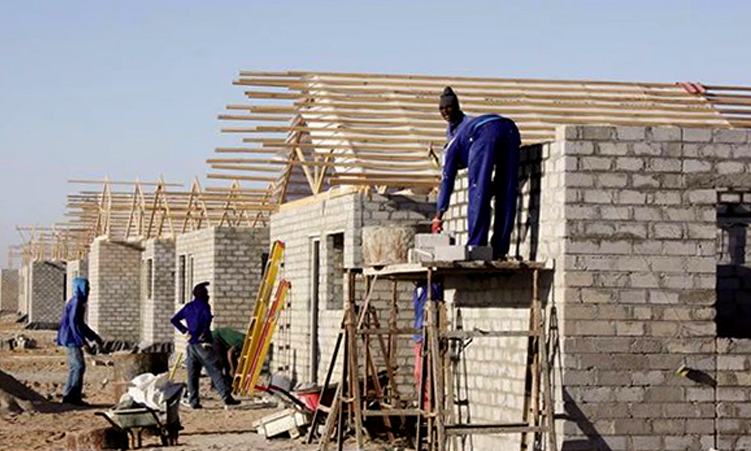
The local construction industry is in shambles, and with government stalling many projects, contractors will depend more on private projects, which are mostly awarded on merit.
This is good for the sector, because, competition in the sector is extremely fierce, with politically connected individuals receiving tenders, without having the necessary skills and equipment to carry out the tasks, therefore subcontracting to more adequate contractors.
Analysts at Simonis Storms said the outlook on the construction sector remains bleak and is most likely set to contribute negatively towards the gross domestic product calculation for 2023.
According to economic analysts, competition to tender for projects under a restricted development budget is at an all-time high, according to the Construction Industry Federation (CIF).
“In addition, Namibian contractors also have to compete against foreign companies, and smaller Namibian construction businesses have been displaced by larger, more established contractors,” Simonis says.
When undue contractors are appointed, it has contributed to project deliverables not being achieved, causing certain infrastructure projects to stall, the analysts say.
Without a sector council or regulator, the above situation is likely to persist, weighing on the profitability of local operators in the construction sector.
Apart from calling on more investor-friendly policies, since 2006 the CIF has been arguing for a construction council that would serve in the interest of local capacitation and effective regulation of the sector.
Meanwhile, approved building plans saw an impressive increase of 67% on a monthly basis in Windhoek from February 2023, rising from 117 to 195 approvals.
However, Swakopmund experienced a modest monthly increase of 3%, with approvals increasing from 63 to 65, according to Simonis.
“On an annual basis, Windhoek’s approvals in building plans experienced a decline of 21%, while Swakopmund’s approvals saw a remarkable increase of 91% – from 34 to 65,” Simonis says, adding the latter can be attributed to a low base effect.
Simonis says despite the positive monthly results, the total approvals for both Windhoek and Swakopmund decreased by 23% quarter on quarter during the first quarter of 2023, compared to the fourth quarter of 2022.
Similarly, the number of completed building projects also experienced a decrease of 14% quarter on quarter, compared to the previous quarter.
The majority of building plan approvals for both Windhoek and Swakopmund were concentrated within the residential segment of the market.
“Specifically, new residential developments and additions to existing residential properties accounted for over 98% of all approved building plans.
“Further analysis of the approved plans reveals that additions accounted for 69%, followed by residential projects at 29%, and commercial projects at 2%,” Simonis says.
The analysts say year to date, 308 projects were completed, with a total value of N$197 million.
For the same period in 2022, 487 projects with a value of N$248 million were completed.
In March 2023, at total of 102 building projects were completed, compared to 154 building projects in March 2022, with 78 completed in Windhoek, and 24 at Swakopmund.
The total value of completed projects for March 2023 amounted to N$67 million.
The value of projects in Windhoek have been flat, and decreased by 44% year on year in March 2023, together with a decrease of 40% year on year in the number of projects completed – from 130 to 78 projects.
At Swakopmund there has been no change in the number of projects completed, but the value decreased by 29% year on year in March 2023, indicating that low-cost projects could dominate projects at the town.
The construction industry has been facing significant growth challenges since 2016.
In that year, the industry experienced a 41% year-on-year contraction, and has remained in negative growth territory ever since.
It reported a further annual contraction of 16% in 2022, based on preliminary national accounts from the Namibia Statistics Agency (NSA).
According to the NSA, the poor performance for 2022 was reflected in both civil engineering and related services, and building and related services categories of construction works, which experienced reductions in 2022.
Additionally, the gross fixed capital formation for building and construction works has also been declining, dropping by 26% year on year in building, and -3,5% year on year in construction works in 2022.
– email: matthew@namibian.com.na
In an age of information overload, Sunrise is The Namibian’s morning briefing, delivered at 6h00 from Monday to Friday. It offers a curated rundown of the most important stories from the past 24 hours – occasionally with a light, witty touch. It’s an essential way to stay informed. Subscribe and join our newsletter community.

The Namibian uses AI tools to assist with improved quality, accuracy and efficiency, while maintaining editorial oversight and journalistic integrity.
Stay informed with The Namibian – your source for credible journalism. Get in-depth reporting and opinions for
only N$85 a month. Invest in journalism, invest in democracy –
Subscribe Now!