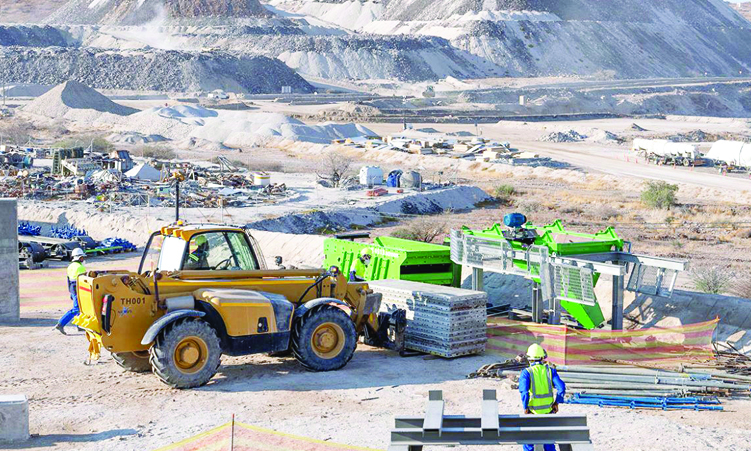
A Contested tin mining project 80km south of Khorixas in the Kunene region is facing renewed scrutiny, with conservancies warning it is financially untenable.
The conservancies have also raised questions about the involvement of Andrada Mining.
The Goantagab tin mining project, located in the Sorris Sorris Conservancy, has been the subject of a protracted legal battle over its environmental clearance.
In December, the Red Mountain Joint Management Area (RM-JMA), which represents three conservancies including Sorris Sorris, submitted an assessment of the project to the government.
The assessment claims the mine is both financially unfeasible and damaging to the sensitive environment.
The findings come months after Andrada Mining signed an agreement to buy tin ore from Goantagab mine, including an option to buy the project.
“There is no reason to believe this project will be viable,” the assessment commissioned by the RM-JMA says.
The conservancies are disputing figures presented in Andrada’s press release on 17 June last year, which says the Goantagab mine will provide Andrada with 240 000 tonnes of high-grade ore averaging 1.5% tin.
According to RM-JMA, the latest scoping study on the project was conducted in 2003 by Snowden Optiro, which projected only 60 000 tonnes per year of 1.23% tin.
“Andrada’s role is strictly as buyer (off-taker), and no ore supply has been received to date,” Andrada’s head of investor relations Sakhile Ndlovu says.
Given the fact that the mining would damage the tourism economy of the area, RM-JMA has formally requested that the minister of mines and energy and the minister of environment and tourism withdraw the area from mining exploration.
The joint venture over 25 years should provide N$340 million in direct cash benefits to conservancies and a total economic contribution of N$2.7 billion, RM-JMA says in its letter.
The letter also raises questions about the high profile of proponents of the mining project.
The conservancy provided several recommendations to prevent similar conflicts, including mandatory opportunity-cost assessments and the clear prohibition of large-scale mining applications under the mining-claim regime.
Goantagab Mining is led by Timoteus Mashuna, who owns eight of the mining claims that form the mine.
The other 10 are owned by Ottilie Ndimulunde.
Mashuna says the Goantagab mine has been continuously mined since 1996.
The area had a mining licence, which lapsed in 2019.
He took over operations from the previous owner using mining claims, but denies that the project exceeds the exploration activities that are legally allowed under the mining claims regime.
“It’s not defined how much mining you can do under a mining claim.
We haven’t mined fully and haven’t set up full operations,” he said.
Mashuna has also disputed studies showing the Goantagab mine is financially unfeasible.
He emphasises his willingness to work with conservancies to enable the mine to be beneficial for the local community, which has been a bone of contention in legal proceedings with RM-JMA.
“These communities are impoverished. Mining will bring more money than tourism, and we can set up structures with the community – such as a trust – that will benefit them,” he says.
In his signed affidavit dated 5 October 2025 in court proceedings against the Red Mountain Joint Management Area, he said there is no law preventing mining in conservancies.
Moreover, he maintains that the community is in favour of the mine.
According to the environment ministry, Goantagab mine has not yet applied for an environmental clearance certificate.
“There is no law as of now that prevents mining in conservancies, but the ministry is working on legislation to fill this gap.
Approvals are granted depending on the impact that the mining would have on the environment obtained from the impact assessment report,” ministry spokesperson Vilho Hangula says.
In an age of information overload, Sunrise is The Namibian’s morning briefing, delivered at 6h00 from Monday to Friday. It offers a curated rundown of the most important stories from the past 24 hours – occasionally with a light, witty touch. It’s an essential way to stay informed. Subscribe and join our newsletter community.

The Namibian uses AI tools to assist with improved quality, accuracy and efficiency, while maintaining editorial oversight and journalistic integrity.
Stay informed with The Namibian – your source for credible journalism. Get in-depth reporting and opinions for
only N$85 a month. Invest in journalism, invest in democracy –
Subscribe Now!