



• S Brent Rodriguez-PlateImages are not static. They grab our attention, incite desire, alter our relations to others, and tweak our beliefs, as they usher us into new worlds.
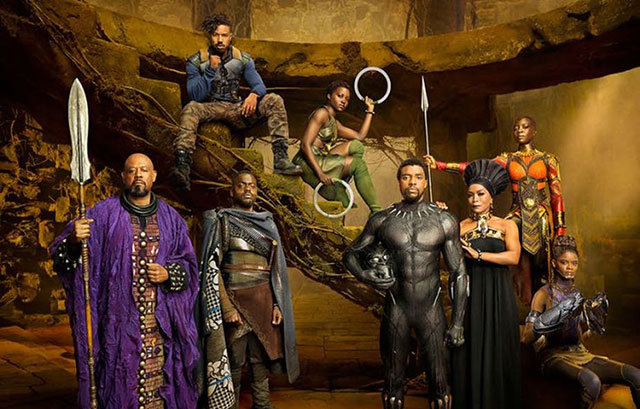
When ‘Black Panther’ was released, Baye McNeil, a former Brooklynite now living in Japan, was thrilled. As he told The Japan Times, he joined “a group of palpably positive brothers and sisters” at a Tokyo theatre. Collectively they were transported to the land of Wakanda. As an exile in Japan and a black man in a country with very few people of African descent, he and his friends entered, as he described, “a bountiful realm of invigorating messages and restorative images” that provided him with a sense of connection and belonging.
Baye McNeil was not alone. Back in the US, the writer Carvell Wallace explained how the movie’s fictional nation of Wakanda operated in very real ways to provide a world that African-Americans could aspire to, both as a place rooted in the past, as well as the future.
Whether it’s a blockbuster movie or two-year-old Parker Curry looking up at Amy Sherald’s portrait of former US first lady Michelle Obama, the images we all see matter.
Seeing is not just believing. Seeing changes what we believe, about ourselves and about other people, including constructions of race.
In his essay, ‘To See and Not See’, the late writer and neurologist Oliver Sacks describes how seeing is not as easy as lifting our eyelids. Instead, as he said
In other words, to have vision is one thing; to see is another.
My research investigates how we learn to see. I’m interested in the ways people use images, but equally interested in the ways images use people and change their perception.
We begin to imagine other people and how they appear, before we shake their hands, and well before any relationship might occur.
We create mental models of others based on our past experiences, and these models influence any new encounters, whether we are conscious of them or not.
Cognitive psychologist Jeffrey Zacks, in his book ‘Flicker: Your Brain on Movies’, offers this fascinating idea that can be either disturbing or offer positive feelings
Indeed, studies in cognitive sciences show that our neural system does not easily differentiate between images we see on screen and images we see in “real life”.
Baye McNeil and Carvell Wallace were under no illusion that Wakanda was not a real place, but the power of images is such that people can feel things in the world of cinema. Those feelings can transfer back into life outside the theatre.
It is precisely because our ability to see is largely learned and heavily influenced by media images, that we can also relearn how to see.
A number of studies in cognitive sciences in recent years have shown how people can, for example, reduce racial biases through practices of seeing.
Psychologists have long documented the ‘own-race bias’, also known as ‘other-race effect’, the inability of humans to recognise and distinguish faces of people from races other than their own.
Indeed, studies have shown that already by nine months, infants demonstrate such perceptual narrowing. This occurs because babies in their first year are exposed primarily to close family members who tend to be of the same ethnic and racial background.
For evolutionary reasons, this narrowing allows for quicker processing of relevant sensations by eliminating other competing neural processes.
Our ancestors needed to distinguish their own kin more than they needed to recognise people from other places.
Today, a number of researchers are exploring the reversibility of the own-race bias, pointing out again the plasticity of our neural system.
One research group used bodily illusions, such as setting white people in front of a computer screen that generates an image of that person, but makes light-skinned people appear darker-skinned. When tested later for racial biases, the biases diminished.
Another group used picture books to forestall the emergence of own race biases by showing images of Chinese people’s faces to Caucasian infants.
Still another study used clips from the movie ‘The Joy Luck Club’, asking a group of white Americans to put themselves in the place of the main Chinese-American character, June. Subsequent tests found a reduction in implicit prejudice toward “outgroups” in general.
Because images matter, the types of images we see matter even more. Flat, two-dimensional images change our perception in the world beyond the movie theatre, outside the picture books.
Of course, we can’t hook up a general population to computers and virtual reality environments that change our racial appearance or set up control environments for our children to have such experiences. But we can choose the images we see on a regular basis.
In an age of information overload, Sunrise is The Namibian’s morning briefing, delivered at 6h00 from Monday to Friday. It offers a curated rundown of the most important stories from the past 24 hours – occasionally with a light, witty touch. It’s an essential way to stay informed. Subscribe and join our newsletter community.

The Namibian uses AI tools to assist with improved quality, accuracy and efficiency, while maintaining editorial oversight and journalistic integrity.
Stay informed with The Namibian – your source for credible journalism. Get in-depth reporting and opinions for
only N$85 a month. Invest in journalism, invest in democracy –
Subscribe Now!