


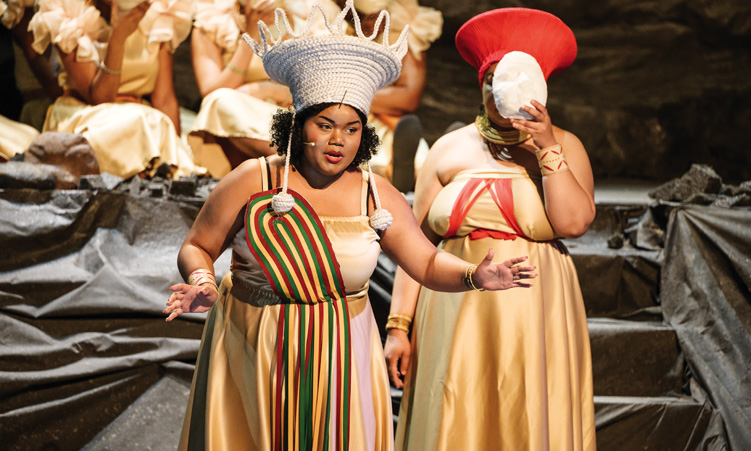
It’s been a little over a month since ‘Chief Hijangua’ made its international debut at a sold-out premiere at Haus des Rundfunks in Berlin.
Lauded as Namibia’s first opera, composed by Eslon Hindundu and directed by Kim Mira Meyer and Micheal Pulse, the Namibian-German co-production revived Hindundu and librettist Nikolaus Frei’s tragic tale of a young Namibian royal’s encounter with treacherous German settlers as a homegrown, experimental and ambitious opera worthy of the world stage.
“What stood out for me in this experience in Berlin as a Namibian artist making work internationally is that I was exposed to new people who have great ideas, and we got to collaborate in bringing something that is truly Namibian,” says Pulse.
“Also being able to see how everybody put in 100%, including when it came to costumes and to stage design. Having all these artists make this one story come to life was a great experience, especially knowing that we, as two countries, share history.”
Unorthodox in its staging at Haus des Rundfunks, a broadcasting centre featuring a concert hall without fly bars or wings, ‘Chief Hijangua’ was not just a success of story, composition, voice and music, but of stage design by Namibia’s Tanya Stroh and Germany’s Felicia Riegel.
For those who have not seen it, Haus des Rundfunks’ concert hall is rather specific. More functional than fancy, wood-panelled, terraced and with the incredible acoustics essential for music and recording, Haus des Rundfunk’s stage does not obviously lend itself to the action, drama and scene changes of a four-act opera.
To build the opera’s various landscape amid the story of a lovelorn Namibian prince who leaves his family, wanders the desert and meets and is changed by the inhabitants of a German outpost, Stroh and Riegel made use of a number of symbolic elements, primarily copper and sand.
“Sand is what all the different places the opera takes place in have in common. The Waterberg, the travel through the Namib Desert, and the coastline have sand in common. So we tried to reduce the set design to the one common material/surrounding,” says Riegel.
“It was important to us to bring some Namibian elements and materials to this installative stage to give the audience a materialistic impression of the desert country where the story takes place,” Riegel says.
“Felicia had this idea to work with copper pipes. So we have this built landscape, but there is a strong use of copper as a way to symbolise borders and natural resources,” says Stroh.
“We are trying to work with tension in the space, but also using copper as a storytelling technique to ask: Why would Germans come here in the first place? What is here? What would drive someone, even Hijangua, to make a certain political
choice? Is it over land ownership, is it over the resources attached to the land?”
Inquiring in its story and in its stage design, ‘Chief Hijangua’ also impressed with its music.
Writing a review for operatoday.com shortly after ‘Chief Hijangua’s’ premiere on 15 September, author Andrew Moravcsik called the opera’s Berlin premiere “historically important”.
Moravcsik further described baritone Sakhiwe Mkosana (Hijangua) as “triumphant” and had high praise for Namibia’s Janice van Rooy (Matjiua), remarking that “she fearlessly commanded the stage with a firm and resonant voice and a lot of attitude – both signs of potential as a future diva.”
– martha@namibian.com.na; Martha Mukaiwa on Twitter and Instagram; marthamukaiwa.com
In an age of information overload, Sunrise is The Namibian’s morning briefing, delivered at 6h00 from Monday to Friday. It offers a curated rundown of the most important stories from the past 24 hours – occasionally with a light, witty touch. It’s an essential way to stay informed. Subscribe and join our newsletter community.

The Namibian uses AI tools to assist with improved quality, accuracy and efficiency, while maintaining editorial oversight and journalistic integrity.
Stay informed with The Namibian – your source for credible journalism. Get in-depth reporting and opinions for
only N$85 a month. Invest in journalism, invest in democracy –
Subscribe Now!