




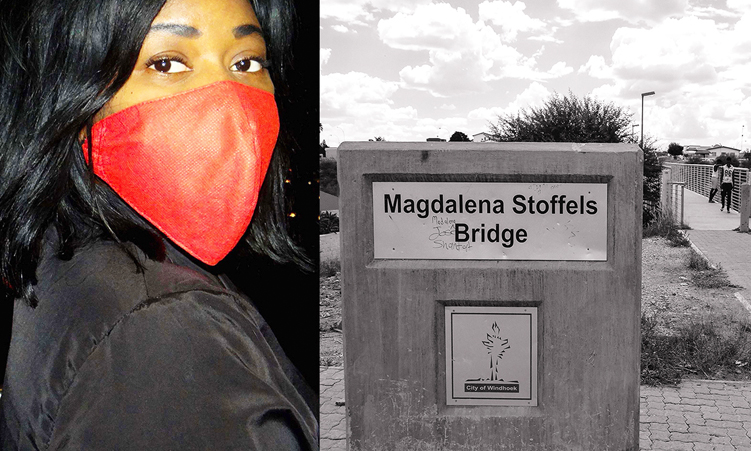
I’ve always found comfort in Windhoek’s Magdalena Stoffels Bridge.
On a sunny day five years ago, I’m watching people walk over it. The sky is magnificent in a fringe of fluffy white clouds and I hear the promise of the bridge’s solid metal frame. Never again.
If young Ingrid Maasdorp could speak, I’m sure she’d disagree. Like Magdalena, Ingrid was raped and murdered and in both their stories, there is a bridge. Magdalena’s bridge was built to honour her memory, offer safe passage and to prevent crime in the deep riverbed where she was killed. Ingrid’s bridge isn’t named for her, but her body was found near one along the B1 road at Okahandja.
Neither of their killers has been brought to justice.
As I think of Madgalena never making it to her school that day and Ingrid never coming home from hers before she was reported missing, the parallels are painful.
They highlight the risk Namibian children face simply trying to access education and they shame the blind eyes we turn to the violence against children in our purportedly peaceful society.
I’ve said it once and I’ll say it again: to be at peace isn’t simply not to be at literal war.
Peace is sending your children to school and not worrying if they will be raped or murdered on the way. Peace is knowing that perpetrators have been found, arrested and are no longer a threat to society. Eventually and God willing, peace is accepting what actually happened to a child after years of wondering at the whereabouts of Spencer.
Like the killings of Magdalena and Ingrid, the gruesome murders of Cheryl Avihe Ujaha (9) and Adrian Myne Oswyn (6) weigh on our nation’s conscience.
Worse is that their killers live freely among us. They wake up each day knowing that we have failed to find them and that we’ve failed to safeguard the most precious among us, our children.
I say “our” and I quote the words of American activist and author James Baldwin. He wrote: “The children are always ours, every single one of them, all over the globe; and I am beginning to suspect that whoever is incapable of recognising this may be incapable of morality”.
Growing up at Oranjemund in the 90s, I had a sense of this without ever having read Baldwin’s words. The children were ours. If you were an older kid, you looked out for the younger ones.
If you were an adult, you knew all the kids in your neighbourhood, the ones who shopped at the same supermarket or were in your kid’s grade. You knew who they belonged to. If they weren’t with their trusted adults, siblings or regular friends, you took note, you took action and you asked questions.
Some of the ‘nosier’ adults would even make calls.
“Hallo, Cathy, was it your little Martha I saw talking to Mr/Ms XYZ at this time and at this place, wearing those shiny black shoes?”
As a kid, I disliked those ‘nosy’ adults but, as an adult, I wish there were more of them.
Well-meaning grown folks who make it their business to cherish the children on every street, at every school, in every neighbourhood, in every town. ‘Busybodies’ who know that children belong to us all and so they watch them, watch those who are around them, intervene when things seem sketchy and, ultimately, keep our children safe.
That’s not to say children aren’t harmed by people they know and who are meant to love them. For many children, home can be as dangerous as anything beyond it.
But the fact remains that we need to do better as a society, as detectives, as a police force, as lawmakers, as activists, citizens, neighbours, communities and human beings. We need to demand better to honour the children we have lost and to protect the children who are still with us.
I used to find comfort in Magdalena Stoffels Bridge. I’d watch people walking over it, thinking the strength of its metal and the weight of its existence would be a deterrent to those who wish to do our children harm.
But the bridge is not a promise, it’s a tombstone. A death marker that says despite blood and bone below steel and stone, child killers roam free.
– martha@namibian.com.na; Martha Mukaiwa on Twitter and Instagram; marthamukaiwa.com
In an age of information overload, Sunrise is The Namibian’s morning briefing, delivered at 6h00 from Monday to Friday. It offers a curated rundown of the most important stories from the past 24 hours – occasionally with a light, witty touch. It’s an essential way to stay informed. Subscribe and join our newsletter community.

The Namibian uses AI tools to assist with improved quality, accuracy and efficiency, while maintaining editorial oversight and journalistic integrity.
Stay informed with The Namibian – your source for credible journalism. Get in-depth reporting and opinions for
only N$85 a month. Invest in journalism, invest in democracy –
Subscribe Now!



