



After a life-altering diagnosis of leukemia and Fanconi anemia in 2018, Robin Lewis emerged from five months in hospital isolation with a mission to create awareness around cancer.
That mission birthed Numinous Expeditions, a pan-African humanitarian initiative aimed at increasing stem cell donor registration and raising awareness about bone marrow donation.
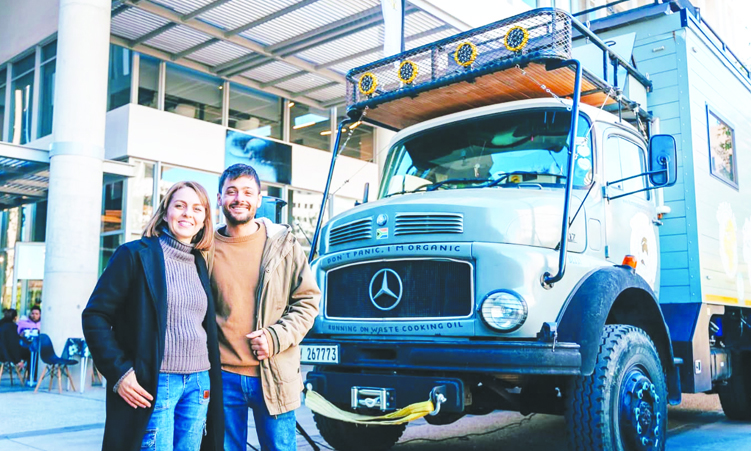
Together with his partner Jolandie, Lewis now travels the continent in a 1517 Mercedes-Benz truck named Betsy, spreading education and hope through their project Matches on the Map.
What makes their mobile home and clinic especially unique is that Betsy runs on used cooking oil.
“We simply couldn’t afford diesel. So we found a family that had gone around Africa on cooking oil, learned the method, and modified our truck accordingly,” Lewis says.
The truck uses two tanks, one for diesel to start the engine, and one for used oil, which gets heated up before powering the vehicle. They collect oil from local restaurants and fast-food outlets along the way.
Numinous Expeditions is about helping people with blood cancer find matching stem cell donors.
After Lewis’s life was saved by a rare match from a complete stranger, he made it his mission to make more matches possible, especially for people of colour who are underrepresented on global donor lists.
With support from the Cancer Association of Namibia and the South African Bone Marrow Registry, Lewis and Jolandie have hosted over 65 donor drives across southern Africa. In Namibia alone, over 650 people have registered as potential donors, with the aim of reaching 1 000 before moving on.
Many patients with blood cancer or bone marrow failure can only survive with a stem cell transplant, but only three in 10 patients find a match in their own families.
The rest rely on public registries. And for patients of African descent, the odds are even tougher.
“A white patient has about a one in 100 000 chance of finding a match,” says Lewis. “But for people of colour, it’s closer to one in 400 000. That’s why diversity matters.”
One can join the registry by filling in a form and providing two cheek swabs and should they be a match, travel and donation costs are covered.
“Today it’s a simple blood donation process, and after three years, you even have the chance to meet the person you helped save,” Lewis says.
Namibia has become one of the most welcoming stops on their journey so far.
One of the most powerful moments came in East London, South Africa, when a young man named Bradley Peters was matched with an international patient – the first confirmed ‘match on the map’ for the project. Peters’s donation gave someone a second chance at life.
Numinous Expeditions has covered nearly 17 000 kilometres, and the reception has been overwhelmingly positive.
“People love the idea. They’re fascinated that the truck runs on oil, and they’re usually happy to help,” he says.
In an age of information overload, Sunrise is The Namibian’s morning briefing, delivered at 6h00 from Monday to Friday. It offers a curated rundown of the most important stories from the past 24 hours – occasionally with a light, witty touch. It’s an essential way to stay informed. Subscribe and join our newsletter community.

The Namibian uses AI tools to assist with improved quality, accuracy and efficiency, while maintaining editorial oversight and journalistic integrity.
Stay informed with The Namibian – your source for credible journalism. Get in-depth reporting and opinions for
only N$85 a month. Invest in journalism, invest in democracy –
Subscribe Now!