






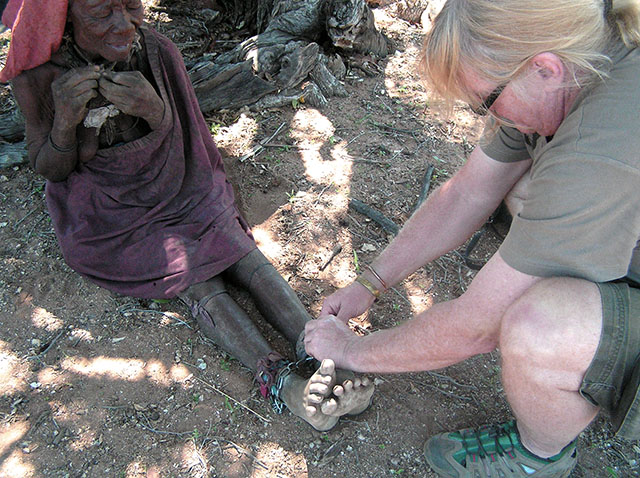
FOR 20 years, Ndjiina Ngombe from Omuramba village in the Kunene region was shackled and isolated in a hut because her family believed that she was a witch, and that she was possessed by evil spirits.
It, however, later turned out that Ngombe was suffering from dementia when Berrie Holtzhausen, the founder of Alzheimer’s Dementia Namibia (ADN) found and freed her in 2012.
Holtzhausen told on Friday that Ngombe’s family misunderstood her behaviour, and concluded that she would bewitch others.
He said the witchcraft suppression law must be respected by every citizen, and should be used by the courts to stop the killing of innocent people, and to send a message that witchcraft, as accepted in the name of culture, is unacceptable.
The Witchcraft Suppression Proclamation 27 of 1933 states that a person shall be guilty of an offence and liable on conviction to imprisonment with or without hard labour for a period not exceeding five years, or to a fine, or to any two or more punishments if they indicate that someone is a witch.
In addition, if a person accuses someone of using non-natural means in causing any disease in any person or property, or in causing injury to any person or property, or names or indicates another as a wizard or a witch, they shall be prosecuted.
However, the law, little-known to Namibians, has had no recorded convictions since independence, although it is still in force.
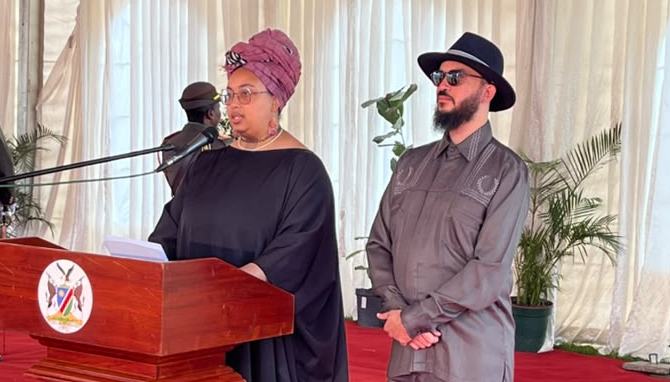
The chairperson of the Law Reform and Development Commission (LRDC), Yvonne Dausab, told last week that the law is outdated, discriminatory and accusatory.
Dausab said protection is necessary to prevent the dire consequences which result from the practice of witchcraft.
“However, the current proclamation is outdated, discriminatory and accusatory. A consolidated and contemporary law must be developed that balances individual rights of freedom of persons with the harm associated with witchcraft,” she stated.
She said whether witchcraft legislation should simply be repealed or redesigned is a matter up for debate.
Dausab added that the detrimental consequence of the law is that the legislation does not distinguish between magic (diviners, herbalists, and traditional healers in general), and those believed to practise so-called black or evil magic, whom Europeans labelled witches.
The definition of a witch or witchcraft is not catered for in the witchcraft proclamation, nor is it defined in any other legislation, including the Labour Act 11 of 2007.
“Thus, it became a criminal offence for African people to use their traditional conventional means to seek explanations for misfortune, illness or death,” she continued.
Dausab said an attempt to define the term would likely be discriminatory, as seen in the case of the Mpumalanga witchcraft suppression bill, which was never passed in South Africa.
“It suggests that there cannot be a definition of witchcraft, as it has different meanings for different communities. The term witchcraft means different things to different people,” she reiterated.
She said although this may be true, a distinction between harmful practices and non-harmful practices is essential.
Dausab further said that although it has not been used since independence, courts have nonetheless mentioned that the genuine belief in witchcraft as a motive may be used as a mitigating factor in cases where such person commits murder or culpable homicide.
Human rights lawyer Norman Tjombe yesterday said that law prohibits the practice of witchcraft, or for someone to be accused of being a witch.
“In that way, the law is a positive law. However, that law is now outdated, and is not responsive to the current circumstances. It’s a matter that the Law Reform Commission and parliament must address,” he observed.
Last year, the High Court at Oshakati dealt with a case where traffic officer David Kashululu sued a teacher, Joolokeni Peneyambeko Nakale, over witchcraft claims.
Kashululu took Nakale to court in 2013 after the teacher allegedly called him a witch when they had a scuffle over a traffic offence.
The court did not apply the Witchcraft Act, but defamation, which is the wrongful and intentional uttering or publication of a false statement about another person to tarnish their good name.
Kashululu said because of the witchcraft claims, his name had been withdrawn from the job promotion consideration list.
He further claimed damages for the loss of promotion, and proved on a balance of probabilities that he was defamed.
However, he failed to prove that he was going to pass the interview which would have led to his promotion.
Last year, reported that justice minister Sacky Shanghala had tabled a bill in the National Assembly to scrap about 144 discriminatory and outdated laws.
The bill stated that the laws to be removed were outdated, and had been overtaken by more relevant legislation.
Among the obsolete statutes is the Vagrancy Proclamation of 1920, the Native Reserves Fencing Proclamation, the Industrial Development Act of 1940, and the Fugitive Offenders and Neighbouring Territories Evidence Proclamation of 1920.