


THIS article is in response to an SMS in The Namibian recently complaining about deforestation between Okahandja and Otjiwarongo because all the trees are being burned to produce charcoal.
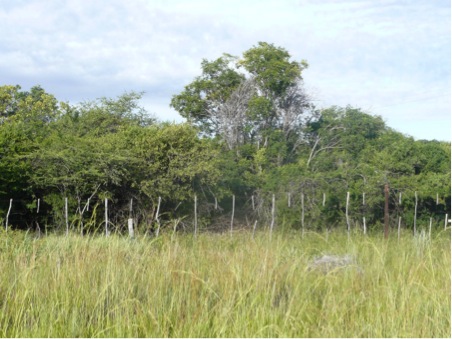
The vegetation along the B1 road from Okahandja to Otjiwarongo is not a natural forest.
Even though the canopies of the “trees” touch, which is a defining characteristic of forests, the woody plants here are not trees, but bushes. Bushes are multi-stemmed woody plants that seldom exceed 10 metres in height.
By contrast, trees are single-stemmed woody plants that may reach great heights. It is thus not a forest that is chopped down and converted into charcoal, but a bush-encroached savanna rangeland being opened up, presumably to repair its grazing capacity.
In contrast to forests, the woody plants in a healthy savanna do not form a continuous layer. They do not grow close to each other but rather far apart. Their canopies do not touch. A healthy savanna is an open rangeland where one can see the landscape for miles. One can see the horizon.
Every savanna has a few dense patches though, usually wet hollows or patches of high soil fertility, where bushes grow in clumps with canopies that touch, very much like in a forest. This is the exception in a healthy savanna and not the norm.
The plant form that dominates in a healthy savanna is the grasses, especially perennial grasses that compete fiercely with bushes. Some perennial grass species are assumed to be hundreds of years old; just as old as trees in a forest and can outlive savanna bushes. Healthy grasses attract regular fires that help to restrain the bush.
The dominance of grasses in a healthy savanna makes it possible for huge herds of grass-eating wild animals to live here. You have probably seen movies and TV programmes on the millions of zebra and wildebeest in the East African Serengeti. This is typical of a healthy African savanna.
Because our Namibian savannas are more arid and less fertile, they do not produce quite as much grass and our herds of grazing wild animals are thus considerably smaller.
Man exploited productive savannas for his own ends since time immemorial. Instead of hunting the great diversity of wild animals, he replaced them with a few species of domesticated livestock.
Farming man can keep huge herds of livestock on savanna rangelands thanks to the dominance of the grass layer. But if we do not manage savannas correctly, we harm their health and their productivity declines.
In the most extreme case, savanna degradation results in desertification, as happens in the northern Kunene region, which I have written about a lot. Fortunately, most of Namibia is affected only by less severe degradation of its savannas, resulting in the type of dense, forest-like savanna that we see along the B1 road from Okahandja to Otjiwarongo. This type of degradation is called bush encroachment.
What happens when man fights natural fires and does not manage livestock grazing well is that the grasses get hammered by the over-dominance of grazing livestock, primarily cattle, but also sheep, donkeys and horses. Grazing livestock is always present. The grasses are always eaten and hardly get a chance to recover their strength after having been grazed down. So they become weaker and weaker and eventually die out. As the grasses become weaker, the few bushes are released from competition and can grow out bigger and become more.
With bush encroachment, bushes become denser and taller, limited only by rainfall and soil fertility. The more it rains and the more fertile the soil, the worse the bush encroachment. That is why bush encroachment near Grootfontein appears worse than near Okahandja where it is worse than near Mariental, but all three places actually suffer severe bush encroachment. Farmers here cannot keep as many livestock as before and become poorer.
Namibian farmers therefore try to counteract bush encroachment by chopping off offending bushes and convert their wood into something useful, like charcoal. They hope the grass layer will also be repaired in the process.
These are legitimate savanna management activities that do not equal de-forestation, which is illegitimate and should be avoided. In subsequent articles we will take a closer look at these activities.
In an age of information overload, Sunrise is The Namibian’s morning briefing, delivered at 6h00 from Monday to Friday. It offers a curated rundown of the most important stories from the past 24 hours – occasionally with a light, witty touch. It’s an essential way to stay informed. Subscribe and join our newsletter community.

The Namibian uses AI tools to assist with improved quality, accuracy and efficiency, while maintaining editorial oversight and journalistic integrity.
Stay informed with The Namibian – your source for credible journalism. Get in-depth reporting and opinions for
only N$85 a month. Invest in journalism, invest in democracy –
Subscribe Now!