



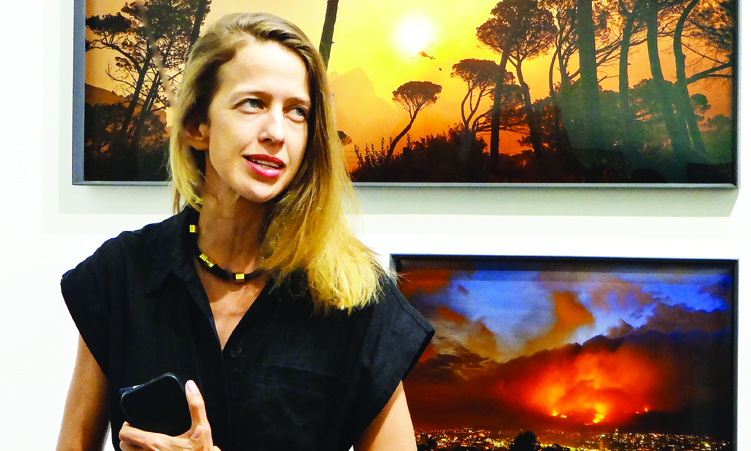
NAMIBIAN artist Nicola Brandt has a surname fitting of her recent Investec Cape Town Art Fair (ICTAF) presentation.
Introducing ‘Fire | Physical Energy’, a series of photographs documenting the 2021 Table Mountain fire juxtaposed with images of GF Watts’ bronze equestrian statues honouring the legacy of Cecil John Rhodes, Brandt faces a rapt audience at Guns & Rain’s booth B16 during a scheduled artist session.
Brandt’s arresting, apocalyptic photographs of the Table Mountain fire, a helicopter transporting water over Molteno Dam and of the fire’s aftermath, are a result of chance.
In April 2021, Brandt was photographing ‘Physical Energy’, a Watts statue at Rhodes Memorial, when the fire broke out.
“With my tripod and camera slung over my shoulder, I walked along the southern exit road flanking Groote Schuur Estate towards the campus of the University of Cape Town (UCT) on the morning of 18 April 2021,” says Brandt.
“I had discovered that the British imperial statue of a horse and rider exists in three different locations: London, Cape Town, and Harare.”
Photographs of these statues dominate one booth wall while images of the fire that spread rapidly through brushwood and old pine trees are the subject of another.
Brandt’s ‘Physical Energy’ series connects the scenes of the blaze, as well as the destructive and regenerative nature of fire to a larger conversation about polarising colonial era monuments, the Fallist movement, post-colonial memorials, archives and also to a parallel decolonial movement in Namibia.
Brandt links the historic to the contemporary while considering fire as it pertains to exploitative capitalism, extraction and climate change and also draws attention to what she terms “landscapes of ruination” through the pine trees that encircle Rhodes Memorial and the UCT, which intensified the blaze.
“One cannot overlook the irony. Pines were introduced into the region in the late 1700s. In the 1800s, Dutch settlers cultivated the pines on the lower slopes of Table Mountain chiefly for supplying firewood to the city, as well as scaffolding and structural timber,” says Brandt.
“Rhodes ordered another round of pine-tree planting on his estate in the 1890s. It is well known that he introduced several alien species to the Cape, some of which have become invasive, wreaking ecological havoc.”
Ultimately, the fire damaged considerable areas of the Rhodes Estate, as well as a number of buildings on UCT’s main campus.
“The Cape Town fire once again reveals the fragile nature of collections. The Jagger Library, which contained a collection of tens of thousands of historical archival documents and books – a resource of incalculable value – was severely damaged,”says Brandt.
Exploring “agendas of power” through the figure of Cecil John Rhodes and the exploitative systems established during his lifetime, Brandt’s artist statement concludes with a chilling observation of the enduring nature of colonial power, even under fire.
“On the day that the fire raged, it also engulfed the Rhodes Memorial complex, which somehow remained almost perfectly intact,” says Brandt. “Only a thin layer of blackened ash covered the surfaces of the monument.”
– martha@namibian.com.na ; Martha Mukaiwa on Twitter and Instagram; marthamukaiwa.com
In an age of information overload, Sunrise is The Namibian’s morning briefing, delivered at 6h00 from Monday to Friday. It offers a curated rundown of the most important stories from the past 24 hours – occasionally with a light, witty touch. It’s an essential way to stay informed. Subscribe and join our newsletter community.

The Namibian uses AI tools to assist with improved quality, accuracy and efficiency, while maintaining editorial oversight and journalistic integrity.
Stay informed with The Namibian – your source for credible journalism. Get in-depth reporting and opinions for
only N$85 a month. Invest in journalism, invest in democracy –
Subscribe Now!