



From above, one of the richest diamond mines in the world looks like a giant gray fingerprint smudged into the scrub-land of southern Botswana.
Up close, it is a gaping hole, 2414.02 metres long and nearly five football fields deep. It has helped transform this rural nation from one of Africa’s poorest countries at independence 60 years ago to one of its richest today.
Now the world’s second-largest producer of diamonds, the country is also globally lauded for bucking the infamous “resource curse,” in which countries with abundant natural resources tend to face greater economic instability.
Instead, Botswana has used its wealth to pull its population out of poverty.
But one of Africa’s great success stories is increasingly becoming a cautionary tale about the perils of overdependence on a single natural resource. After half a century of nearly unbroken economic growth in Botswana, United States (US) tariffs, the brisk rise of synthetic diamonds, and other transformations in the global diamond market are now threatening the country’s glittering rise.
DISRUPTIONS IN THE DIAMOND INDUSTRY
Botswana’s diamonds were forged billions of years ago by the heat and pressure of Earth’s mantle, then spit toward the surface by volcanic eruptions. And even here, in one of the most diamond-rich corners of the Earth, they are exceptionally rare.

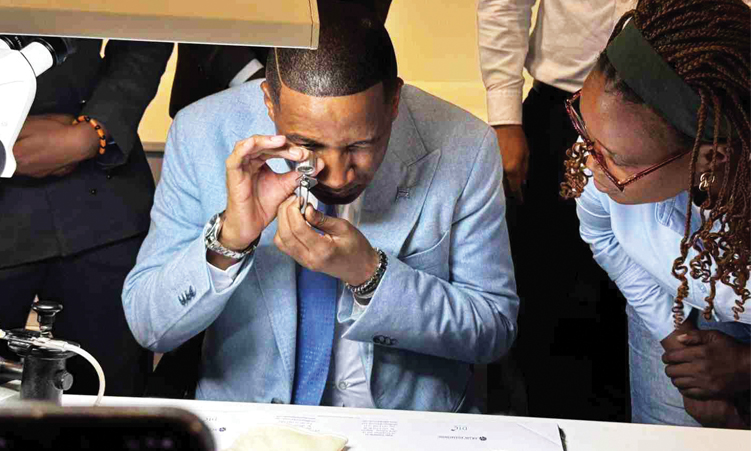
To put it in perspective, the two-storey-tall dump trucks that trundle up the flanks of Jwaneng Mine each carry about 250 tonnes of chewed-up black rock. Inside is perhaps one carat – about 200 milligrams or 0.007 ounces – of gem-grade diamonds.
Diamonds produced in laboratories, on the other hand, take only a few weeks to manufacture, and the potential supply is nearly limitless. They also cost about 10% the price of natural diamonds.
Today, synthetic diamonds – the majority of which come from China and India – account for about one-fifth of the global diamond market, up from 1% a decade ago. Industry analysts predict the synthetic market will grow another 300% by 2034.
Meanwhile, US tariffs – including on countries such as India, where 90% of the world’s diamonds are polished – have disrupted global diamond production, exacerbating the industry’s slump.
This spells bad news for countries such as Botswana, whose economy is, in many ways, a one-stop shop. Diamonds make up 80% of the country’s exports and contribute a quarter of its gross domestic product.
That money comes primarily from Debswana, whose ownership is split 50-50 between the government of Botswana and the South African mining giant De Beers.
Between 2023 and 2025, Debswana’s output in Botswana dropped 39%. Experts predict Botswana’s diamond revenue in the fiscal year ending this September will be less than half the historical average.

Cuts at Debswana, one of Botswana’s largest private employers, fan out beyond the diamond industry. The company also runs schools, major hospitals, and even game parks in the country. Dimpho Selebe worked for 17 years as a teacher in a mine-run school at Letlhakane, where he says his salary was double what teachers in the public school system earn. “I was there when Debswana was flourishing,” he recalls. He flourished, too, sending his children to good schools and buying himself a farm.
But as the mine cut its production, Selene saw the writing on the wall. Last year, when the company offered him a voluntary buyout, he decided to take it. Now, he is retraining to become a tour guide.
“I don’t want to remain idle,” he says.
Over the last two years, Debswana has offered similar buyouts across its mines, hoping to shed about 10% of its workforce.
Meanwhile, its losses – along with those faced by smaller private companies – are already having major consequences for Botswana’s bottom line. The country’s economy shrunk by 3% in 2024, and that recession continued in 2025.
A COUNTRY OF SMALL STONES
The effects of declining diamond sales are now clearly visible in towns such as Jwaneng, which sprung up beside the mine in the early 1980s.
The economy of Jwaneng – whose name means “place of small stones” in Tswana – orbits around the mine. In addition to mine workers themselves, many at the town make a living selling fruit, cellphone credit, or plates of chicken and salad outside its gates, or driving the grunting minibus taxis that ferry employees to and from work.
But Jwaneng has recently taken a series of knocks. In addition to losing employees to Debswana’s voluntary buyouts, sections of the mine closed for part of 2025 to cut costs as demand for diamonds declined.
– The Christian Science Monitor
In an age of information overload, Sunrise is The Namibian’s morning briefing, delivered at 6h00 from Monday to Friday. It offers a curated rundown of the most important stories from the past 24 hours – occasionally with a light, witty touch. It’s an essential way to stay informed. Subscribe and join our newsletter community.

The Namibian uses AI tools to assist with improved quality, accuracy and efficiency, while maintaining editorial oversight and journalistic integrity.
Stay informed with The Namibian – your source for credible journalism. Get in-depth reporting and opinions for
only N$85 a month. Invest in journalism, invest in democracy –
Subscribe Now!