


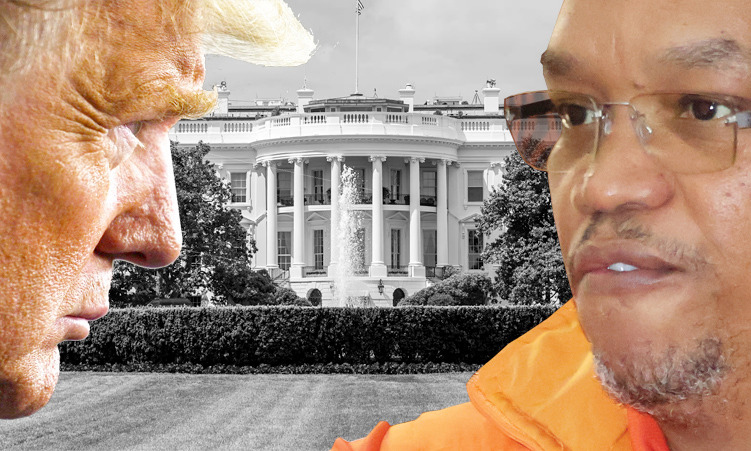
In late november last year, a newspaper headline read that Landless People’s Movement leader Bernadus Swartbooi would seek the independence of Namibia’s two southern provinces.
The party has of late dominated the Hardap and ||Kharas regions.
These regions have been the main sources of wealth in Namibia for over 100 years. Since Germany’s genocidal war against the Nama and Herero peoples, southern Namibia has been the source of the bulk of the nation’s export wealth.
From diamonds to lead and zinc, hake, beef and grapes – all have come from the country’s south.
The Nama people have long considered that whereas their ancestral land has been a source of wealth for the nation, they have not shared in that wealth because the land was in effect stolen by German and South African colonialists.
Resolving this issue is the basis of Swartbooi’s political agenda.
SPERRGEBIET: THE GREAT GERMAN FRAUD
The greatest source of Namibia’s wealth for over a century has been diamonds. Perhaps the most egregious loss by the Nama was the pre-colonial deal made by captain Josef Fredericks of Bethanie to sell large tracts of land to the Germans prior to the beginning of the actual colonial era.
In 1882, Bremen businessman Adolf Lüderitz decided to establish a base on the coast between the Orange River and Walvis Bay because he expected to find minerals in the interior. He received chancellor Otto von Bismarck’s blessing for his business venture, so long as he did not interfere with the rights of others, such as the British.
It is said that Von Bismarck himself was not interested in acquiring for Germany what he called a ‘Sandkiste’ (a sand box; a child’s plaything).
Von Bismarck, like everyone else, was unaware of the huge wealth that was to be found in the sands of the Namib Desert.
Heinrich Vogelsang, on instructions from Lüderitz, arrived at Angra Pequena in April 1883.
In May, Vogelsang set off on foot to Bethanie to meet Fredericks and he acquired the bay of Angra Pequena plus five miles of ground in all directions from the bay.
Payment was £100 and 200 rifles. Later the same year, Vogelsang returned and extended Lüderitz’s business area by purchasing from Fredericks (for £500 in gold and 60 guns) a 32km wide coastal strip from the Orange River up to the 26°S latitude.
Fredericks was probably unaware that a German mile was 7.4km and not 1.6km as in the British mile.
He had in effect sold a vast tract of land which would prove, in less than 30 years, to be one of the richest diamond areas in the world.
The transaction formed the geographic basis of what was to become the ‘Sperrgebiet’(forbidden area).
SHOOTING FROM THE HIP
Swartbooi has indicated that even an armed uprising was a distinct possibility and that he intended to write to his pretend friend Donald Trump for assistance for the people of the south from the United States.
To many of the political commentators in Windhoek all this sounded somewhat deranged, and, as one commentator put it, it was “vintage Swartbooi” who has a reputation of shooting from the hip.
But underlying the comments was a politics and an economics that needs much more understanding by the majority of Namibians.
Swartbooi’s immediate interest in making such outlandish statements was that he was facing a regional election and needed the votes.
Alas his pretend friend is much more successful at mobilising his base, and despite his efforts the LPM’s share of the vote in the south decreased.
This then raises the question of the country’s north-south divide. It is certainly ethnic and the sense of loss is felt with far greater intensity among the Nama and San peoples than many of the northern population.
The problem is that the concentration of Namibia’s resource wealth lies in the south and now with the discoveries of oil in the Orange River Basin the sense of historical grievance will only become worse as even more wealth accumulates in the hands of northern, largely Ovambo elites.
Ironically, however, it is in the off-shore of the ||Kharas region, and not the Hardap region, where the oil is found.
This will only serve to further muddy the waters of regional division in Namibia.
LESSONS FROM NIGERIA
In Nigeria, as in Namibia, the south of the country currently produces some 85% of Nigeria’s oil, which is its main source of wealth.
It is found in four states – Akwa Ibom, Delta, Rivers, and Bayelsa. This south-eastern region was the backbone of the Igbo uprising following Nigerian independence in 1960.
The subsequent catastrophic Biafran war saw somewhere between half to two million Igbos dying of starvation as the Nigerian government blocked all imports to the rebel Biafra, including food.
Following the war and several coups, the 1999 Nigerian constitution gave each of these oil-producing states a 13% derivation grant from the share of revenue generated from oil extracted on their territory and importantly as well as off-shore.
These are essentially Igbo states though there are many other ethnic minorities, such as the Ogoni, and these groups have been in conflict with Igbos.
Once Namibian oil production reaches 500 000 barrels a day in the 2030s, as the president Netumbo Nandi-Ndaitwah recently suggested, the potential for further regional division will grow.
To avoid the repetition of the stresses created by oil wealth in southern Nigeria, the decision in Namibia has be made to give a percentage of the oil revenue to the southern regions of Namibia for development projects similar to the Nigerian derivation fund.
What, however, must be recalled is that all the oil and gas that has thus far been discovered is not on-shore, it is located some 200km to 300km off-shore and quite rightly must be seen as the property of all Namibians and not just the Nama.
Sadly, though the same was true of Namibia’s rich hake fisheries which has been of great benefit to Namibia’s political elite, much less so to Namibian workers.
Once the oil revenues start to accrue to the Namibian fiscus at the end of the decade the possibility of rational debate about how to use and divide the funds in the Welwitschia Sovereign Wealth Fund will be overtaken by the greed of the political elite that oil booms invariably seem only to exacerbate.
It is vital that Namibia now define how the oil revenues that go into the fund can be used to resolve the nation’s inequality and poverty issues.
The Nigerian experience of mass slaughter during its oil-driven civil war should make Swartbooi reconsider his bellicose statements about an armed uprising in the south.
The prospects of mass slaughter in the south of Namibia during a civil war should induce greater moderation from leaders.
If not, then perhaps the hanging by the Nigerian military dictator Sani Abache in a sham trial of Ogoni dissident Ken Sarowiwa in 1999, for trying to protect his people from the environmental effects of oil in the Niger delta, should strike a more personal chord and induce greater reflection and moderation from Swartbooi.
The division and alienation of the people of southern Namibia can be resolved peacefully only if the resources from oil and gas are shared fairly – there is no need for leaders to engage in such violent rhetoric.
In an age of information overload, Sunrise is The Namibian’s morning briefing, delivered at 6h00 from Monday to Friday. It offers a curated rundown of the most important stories from the past 24 hours – occasionally with a light, witty touch. It’s an essential way to stay informed. Subscribe and join our newsletter community.

The Namibian uses AI tools to assist with improved quality, accuracy and efficiency, while maintaining editorial oversight and journalistic integrity.
Stay informed with The Namibian – your source for credible journalism. Get in-depth reporting and opinions for
only N$85 a month. Invest in journalism, invest in democracy –
Subscribe Now!