




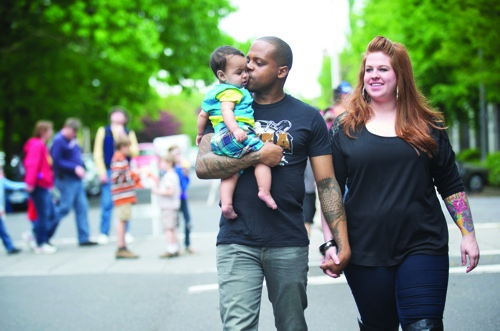
The idea of race doesn’t really occur to most children until early primary school when all little heads start to fill with 2D concepts of girls and boys, rich and poor, and black and white.
With every child born to parents of different ethnicities, Namibia grows in cultural diversity. With the mixing of cultures, mixing races, predominantly black and white, is inevitable.
While being multicultural in itself can be difficult, carrying the weight of racial stereotypes and animosity that still lingers in Namibia today can have a strong effect on many biracial children in the country and most probably, all over the world. With Namibia having gained independence only 24 years ago, racial hostility felt by interracial families is a topic still all too relevant. Many are not fully embraced by either side of their family, many constantly have the word ‘oshilumbu’ (white person in Oshiwambo) thrown at them by aunts and uncles and many notice a distinct difference in treatment based on how brown their skin is or how curly their hair is. The journey of a young, biracial child can be truly colourful and culturally vibrant, yet difficult. The YouthPaper spoke to some biracial youths on their experiences growing up, how their upbringing has shaped them and any difficulties they encountered and may still struggle with today.
Nameya Jacobs
Well, growing up mixed raced wasn’t an issue for me when I was younger. For instance, I was never exposed to severe racism or exclusion because of the colour of my skin, but as I’ve grown up, it’s become a lot more obvious in social status. People are constantly asking me whether I feel more black or more white, which is a con, considering I don’t feel a colour, and not being able to fully express both my heritages because the history behind both is so complex and quite difficult to understand and embrace. Another obvious con is growing up with a white mother who had no idea how to manage my curly hair, but that being said, I’d say there are more pros: being multi-cultural, having beautiful skin, having curly hair and being able to visit different countries because of where my parents are from.
Mutaleni and Nashikoto Ya Toivo
The colour of one’s skin does not determine who we are. No matter what your race is, we are all equal whether black, white or mixed. Growing up as a biracial child, you really do get “the best of both worlds”. You are exposed to two cultures as opposed to one and in most cases, you end up being bilingual. Never once have we consciously been discriminated against or been shown any animosity. However, at times, we have felt conflicted in having to choose between racial groups. At the end of the day, the decision has always been ours and we have ruled against having to make a decision altogether. We will not let anyone label or place us in a racial group for their own social gain. The colour of one’s skin does not matter to us and we feel privileged to have learnt that at an early age. It has definitely made us open-minded people, as we have been exposed to other cultures. It has made us better people in the sense that we try to not judge one’s character or personality based on the colour of their skin, and in doing so we have gained many friendships.
Ben Fuller
Growing up as a mixed raced child was a bit of a challenge because I am the only mixed race child in my family. Sometimes my Namibian family would look at me as someone different. When I was playing on the farm (since my dad is white), I would usually be the odd one out as well. I would say that my black family fears him. Because of this, they don’t treat me like they treat my cousins and they would often use me to get on my dad’s good side from time to time. But as I grow older, my family members have learnt that I won’t tolerate being treated differently. I still love my family even though I feel that they still don’t see me as one of them, but as just another white person.
Mwalengwa Amalie Hillebrecht
I never really thought about my race until I was in school and someone asked me if I was white when my dad came to pick me up from school. I didn’t know how to answer and then I really started noticing that everyone looked like their parents and could identify with a specific race or culture. I grew up speaking English because my mom did not speak German and my dad did not speak Oshiwambo. I never felt German because I didn’t grow up in a German-speaking environment and it was the same when it came to Oshiwambo.
My dad’s family considers my sister and I black while my mom’s family considers us white. Neither side embraced us. I could not even say I was coloured because culturally I was not. I only knew one other mixed family and we weren’t in frequent contact. I wanted to speak German and Oshiwambo so I could at least identify with both sides of the family. Today, I’ve accepted that I am not distinctly German or Oshiwambo.
I am not denying that I’m neither of them genetically, but culturally, I cannot identify with them, and it is okay. Culture is merely how you live your life.
Nameya van der Linden
Growing up having two cultures for me is amazing and I wouldn’t have it any other way. My DNA is a mixture of African and European. It feels like I’m living the best of both worlds by being mixed race. I get an intimate look at two cultures and two families, but it has not always been ideal for me. As I grew up, a lot was expected from me such as learning both my mother and father’s mother tongues. I found no purpose in it since I was never close to my dad’s side of the family, therefore I had no one to communicate to in his mother tongue. My mom’s side of the family all live in Europe, and so once again I saw no purpose.
Until this day, I always get stereotyped as either black or white. I’ve never appreciated it since I do not consider myself either, but both.
Being biracial makes me feel special and unique, despite the negativity. It has taught me so many different aspects of life and growing up, and I’m overjoyed to be a mixed baby.
In an age of information overload, Sunrise is The Namibian’s morning briefing, delivered at 6h00 from Monday to Friday. It offers a curated rundown of the most important stories from the past 24 hours – occasionally with a light, witty touch. It’s an essential way to stay informed. Subscribe and join our newsletter community.

The Namibian uses AI tools to assist with improved quality, accuracy and efficiency, while maintaining editorial oversight and journalistic integrity.
Stay informed with The Namibian – your source for credible journalism. Get in-depth reporting and opinions for
only N$85 a month. Invest in journalism, invest in democracy –
Subscribe Now!



