



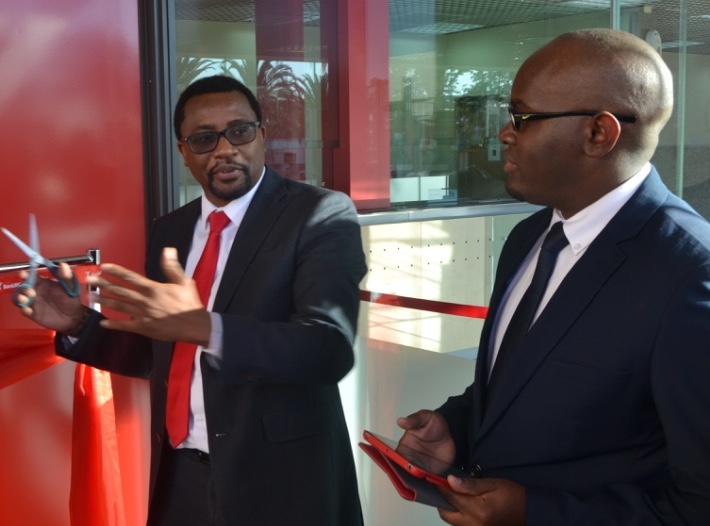
BANK BIC Namibia plans to open five more branches in Namibia within the next two years, chairman of the bank Fernando Teles said this week. The bank has its roots in Angola and also operates in Portugal, Cape Verde and South Africa.
Teles, who spoke during the official opening of the Bank BIC branch in Windhoek, disclosed that the bank plans to open a branch at the border (Oshikango) and Walvis Bay. In the next five years, the bank hopes to expand its branches in Namibia to 20.
The bank furthermore plans to connect the Angolan and Namibian economies through its services. Bank BIC is the biggest bank in Angola with 250 branches, according to Teles.
The bank has become the eighth deposit-taking banking institution in Namibia. Isabel dos Santos, the daughter of Angolan president José Eduardo dos Santos, is a major shareholder in Bank BIC Namibia.
Minister of finance Calle Schlettwein said in a speech read by his deputy Natangwe Ithete at the same function that the entry of new commercial banks onto the Namibian financial market landscape resonates well with the sector policy intention to inject greater participation and competition in the banking industry.
The 2015 Global Competitiveness Report ranked Namibia’s financial market development at 50th position among the 140 countries assessed globally, while the soundness of Namibian banks was rated in 33rd position.
“The entry of Bank BIC on the scene increases the number of deposit-taking commercial banks from the current seven to eight, and adds to healthy competition in the banking industry,” Schlettwein said.
Figures presented by the minister showed that the total banking industry assets were estimated at about N$99,9 billion by 2015, or some 67,6% of GDP. Profitability ratios point to a highly profitable industry, with the return on equity averaging 23,6% over the last four years.
“Bank BIC is entering this environment from a vantage point of demonstrated experience of serving market segments that are often underserved. It can improve the Namibian savings environment by increasing competition in the rates offered to savers and by creating more branch locations across the length and breadth of the country, while leveraging safe technological innovations,” he said.
Namibia has already seen a marked improvement in the use of banks’ financial products, from 45% in 2007 to 62% in 2011, chiefly driven by uptake among the rural population and individuals on very low incomes.
“However, the country’s competitiveness score shows that there is still room for improvement in the availability and affordability of financial services and ease of access to loans,” the minister said.
Schlettwein said in addition to compliance with regulatory requirements, Bank BIC is expected to embrace national development policies and meet its transformation targets.
He said Bank BIC should take advantage of opportunities that abound in the Namibian micro, small and medium enterprises (MSME) sector.
Under the Harambee Prosperity Plan, the government plans to increase the proportion of MSMEs with access to finance from 22% to 50% by 2020.
The Namibian and Angolan central banks have a currency conversion agreement between the Namibia dollar and the Angolan kwanza.
In an age of information overload, Sunrise is The Namibian’s morning briefing, delivered at 6h00 from Monday to Friday. It offers a curated rundown of the most important stories from the past 24 hours – occasionally with a light, witty touch. It’s an essential way to stay informed. Subscribe and join our newsletter community.

The Namibian uses AI tools to assist with improved quality, accuracy and efficiency, while maintaining editorial oversight and journalistic integrity.
Stay informed with The Namibian – your source for credible journalism. Get in-depth reporting and opinions for
only N$85 a month. Invest in journalism, invest in democracy –
Subscribe Now!