



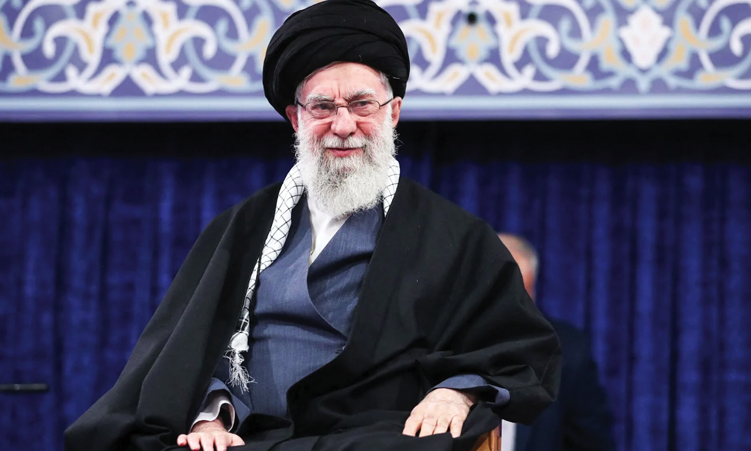
Iran’s supreme leader, Ayatollah Ali Khamenei, who was killed on Saturday in United States-Israeli air strikes, was a key figure in Iranian political life for more than 40 years, and the country’s political and religious figurehead since 1989.
During that time, he presided over a nation undergoing significant social and political change, and repositioning itself in the wider world.
Born into a clerical family on 19 April 1939, Khamenei undertook religious training at seminaries in the holy city of Mashhad, as well as Najaf in Iraq.
He returned to Iran and eventually settled in Qom, where he furthered his clerical studies under figures including Ayatollah Hossein Borujerdi and Ayatollah Ruhollah Khomeini, who was later to become the supreme leader.
During the 1960s and 1970s, he participated in covert activities against the Shah, Mohammad Reza Pahlavi, for which he was arrested and tortured multiple times by the Savak secret police.
In 1979, the Shah was overthrown after popular protests. Khomeini, who had been in exile since the mid-1960s, returned to Tehran from France amid jubilant crowds and widespread support.
How did Khamenei rise to power?
Khamenei quickly ascended through the ranks of the early revolutionary state, assuming key roles on the Islamic Revolutionary Council, as well as a lawmaker and deputy defence minister. He also led Friday prayers in Tehran.
Khamenei was one of the leading revolutionary figures targeted in assassination attempts in 1981, when a bomb hidden in a nearby tape recorder exploded as he was addressing a mosque. The attack was attributed to the anti-clerical opposition Forqan Group. Khamenei suffered serious injuries and was left paralysed in his right arm.
After president Mohammad Ali Raja’i and prime minister Mohammad Javad Bahonar were assassinated in August 1981 by the dissident Mujahedin-e Khalq (People’s Mojahedin Organisation of Iran), Khamenei ran for the presidency, winning 95% of the votes in an uncontested election.
He was publicly backed by the three other candidates, one of whom, Mir-Hossein Mousavi, was to become prime minister. Khamenei sought to cement the clerical establishment’s control of the key organs of power, often clashing with more left-leaning figures, including Mousavi.
Khamenei’s foreign policy focused initially on managing Iran’s eight-year conflict with Saddam Hussein’s Iraq, during which an estimated one million civilians and troops died on both sides.
In September 1987, Khamenei attacked the United States (US) presence in the region at the United Nations General Assembly in New York.
“Our message to Third World governments is that as long as the order of domination and the current situation exists, they should try to create unity among themselves: this is the best way to become powerful,” he said.
Khamenei becomes supreme leader
In 1989, the world changed with the end of the Cold War between the US and the Soviet Union.
Iran also began to witness significant changes. The death of Khomeini on 3 June 1989 was a crucial turning point for the country.
Khomeini’s long-time designated successor, Ayatollah Hossein-Ali Montazeri, had been sidelined and effectively defrocked by Khomeini only three months earlier due to his calls for more pluralism in politics.
Iran’s Assembly of Experts designated Khamenei as Iran’s new leader, a role which Khamenei himself initially argued he was not qualified to assume.
Khomeini’s theory of an Islamic government, on which the Islamic Republic’s political system was partly based, centred on the notion of the guardianship of the jurist, known as velayat-e faqih. It asserts the power of the clergy over the state, and means only the highest-ranking Shia clerical figure is deemed sufficiently qualified to be Iran’s supreme authority.
But Khamenei’s position in June 1989 was only that of a middle-ranking hojatoleslam. For some clerics, Khamenei was not sufficiently qualified in religious matters to hold the post. Khamenei himself asserted as much in his inaugural address, noting that he was but a “minor seminarian”.
Subsequent changes to the constitution stated that it was more important for the office holder to be “aware of the times”, and, therefore, politically minded, rather than derive their authority solely from certain religious qualifications. At the same time, the executive powers of the presidency were also enhanced.
Khamenei’s unconventional assumption of power eventually led to a form of dual leadership between himself and Ali Akbar Hashemi-Rafsanjani, president from 1989 to 1997.
During the early years of Khamenei’s rule, the two long-time protagonists in Iranian post-revolutionary politics initially acted in step with one another.
Challenges to Khamenei
Khamenei faced opposition, both from within the establishment and, perhaps more seriously, among the wider population.
The relationship between the presidency and supreme leader came under increasing strain during the 1990s, as the liberalising tendencies of Rafsanjani collided with Khamenei’s conservatism.
His relative pragmatism was especially tested with the rise of the liberal reformist movement in Iranian politics from the mid-1990s onwards.
This reached its zenith with the election of Mohammad Khatami as Iran’s fifth president in 1997. Khatami rode a wave of popular optimism and secured support from Iran’s rapidly growing young population and female voters.
Khamenei now adopted a more recognisably conservative outlook, often acting as a balance against the more liberally inclined Khatami. This approach also extended to curtailing reformist efforts to further open Iran to the West.
When Mahmoud Ahmadinejad became president in 2005, the assumption was that he and Khamenei would be in lockstep, due to Ahmadinejad’s popularity among Iranian conservatives.
Nowhere was this more apparent than following the disputed 2009 presidential elections, when Ahmadinejad controversially secured a second term with Khamenei’s support. The ayatollah’s authority was challenged by popular protests in support of defeated candidates, Mir-Hossein Mousavi and Mehdi Karroubi, and the rise of the Green Movement.
The demonstrations marked some of the most open displays of dissent against the Islamic Republic’s rulers since the early years of the revolution. Lesser demonstrations, against economic conditions, took place in 2017 and 2019.
In 2022, months of widespread protests took place after a young woman, Mahsa Amini (22), died from her injuries after being detained by the ‘morality police’ for allegedly wearing her headscarf “improperly”.
In October 2022, Khamenei argued that the protests were not about the death of Amini or the wearing of the hijab but the involvement of foreign governments.
“It is about Islamic Iran’s independence, resistance, strength and power,” he said. “That is what this is about.”
In late December 2025, a wave of protests prompted by dire economic conditions broke out across Iran, resulting in a deadly crackdown by security forces.
Khamenei acknowledged that thousands of people had been killed, but blamed US president Donald Trump for the unrest.
“We consider the US president criminal for the casualties, damages and slander he inflicted on the Iranian nation,” Khamenei said, according to state media.
Iran, the US and the nuclear deal
Iranian electoral politics swung back towards a more moderate outlook when Hassan Rouhani became president in 2013. Khamenei reasserted his authority against his president, but also gave his consent for Rouhani to pursue a more pragmatic foreign policy.
Much of this focused on the attempts of foreign powers to stall Iran’s nuclear ambitions, an especial cause of tension between Tehran and Washington, which had resulted in crippling economic sanctions against Iran for much of the past decade.
Khamenei initially allowed Rouhani and his negotiating team considerable power: as secretary of the Supreme National Security Council, he had led nuclear talks with key European Union powers between 2003 and 2005.
Discussions eventually came to fruition with the Joint Comprehensive Plan of Action in 2015. One year later, sanctions were lifted.
Khamenei cited the need to demonstrate “heroic flexibility” in the negotiations. At the same time, he imposed strict limits on Iranian concessions to world powers in the agreement.
Later, he accused the US of reneging on its commitments, saying: “The nuclear deal, as an experience, once again proved the pointlessness of negotiating with the Americans, their bad promises and the need not to trust America’s promises.”
Trump’s subsequent violation of the deal in 2018 was seen by Khamenei as proof that the US could not be trusted, and set the stage for a sharp downturn in Iran’s relations with the US and some of its key allies in the region.
The unravelling of Iran’s Axis
On the regional political front, one of Khamenei’s most consequential projects was the creation of the ‘Axis of Resistance’.
The alliance brought together Hezbollah in Lebanon, former Syrian president Bashar al-Assad, Hamas in Palestine, the Houthis in Yemen and an array of allied armed groups in Iraq.
After years of regional ascendancy, however, the axis began to unravel following 7 October 2023, when Israel launched its war on Gaza, later expanding military operations to Lebanon, Syria and Iran.
In September 2024, Israel assassinated Khamenei’s close ally, Hezbollah’s leader Hassan Nasrallah, along with key commanders, significantly degrading the group’s leadership and fighting capability. Months later, Assad was overthrown by rebel forces in Syria, effectively severing Iran’s land corridor to Lebanon.
Israel capitalised on the axis’s weakened position to strike Iran directly. Over 12 days in mid-June 2025, Iran fought its first open war at home in more than four decades. – Middle East Eye
Editor’s note: This article contains material originally published in a profile by Edward Wastnidge in 2024.
In an age of information overload, Sunrise is The Namibian’s morning briefing, delivered at 6h00 from Monday to Friday. It offers a curated rundown of the most important stories from the past 24 hours – occasionally with a light, witty touch. It’s an essential way to stay informed. Subscribe and join our newsletter community.

The Namibian uses AI tools to assist with improved quality, accuracy and efficiency, while maintaining editorial oversight and journalistic integrity.
Stay informed with The Namibian – your source for credible journalism. Get in-depth reporting and opinions for
only N$85 a month. Invest in journalism, invest in democracy –
Subscribe Now!