In early April, a Cape Fur Seal rescued at Mossel Bay in South Africa had to be euthanised because of its poor condition.
The animal hospital caring for it asked that the seal be tested not only for rabies, but also for highly pathogenic avian influenza (HPAI).
Results received earlier this month confirmed that the seal was infected with bird flu. This is historic as it’s the first-ever recorded case of bird flu in a Cape Fur Seal.
Cape Fur Seals, which are endemic to Southern Africa, now face threats from two infectious diseases, rabies and avian influenza, in addition to many human-related threats.
Avian influenza is an airborne disease that can spread through infected birds, droppings, contaminated environments and airborne particles. Seals are most likely infected through direct contact with seabirds or contaminated water.
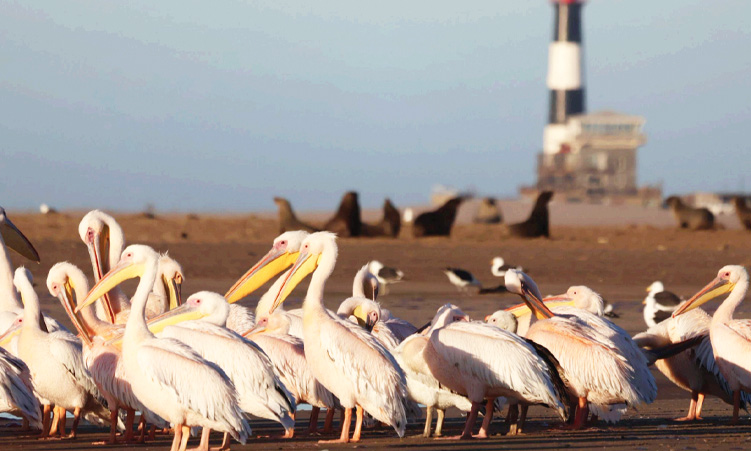
As seals and seabirds are often found resting or feeding together, and because seals occasionally hunt seabirds, the likelihood of transmission is considered quite high.
It was previously thought that avian flu could not be transmitted to Cape Fur Seals.
NAMIBIAN CONCERN
There is now serious concern that the virus could spread to Namibia’s seal populations, especially as seals and seabirds travel long distances up and down the coastline between Namibia and South Africa.
Many seals showing suspicious, and sometimes aggressive, behaviour have already been observed close to our Namibian colonies.
Because of the remote locations of Cape Fur Seal colonies, only some of these animals have ever been tested. When examined, it was usually only for rabies.
Namibia has already experienced outbreaks of bird flu.
The first one was detected in penguins in 2019 – more than 500 African Penguins were reported dead on Halifax and surrounding islands.
In 2022, Cape Cormorants were primarily affected. More than 6 500 birds died in
Namibia alone, threatening populations of an already endangered species.
Most recently, Common Terns were especially affected by bird flu last year.
SYMPTOMS
Signs to look out for in birds include unusual behaviour, seizures or twitching, head nodding, cloudy eyes, or birds that seem unusually tame.
The symptoms in seals are similar. They include severe lethargy, tremors, seizure-like activity, and breathing difficulties such as coughing or rapid, laboured breathing.
The virus is deadly for both seabirds and seals.
First detected in poultry in 1996, the virus mutated by 2020 and spread easily among wild birds. By 2022, it was known to spread from mammal to mammal.
In 2023, it caused mass deaths in Southern Elephant Seals in Argentina, killing more than 17 000 pups.
It also caused major losses in South Georgia in 2024, when nearly half of all breeding females were lost.
As of April this year, 36 Northern Elephant Seals, three California sea lions, and one southern sea otter were confirmed to be infected with avian flu in Californiain the United States.
It also the first time the disease has been detected in Northern Elephant Seals. The situation is concerning and is being closely monitored by authorities in California.
‘DON’T TOUCH’
Although not usually fatal to humans, people can still become infected and experience severe flu-like symptoms.
The public is therefore urged not to touch any animal and to keep a safe distance from any seabird or seal in distress along our coast.
Instead, please immediately notify Ocean Conservation Namibia (OCN) or the state veterinarian if you notice any suspicious behaviour or symptoms.
* Damian Schreiber, publicist, educator, seal rescuer and junior researcher at Ocean Conservation Namibia. He has a master’s in ecology and society from Costa Rica’s University for Peace.