


SENIOR politicians are often only known by their official face and voice.
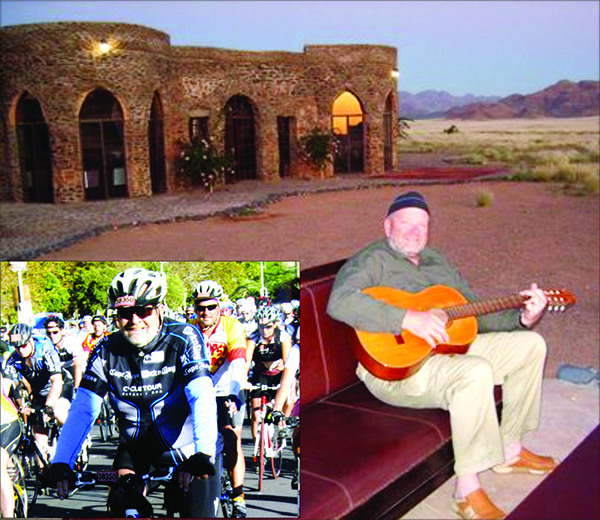
Anton von Wietersheim (AvW), a third-generation Namibian; farmer; businessman; government minister; and one of the key participants in Namibia’s independence – now senior RDP representative and member of parliament – also has a people’s face – cycling to and from his bookstore in Swakopmund on his bicycle or motorbike; attending casual events as a friend and fellow townsman; or just spending quality time with his family. Always friendly to the normal folk on the street, he continues to hope and strive for a wonderful government and future for Namibia. The Namibian (TN) wanted to know a little bit more about this people’s politician.
TN: Who are you in a nutshell?
AvW: I was born in 1951. A third generation Namibian. My grandfather was sent to the then German SWA as soldier, and later settled as farmer. My mother was born in this country. I grew up on my family’s farm near Kalkrand. I attended a boarding school in Windhoek; obtained a B.Agric.Admin at the University of Stellenbosch in 1975.
I returned to the family farm ‘Gras’, transforming it into one of the first and largest game farms in southern Namibia. I practised photo and hunting tourism, undertook individualised fly-in safaris, using my bush-plane, from Namibia into neighbouring countries. We established ‘Gras Primary School’ and Hostel in 1979 for about 80 farm workers’ children from all over the district. My own children also attended the school from 1985.
Social awareness and engagement – also in other fields – contributed significantly to my increasing political engagement and resulted in my close friendship with the late Hendrik Witbooi of Gibeon. I also undertook a familiarisation tour of the United Nations Institute for Namibia in Lusaka that was under Hage Geingob’s directorship in 1985.
I was a founding member of Namibia Peace Plan 435 chaired by Brian O’Linn, pro-actively promoting Namibian independence in terms of UN Resolution 435. I was part of a delegation of mainly white Namibians, who met the top Swapo leadership in Stockholm, Sweden, for consultations in June 1988; and was part of the pre-independence Swapo consultative conference in Kabwe, Zambia, in October 1988.
I participated in independence elections as Swapo candidate and was elected a member of the Constituent Assembly; became a member of the National Assembly after independence; and was appointed deputy minister of Trade and Industry (1991), then as Minister of Agriculture, Water & Rural Development (1992-1993). I was dismissed as minister by first President Sam Nujoma in November 1993 after challenging him in Cabinet about emerging corrupt practices enjoying his protection.
I left the public domain after the end of my term in the National Assembly (1995), and was branded ‘persona-non-grata’ after my fallout with Nujoma. All this strained our family relations and my first wife and I separated. I moved to the coast to take over Swakopmunder Buchhandlung (1998). I sold the farm in 2000, when our Constitution was changed to afford Nujoma a third term. Namibian soldiers were sent to the DRC, and illegal farm invasions started in Zimbabwe. I joined the newly-formed RDP in 2008, hoping for a ‘new dawn’.
TN: Did you want to become a politician? Why did you become a politician?
AvW: No, I never wanted to become a politician! Even when I became politically involved, I did not associate my engagement with a political career. As a kid, I had all kinds of ideas; becoming a lawyer appealed to me a lot. However, in a way, farming remained the ever present future goal.
TN: What was the favourite part of your career?
AvW: It was my hunting and flying activities. The bookshop made me realise a lifelong dream. In politics, it is the transition period from the implementation of UN Resolution 435 to the raising of the Namibian flag on Independence Day.
TN: What was the hardest part of your career?
AvW: The realisation during my time as minister that our vision and ideals were becoming secondary to a culture of entitlement, nepotism and all out corruption.
TN: Why did you join the RDP?
AvW: The RDP was the first true alternative party to commit to. It emerged from the liberation movement. It tried to revive the vision and ideals that induced my involvement in politics.
It separated from the ruling party like myself. I never considered joining another opposition party after 1995 because I did not want to continue in politics for the sake of being a politician. I wanted to engage for the sake of a cause I believed in.
TN: Will you ever become president?
AvW: The answer is too complex for a Yes or a No. The national spirit during the transition would have made virtually everything possible, but hard realities today would prevent me from even vying for the office of president.
TN: You are one of a few white – German – politicians in Namibia. How do you see racism, and the real or perceived hostilities against Germans?
AvW: Yes. German-speaking to be precise. Sadly, racism is blown up by some radical leaders, mainly from the ruling party, for their own purposes. I regard tribalism as more dangerous than racism. However, like in Zimbabwe, when the ruling party needs a scapegoat for failures, it pulls out the race card or the legacy of colonialism.The hostilities against Germans is a ploy for support in the upcoming elections from those affected by colonialism. It also serves as a scapegoat. I and many observers regard race relations in Namibia as exceptionally friendly, compared to some other African countries.
TN: Why did you become the owner of a book store? What’s your all-time favourite book and author? What’s your favourite newspaper?
AvW: I always was, and still am, an avid reader, and owning and running a book shop has increasingly, through my life, become a kind of a dream. So when the opportunity arose – in fact for a second time within a couple of years – I ‘grabbed’ it.
I have so many interests such that it is not easy to pick out an ‘all-time’ favourite. As far as authors are concerned, I can, with certainty, single out Antoine de Saint-Exupéry. He is a very unique combination of practical, highly skilled, down-to-earth person with a brilliant philosophical mind. My most favourite book is ‘Citadelle’. My favourite newspaper has always been and still is The Namibian.
TN: What is the craziest thing you have done in your life?
TN: What are your hobbies?
AvW: I love collecting paintings, historic books and Namibian minerals. I regard my motorcycling not only as a means of transport but very much as a hobby too.
TN: What is your opinion on the constitutional amendments?
In an age of information overload, Sunrise is The Namibian’s morning briefing, delivered at 6h00 from Monday to Friday. It offers a curated rundown of the most important stories from the past 24 hours – occasionally with a light, witty touch. It’s an essential way to stay informed. Subscribe and join our newsletter community.

The Namibian uses AI tools to assist with improved quality, accuracy and efficiency, while maintaining editorial oversight and journalistic integrity.
Stay informed with The Namibian – your source for credible journalism. Get in-depth reporting and opinions for
only N$85 a month. Invest in journalism, invest in democracy –
Subscribe Now!