



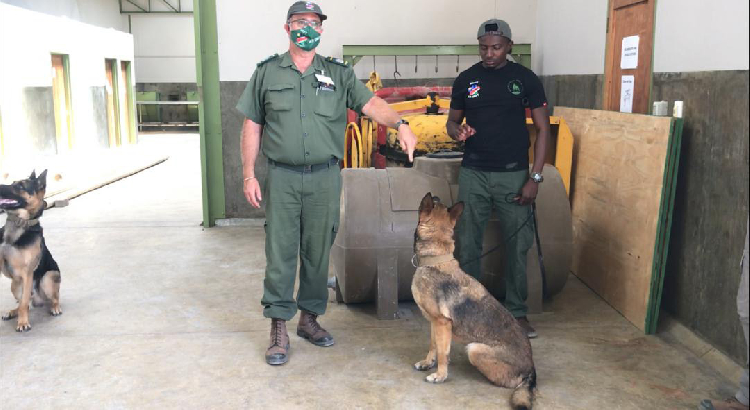
THE Ministry of Environment, Forestry and Tourism’s N$260 000 investment in a canine unit to aid anti-poaching efforts is bearing fruit as the dogs have made 66 finds since the unit became operational last year.
This is according to the ministry’s control warden for central parks, Manie le Roux, who is also the K-9 unit’s coordinator.
Le Roux recently gave environment minister Pohamba Shifeta and other stakeholders from the ministry an update during a visit to the dog unit’s new base and facilities at Okaukuejo in Etosha National Park.
The dogs were moved here in July.
Le Roux said any find made by the dogs is considered a success.
Many of the currently listed successes were the discovery of licensed firearms, although the dogs also found a number of unlicensed arms, which led to some arrests.
The ministry acquired the specially trained dogs for N$65 000 from Dutch company Invictus K9 in 2018.
“The dogs are not trained to bite, attack or chase poachers. They are not pets, they are working dogs,” Le Roux said.
They have a work life of up to 10 years.
Le Roux said the three German shepherds and one Malinois German shepherd cross-breed are trained to detect highly protected species, such as rhino, pangolin and elephant, as well as firearms, ammunition and other items.
They are also trained to detect hot tracks within the first five hours.
The ministry earlier this year announced they would acquire another four dogs for the canine unit, which would be deployed to the north-eastern regions of the country.
The dogs have not yet arrived due to travel restrictions imposed as a result of the ongoing coronavirus pandemic.
Discussing the expansion of the unit, Le Roux said there are plans to acquire horses to complement the canine unit.
The horses will assist in tracking and expanding the scope of work done by the dogs and their handlers.
“A dog and handler can be put on the horses to accommodate fatigue of dogs and handlers. Combine that with a helicopter, which the dogs are already trained to fly in so they are not frightened by the noise, to allow the teams to run ahead of time and thus be able to track fresh spoors,” Le Roux said.
Shifeta said the horses are a necessary addition to anti-poaching efforts, because of increasing incidents of poachers entering the northern boundary of Etosha National Park with horses.
Apart from the working dogs, the ministry has a specially trained dog named Azzaro for protected species detection.
Azzaro was the first dog to be acquired for this type of work in Namibia in 2016, and is deployed to entry gates of national parks, crime scenes and areas where protected species such as rhino and elephant are found dead of natural causes.
In an age of information overload, Sunrise is The Namibian’s morning briefing, delivered at 6h00 from Monday to Friday. It offers a curated rundown of the most important stories from the past 24 hours – occasionally with a light, witty touch. It’s an essential way to stay informed. Subscribe and join our newsletter community.

The Namibian uses AI tools to assist with improved quality, accuracy and efficiency, while maintaining editorial oversight and journalistic integrity.
Stay informed with The Namibian – your source for credible journalism. Get in-depth reporting and opinions for
only N$85 a month. Invest in journalism, invest in democracy –
Subscribe Now!