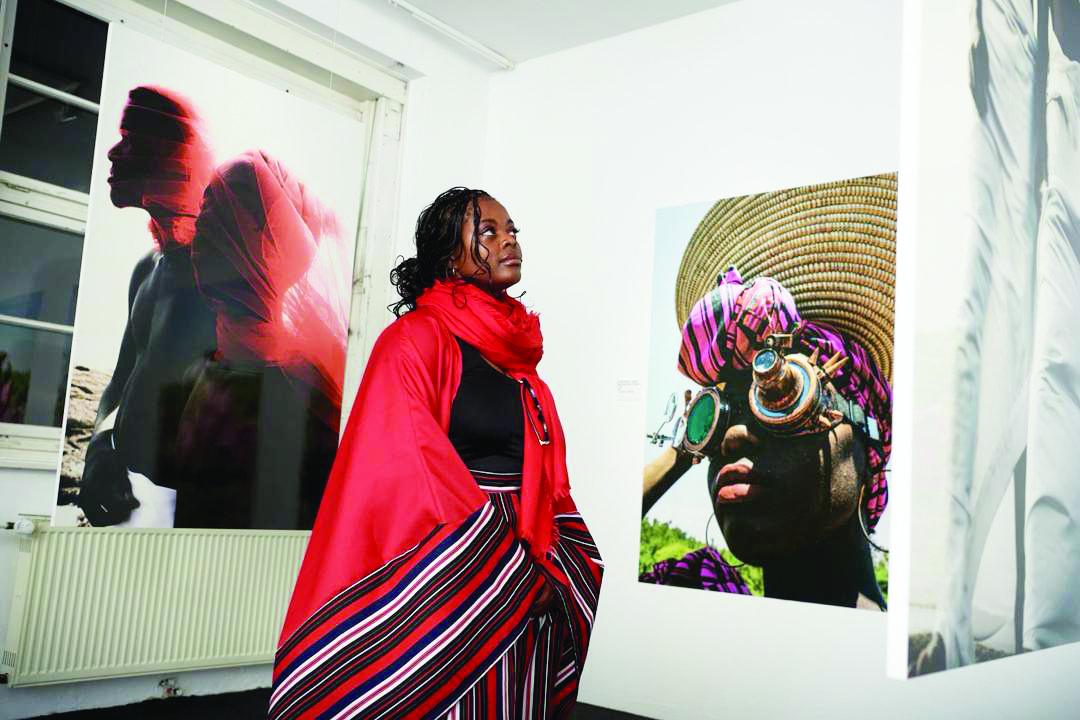
FUTURIST inner and outer worlds, reflections of black masculinity and visions of Aawambo culture are the thematic sparks that ignite photographer Namafu Amutse’s current showing at Offenes Kulturhaus (OK) Linz in Austria.
Exhibiting alongside Senegalese artist Mbaye Diop and Ugandan artist Olivia Mary Nantongo in ‘Wandala – drama. dream. decolonised!’, Amutse makes use of Namibia’s natural landscapes to reshape how black people are perceived, mythologised and remembered.
Delicate and disruptive in images set against the Atlantic ocean, Amutse underscores the bond she shares with her brothers while expanding the borders of black masculinity, brotherhood and contentment in ‘Chrysalis’. In ‘Afrofuturism Meets the Aawambo People’, natural settings and pink cultural attire are juxtaposed with ultramodern eyewear which anchor ideas of the future in the present while highlighting the evolutionary act of seeing.
“On a visual level, futurism enters my work through subtle, playful elements like sculptural glasses, masks and reflective surfaces. These objects reference imagined futures, functioning less as technology and more as symbols or tools that disrupt familiarity and invite the viewer into an alternative way of seeing,” says Amutse.
“Beyond aesthetics, the futurism I am interested in is deeply internal. My work engages the idea that meaningful futures require inner transformation, self-awareness, healing and reorientation,” she says.
“So, rather than projecting a technologically advanced Africa, I focus on the internal growth that must take place within individuals and communities in order for any future to be sustainable or liberated. In this sense, futurism becomes a psychological and spiritual space before it becomes a visual one.”
Though Amutse’s work considers the future as well as alternate, secreted or metaphorical landscapes, such speculation is conceptualised within existing places and spaces.
“I situate my work primarily within natural landscapes. Nature offers a sense of continuity and grounding, something stable to return to while imagining alternative futures,” says Amutse.
“These environments are deeply personal to me. They function as both literal and symbolic spaces: places of familiarity, memory and stillness against which speculative elements can exist without overwhelming the image,” she says.
“In contrast to dominant contemporary images of Africa and Namibia, which are often framed through narratives of limitation, crisis or development, the worlds I create resist urgency and spectacle. They are quiet, intentional and inward-looking.”
Amutse says by placing futuristic elements within familiar, unchanged landscapes, her work suggests that the future doesn’t require escaping the present, but rather a re-seeing of it.
“The feeling that stuck with me was watching people step into a world I created and sensing that they stepped out of it a little differently,” Amutse says.
Shining among a cohort of young and exciting Namibian photographers, Amutse’s practice is largely intuitive with the artist responding to what she recognises as “the call”.
“All I am certain of is that people move me to create. Black people move me to create. My siblings move me to create. Being able to build worlds around and within them is what keeps me going, and what keeps pulling me back to the camera,” says Amutse about inspiration.
“I always say that when we are long gone, the work will remain. Photography allows us to document what life looked like, what we cared about, what scared us and what we dreamt of.”
Amutse describes photography as both education and archive and encourages artists to document and share their realities.
“The same way we look back at earlier photographers and artists to understand their time, people will one day look at our work and ask: What were they thinking about in 2026? What mattered to them? What were they trying to say or disrupt?” she says.
“That is why I think contemporary Namibian photography is important, and why I am glad to see more people picking up their cameras.”
Follow Namafu Amutse at @namafu on Instagram to learn more about the artist.
– martha@namibian.com.na; Martha Mukaiwa on Twitter and Instagram; marthamukaiwa.com
In an age of information overload, Sunrise is The Namibian’s morning briefing, delivered at 6h00 from Monday to Friday. It offers a curated rundown of the most important stories from the past 24 hours – occasionally with a light, witty touch. It’s an essential way to stay informed. Subscribe and join our newsletter community.

The Namibian uses AI tools to assist with improved quality, accuracy and efficiency, while maintaining editorial oversight and journalistic integrity.
Stay informed with The Namibian – your source for credible journalism. Get in-depth reporting and opinions for
only N$85 a month. Invest in journalism, invest in democracy –
Subscribe Now!