








When I go home today, I can’t wait to get a warm cup of coffee, take a hot shower then snuggle up in front of the television watching Netflix.
I’m sure many readers might plan on doing something similar. Warmth, comfort and safety are practically synonymous with the feeling of home. For hundreds of thousands of Namibians living across the country, though, having a home of their own is largely unaffordable. A dream many are forced to defer.
While many middle income earners and first-time home buyers struggle with high property and rental costs, there is an even larger gap between them and those living in informal settlements.
Let’s remember the names of 15-year-old Willem Naub, who lives in Drimiopsis in a home without electricity making it difficult for him to study at night; Gerson and Tina Narib, Thiofillus Witbeen and Zelda Geingos – residents of an Okahandja dumpsite. Or Saima Thomas and Jason Shindenge who lost their lives when a flood swept their shack away in the Babylon informal settlement in Katutura.
These are all real names and stories, and while the government and land activists may argue every week in the newspapers over rent control and housing costs, there are affordable and realistic housing alternatives for people who currently live in shacks.
“I think it’s important to know where Namibia is from an economic perspective,” said Regardt Lourens, director of Fine and Country and Eumbo Lange – My Home.
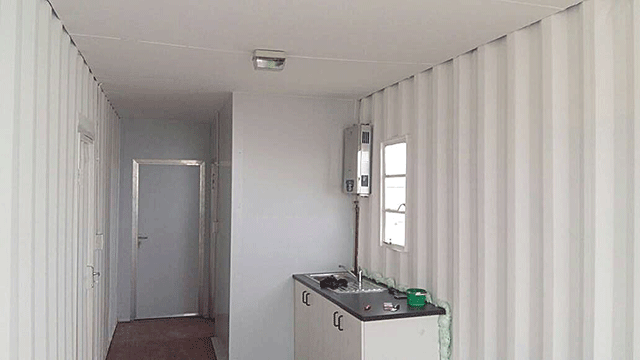
Eumbo Lange deals with customising shipping containers into homes or office spaces, an alternative for those who can’t afford brick homes, as well as an affordable option for informal settlement residents.
“We’ve had so much increase in home and building prices that our first-time home owners just aren’t in a position to buy,” Lourens said, adding that housing isn’t only a problem in Namibia, but in sub-Saharan Africa as well.
He mentioned the container houses were initially not meant as a solution for the first-time buyers, but to a market that cannot even afford a home.
While container homes are not a new concept and have been efficient in regions such as Europe and the Americas, the versatility they offer makes them an affordable option. Moreso, they are completely kitted out as a home with running water, hot water, kitchen facilities, a ceiling and electricity.
“It’s a fully functional home, and it takes us about two weeks to build.”
With millions of containers available worldwide, Eumbo Lange sources containers globally, and while there is a vast range of products available, their main focus is to provide affordable homes. These container homes range from N$100 000 to under N$200 000, while add-ons are also an option.
Lourens mentioned that this could be an opportunity to get into trading and make roughly 50% net balance. “People look past the potential of a container home and the conversion of it,” he said. Lourens also mentioned that a container home has a lifespan just short of a century. He added that with market research, they discovered that a large number of government employees make use of shacks as houses.
With a waiting list of over 600 people, Lourens said the market has been penetrated successfully, while the only drawback is the lack of backing from local financial institutions to fund these homes as normal brick houses. He added that while the houses do not have a payment scheme at the moment and require a once-off payment, they are working on a payment method to allow buyers to pay off their new home over a five-year period.
Another drawback is the land issue. Although the container home might be a solution to shacks, the distribution of land still acts as a barrier. “The delivery of land is one of our biggest headaches,” Lourens said mentioning that the process and partnerships in regard to this are not running efficiently.
The demand for land is stripping the supply, he said, but with quicker delivery of land, the scales will tip, and this is not only a problem for informal settlements, but for Namibia as a whole. “I think it is important we look at public-private partnerships all over different segments when it comes to our housing dilemma.”
Lourens said orders have been coming in countrywide, and that the product has gained popularity. “We do believe that these container homes can make a difference. It gives people the stepping stone to sell this home at a later stage and move up into buying one or two bedroom brick homes.”
He said container homes can even be expanded on a larger scale, pointing out that in Johannesburg, the largest South African city, an 11-storey student container home has been built in the Newton district.
Currently, the container homes are built and customised on site at Walvis Bay and take about two to three weeks for delivery.
FABlab Namibia is the first advanced manufacturing, prototyping and design lab in Namibia and the largest FABlab currently within Africa. Bjorn Wiedow, co-founder and deputy director of FABlab Namibia whose premises consist of three converted containers, advocates the functionality of this type of housing. He designed the structure of the building.
“It was a fast, easy and cost effective way of erecting a structure,” he said. “It’s a great building method. Although it gets very hot, the insulation is very good. I would recommend it in Namibia, especially for things like workshops,” he said.
In terms of crime, Wiedow says just like any other home, if criminals want to get in, they will find a way.
“It’s relatively safe. We have normal alarms installed, along with beams and CCTV.”
“A container is something you can play with,” says Lourens. “From businesses, to coffee shops, to book stores – it’s all containers. Imagine replacing shacks with container homes, we can set a standard in Africa that has never been seen.”
Lourens mentioned that the risk of shack fires is limited in container homes which are safer, more environmentally friendly and self regulating.
For more information on container homes, visit the Eumbo Lange Facebook and Twitter pages.