


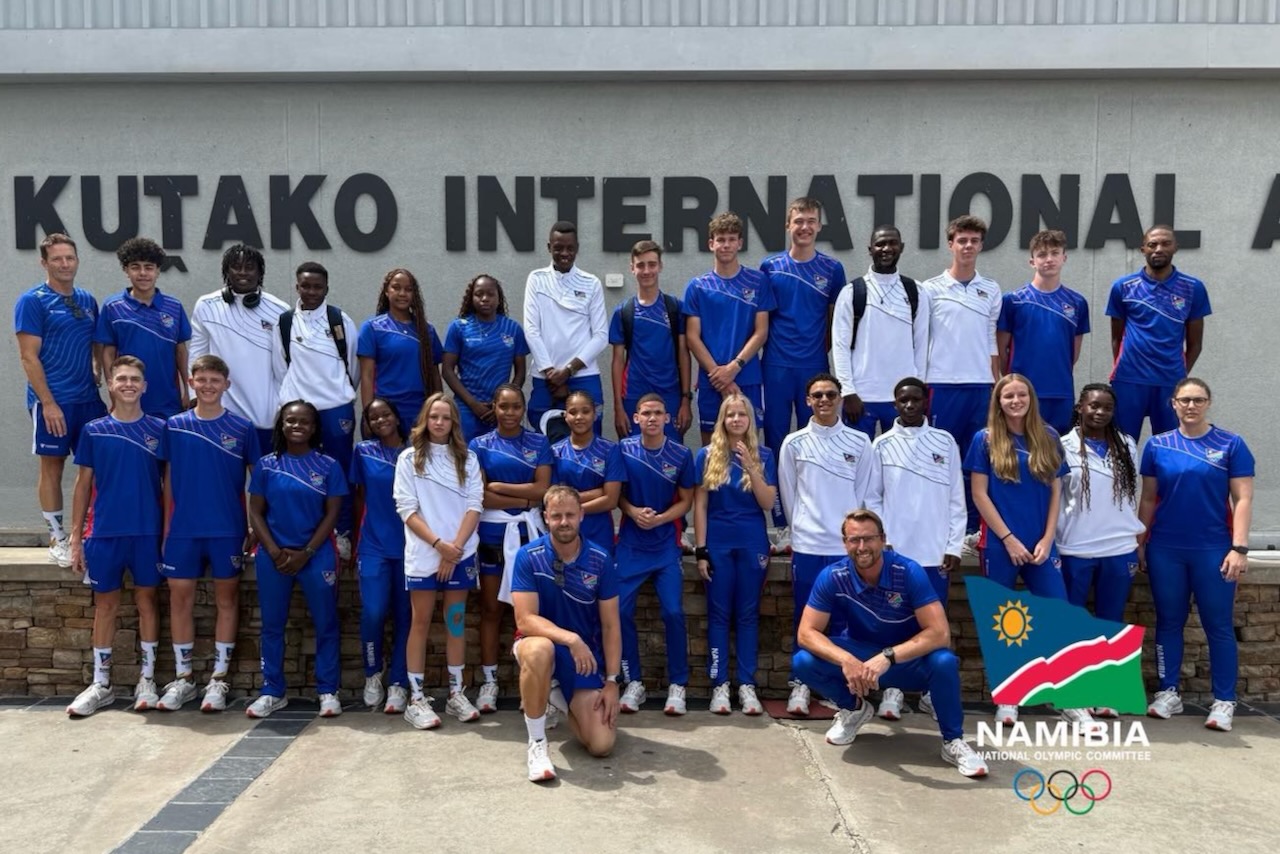
The fourth African Youth Games got underway in Angola yesterday with Namibia amongst more than 50 African nations that will be competing.
Close to 3 000 young athletes between 14 and 17 will be in action in 33 different sport codes at the quadrennial games, which will also serve as a qualifying event for the 2026 Youth Olympic Games, to be held in Africa for the first time in the Senegalese capital, Dakar.
The Africa Youth Games were established by the Association of National Olympic Committees of Africa (Anoca) to serve as a vital development platform and a bridge for young African athletes.
The idea was conceived by Lassana Palenfo, the president of Anoca in 2006, while the first edition of the games was held in Rabat, Morocco, in 2010.
Only three North African nations competed in the inaugural event, namely Tunisia (who were the overall winners), Egypt and Morocco.
Since then, though, the games have exploded with about 2 000 athletes from 51 African countries competing in the 2014 edition in Gaborone, Botswana.
That was also Namibia’s debut at the games, which saw them finishing 10th overall on the medal table with a total of 14 medals (four gold, five silver, five bronze).
Egypt were the overall winners (44 gold and 89 medals in total), followed by South Africa (41 gold, 93 in total) and Nigeria (19 gold, 41 in total).
Four years later, the games were held in the Algerian capital, Algiers, where more than 3 000 athletes representing all 54 African nations were in action.
Egypt were the overall winners with 103 gold and 204 medals in total, followed by Algeria (71 gold, 225 in total) and Tunisia (236 gold, 136 in total), while Namibia improved to ninth overall after winning eight gold, seven silver and 13 bronze medals for a total of 28.
The 2022 games were due to be held in Cairo, but were cancelled, although no reasons for the cancellation were publically announced.
The 2025 games will be held from 10 to 20 December in six Angolan cities, namely Luanda, Benguela, Bengo, Lubango, Huambo, Mocamedes and Caxito.
Originally a Namibian team of 32 athletes was selected to compete in nine sporting codes, but that number was reduced to 24 athletes in seven codes, after gymnastics and wrestling were late withdrawals.
According to Namibia Olympic Committee chief executive Anri Parker, logistical problems encountered by the local organising committee (LOC) led to their withdrawal.
“The local organising committee in Angola couldn’t get the facilities or equipment needed to host those events in time. It’s a huge disappointment because we invested a lot, we already paid for the flights and their kit, so that’s quite a loss,” she says.
Despite the setback, Parker says they are expecting some great performances by the Namibian team.
“I’m sure we will have some tremendous results because our youngsters have shown a lot of potential and most of them are in the top five in Africa in their respective events,” she says.
The Namibian team will now compete in seven codes and will be represented by the following athletes and officials:
Athletics: Lume Jansen van Rensburg, Alexandra Scheepers, Mihesco Fernando, Anro Bouwer, Lodewikus Viljoen, Madeleine Kotze (team manager), and Henk Botha (coach).
Aquatics: Madison Bergh, Victoria de Sousa, Roselinde Matyayi, Lorenzo Esterhuizen, Rodney Feris, and Jean Michael Leitner (coach).
Basketball: Winnie Mubita, Ondeya Neri, Twapewa Nakanyala, Jessica Damon, and Anna Iimene (coach).
Boxing: Elina Shilongo, Kalenga Abraham, Lungameni Ipundaka (coach), and Vilho Heita (assistant coach).
Cycling: Julius Braun, Mike Baartman, Theodor Janse van Vuuren, Gero Friederich, Hans du Toit (coach), and Jafet Amukushu (technical personnel).
Golf: Jan Pieter, Samuel Nel, and Frans Katjimune (coach).
Table tennis: Kamrouz Ghayouri, Lian Gebauer, and Promise Faleye (coach).
In an age of information overload, Sunrise is The Namibian’s morning briefing, delivered at 6h00 from Monday to Friday. It offers a curated rundown of the most important stories from the past 24 hours – occasionally with a light, witty touch. It’s an essential way to stay informed. Subscribe and join our newsletter community.

The Namibian uses AI tools to assist with improved quality, accuracy and efficiency, while maintaining editorial oversight and journalistic integrity.
Stay informed with The Namibian – your source for credible journalism. Get in-depth reporting and opinions for
only N$85 a month. Invest in journalism, invest in democracy –
Subscribe Now!