



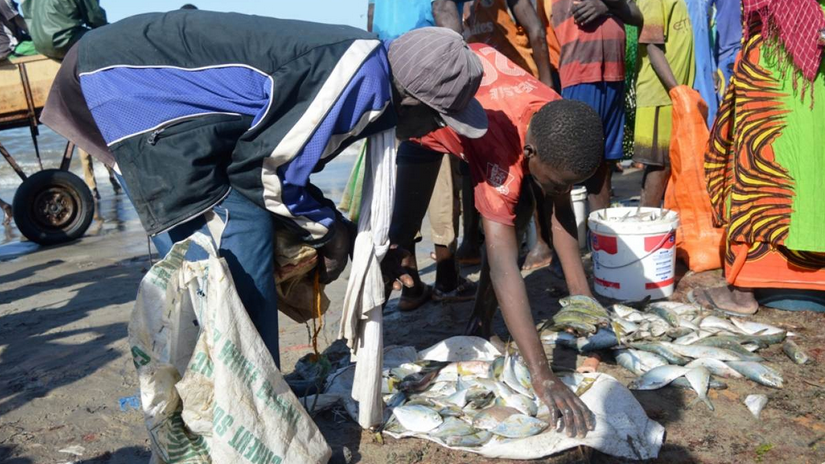
JOAL-FADIOUTH – Jostling for space and swatting the smoke away from her eyes, Mariama Ngom sighs as she and her teenage daughter fling fish onto a large grill in a chaotic fishing port in Senegal.
Like thousands of other women in Joal Fadiouth, she works full-time, salting and smoking small pelagic fish like mackerel, anchovies and sardines, to be sold across West Africa.
When she moved to the town, south of the capital Dakar, in 2010, Ngom could earn up to 10 000 CFA francs (U$$16) a day. Now, she is lucky to make 3 000 CFA (US$5), as catches have plummeted.
“I struggle to feed my six children a lot of the time – I take some of the fish I smoke home … we often have nothing else to eat,” Ngom told the Thomson Reuters Foundation.
Once among the richest in the world, West Africa’s fish stocks are being depleted by industrial trawlers, which comb the oceans to feed European and Asian markets, experts say.
In Senegal, dwindling stocks pose a threat to livelihoods and food security. Some 600 000 people, almost 20% of the workforce, work in fishing, and fish accounts for 75% of the country’s animal protein intake, World Bank data shows.
Many mothers like Ngom have taken their children out of school in recent years, and even brought them to work, as they can no longer afford to pay their fees, said Marianne Teneng Ndaye, head of Joal’s trade federation of women fish processors.
“The actions of foreign aquaculture factories and trawlers have drained us,” she said, adding that the women had protested and tried to meet with the factory owners, without success.
More than 400 foreign fishing vessels, mainly from China, Europe and Russia, navigate in West African waters, according to environmentalist group Greenpeace.
They include a couple of dozen mega trawlers which target small pelagic fish to make feed for salmon, chicken, pigs and other animals grown at aquaculture and livestock farms around the world, according to Dyhia Belhabib, a fisheries expert.
“In terms of numbers, the number of boats is tiny, but their impact is huge,” said Belhabib, an adviser for the University of British Columbia’s sea around us research project. Each mega trawler can capture up to 20 000 tonnes of fish a year – equal to the annual catch of more than 1 700 traditional Senegalese pirogues – she said.
Around a quarter of all fish caught in the world’s oceans each year are used to make fishmeal and fish oil, rather than as food for people, according to a recent study published in the journal ‘Fish and Fisheries’.
Part of it is used to feed a booming global aquaculture industry, which in 2014 harvested 74 million tonnes of fish worth an estimated U$$160 billion, said the UN Food and Agriculture Organisation (FAO). In Senegal alone, aquaculture production grew 71% to 2 082 tonnes last year, from 1 215 tonnes in 2015, government figures showed.
“Fish are being used to feed animals, yet we need fish to survive,” said Abdou Karim Sall, the head of a fishermen’s association in Joal, representing about 3 000 boats. Following pressure from local fishermen, in recent years, Senegal has stopped licensing the fishing of small pelagic fish to foreign industrial trawlers. But vessels continue to operate from neighbouring countries, like Mauritania, Belhabib said.
And trawlers of Asian, European and Western African origin often carry out illegal incursions into waters reserved for locals, or flaunt fishing regulations, experts say.
Illegal, unreported, and unregulated (IUU) fishing costs West African economies U$2,3 billion a year, according to a recent study published in the Frontiers in Marine Science journal.
To compete with foreign trawlers, Senegalese fishermen have started building more and bigger boats to venture further into the ocean, but catches continue to drop, said Sall. In 2016, fish catches in Joal dropped by 40% to 90 000 tonnes from 150 000 tonnes the previous year, and the tally is set to decrease even further this year, he said.
“We’ve increased the size of boats and nets, but we catch less fish,” Sall said, adding that fish prices at local markets had consequently gone up. –
In an age of information overload, Sunrise is The Namibian’s morning briefing, delivered at 6h00 from Monday to Friday. It offers a curated rundown of the most important stories from the past 24 hours – occasionally with a light, witty touch. It’s an essential way to stay informed. Subscribe and join our newsletter community.

The Namibian uses AI tools to assist with improved quality, accuracy and efficiency, while maintaining editorial oversight and journalistic integrity.
Stay informed with The Namibian – your source for credible journalism. Get in-depth reporting and opinions for
only N$85 a month. Invest in journalism, invest in democracy –
Subscribe Now!