




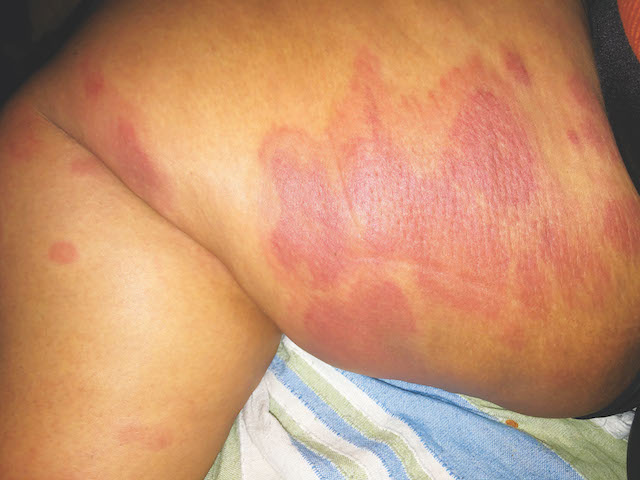
HIVES start off as red bumps looking like mosquito bites, but quickly spread across the body like wildfire.
It appears as swollen, red and itchy skin and shows up suddenly.
Oshakati-based general practitioner Dr Tauya Muteka describes urticaria, commonly called hives, as a vascular reaction of the skin marked by the transient appearance of smooth, slightly elevated patches exhibiting abnormal redness and severe itchiness.
“Individual lesions resolve without scarring within several hours. Most cases of urticaria are self-limited and of short duration. The eruption rarely lasts more than several days, but may be recurrent over weeks,” she says.
A lesion involves any damage or abnormal change in the tissue of an organism, usually caused by disease or trauma.
It can present at any age.
Muteka says there are five types of hives: ordinary urticaria, which is acute, chronic and episodic, physical urticaria, angioedema, contact urticaria and urticarial vasculitis.
Acute urticaria is described as a rash that clears completely within six weeks, whereas chronic urticaria, which is rarer, persists or comes and goes for more than six weeks over many years.
Causes vary from life-threatening anaphylaxis to underlying disease.
Ondangwa-based surgeon Dr Akutu Munyika says the allergic triggers for acute urticaria can range from medicine like beta-lactam antibiotics, sulfonamides, and aspirin to foods including milk, eggs, peanuts, sesame, soy, wheat, shellfish, and fish.
Munyika says food additives, infections, insect bites or stings as well as contactants and inhalants, including animal dander and latex, could also set off acute urticaria.
Chronic urticaria is caused by physical factors like cold, heat, and pressure.
He says urticaria is treatable, depending on the causes, with antihistamines like Benadryl and Atarax, which are short-acting, or longer-lasting Claritin and Reactine.
Corticosteroids, which are a form of steroids used to treat swelling and inflammation, as well as allergic asthma, can also be used, Muniyka says.
According to research, factors such as one’s menstrual cycle, location and severity of symptoms, associated symptoms, and potential environmental triggers should be considered.
Other important factors include medication and supplement use, travel history, a family history of urticaria and angioedema.
Both doctors say patients with chronic urticaria are at increased risk of certain cancers.
A study done by the National Health Insurance Research Database of Taiwan found that among 12 720 patients with chronic urticaria, 704 cancers were found.
Patients revealed long-term antihistamine use, but no history of malignant tumours, autoimmune or allergic diseases.
An increased risk of cancer, especially hematologic malignant tumours were observed.
The relative risk of cancer varied by age and was the highest among those aged 20 to 39 years.
Most cancer cases were detected within the first year of diagnosis.
Non-Hodgkin’s lymphoma is cancer that originates in your lymphatic system, the disease-fighting network spread throughout your body.
In another study 1 155 consecutive cases of chronic urticaria were reviewed.
According to the British Journal of Dermatology, a malignancy was diagnosed in 36 patients with urticaria.
In an age of information overload, Sunrise is The Namibian’s morning briefing, delivered at 6h00 from Monday to Friday. It offers a curated rundown of the most important stories from the past 24 hours – occasionally with a light, witty touch. It’s an essential way to stay informed. Subscribe and join our newsletter community.

The Namibian uses AI tools to assist with improved quality, accuracy and efficiency, while maintaining editorial oversight and journalistic integrity.
Stay informed with The Namibian – your source for credible journalism. Get in-depth reporting and opinions for
only N$85 a month. Invest in journalism, invest in democracy –
Subscribe Now!