


Theirs maybe the newest dance studio in town, but First Rain Dance Theatre (FRDT) is no stranger to the dance industry in Namibia.
Founded in 2010 by a group of professional dancers, FRDT has dazzled Namibian audiences with its seamless choreography and its most loved production, ‘Anima’, which still has all of us buzzing almost a year later.
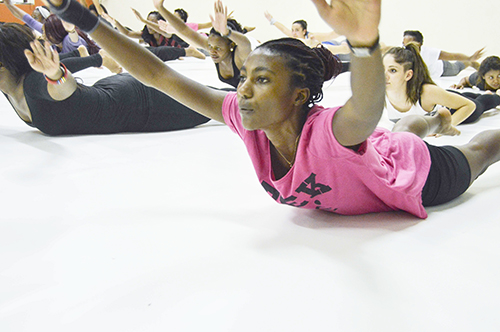
Last Thursday, Tulimelila Shityuwete and Haymich Olivier, the directors of the dance company, opened their doors to the public for the first time with their contemporary dance workshop for beginners.
With a lot changing in the arts industry, particularly with arts and culture being a new addition to the Ministry of Education, there has never been a more exciting time to be an artist and a dancer in Namibia than right now, and FRDT hopes to be at the epicentre of this change.
Like many of the arts, finding consistent funding and being able to create a self-sustaining business out of their craft is at the forefront of most practitioners’ minds. By opening a studio, FRDT hopes to create a hub for dance in the capital, which can hopefully employ full time dancers in the future, as well as create a holistic learning environment for beginners and dance enthusiasts.
The month long course will be the first of many courses and workshops that will be open to the public. The tailor-made course will include learning five different contemporary dance styles, as well as incorporating various forms of exercise like yoga and Pilates to condition the bodies of the dancers.
Offering lessons like these is what keeps the studio running financially as well as remaining an active part of the community.
Haymich explains that, historically, some of the first forms of dance that gave way to contemporary dancing like ballet were extremely exclusive, and only a lucky few, mostly from privileged backgrounds, were able to perform it, or even watch it in theatres.
This association of dance being exclusive is a barrier that FRDT hopes to break by creating an open space for dancing within their studio and taking some of its productions, like ‘Anima’ out of the studio and into fields and arenas across the country.
They consider performing for Namibian audiences a bigger priority than performing for international audiences at the moment, because they believe that enjoying world class contemporary dance performances should be something that all Namibians can experience.
Dancing is an important part of Namibia’s contemporary and traditional culture, which permeates every aspect of our lives, from dancing in clubs, celebratory dances when our favourite teams score a goal, or even in our indigenous cultural roots. We have a dance for every occasion, be it a wedding, healing ritual or a coming of age ceremony, and these dances have been at the heart of our African heritage and history for millennia. In most cases, dance was just a natural part of society and wasn’t formally introduced in an educational institution, but was instead passed on from generation to generation as a different avenue to express and communicate our different experiences.
It could be that having dance as such an intrinsic part of our culture makes it difficult for many of us to understand how dance is a very specialised industry of its own, and not just something that we see on television in music videos, or at our social gatherings.
Which is why FRDT welcomes arts and culture as new additions to the Ministry of Education.
“I’m generally excited that the arts and education are now under one ministry. It is important to promote the idea of professional artistry and alternative career paths for the youth, and it’s such a big deal for the arts to be recognised. I’m hoping that consideration is taken to develop the industry, not only through performances, but also in educating artists on how to market themselves and their businesses,” said Haymich.
And although making a sustainable art industry is important, it doesn’t compare to the educational benefits and effects that the arts and particularly dance have on the youth.
Tuli reiterated the benefits of dance with development.
“It plays a huge role in development, both emotionally, mentally and physically. To be a dancer, you need several different types of intelligence, you need spatial, aural, and physical intelligence. You need to engage your prefrontal cortex, you process a lot of information. You are using so many different parts of your body. There is a saying that you have to be an Olympic athlete and a world-class artist to be a dancer.
“People get stuck in the school system with this very narrow perception of what makes you clever and there are so many avenues that are not explored,” she says.
Dance and the arts are some of them. A lot of our education has emphasised the importance of traditional academic learning, which leaves little space for those who don’t fit into those categories to thrive and excel in something that they are truly passionate about.
On top of wanting to teach dance lessons to those who are curious about learning it, FRDT also wants to change our attitude with regards to how we view dance, and the arts specifically.
Namibia still has a very rigid and limited idea of how we see dance, and dance companies like FRDT are working hard to change that. Tuli admits that a narrative has been created that the life of a dancer is one full of glitz and glamour but fails to mention how much hard work, dedication and interchangeable skills like working with people and being business savvy in order to survive go along with it.
“Helping our clients understand that when they hire us for a five minute performance, what they are actually paying for is hours spent researching the dance routine, then transferring and teaching it to the dancer. The time spent during rehearsals, the costumes, our years of training as dancers, Haymich and I have a Bachelor and a Honours degree and over 20 years of experience between the two of us, that is what you are paying for,” says Tuli.
Along with training 11 new trainee dancers, preparing for the NTN’s dance month in July, and an ‘Anima’ film in the works, FRDT has a lot of exciting things on the horizon, along with their aim to change our relationship and understanding of dance in Namibia, one step at a time.
In an age of information overload, Sunrise is The Namibian’s morning briefing, delivered at 6h00 from Monday to Friday. It offers a curated rundown of the most important stories from the past 24 hours – occasionally with a light, witty touch. It’s an essential way to stay informed. Subscribe and join our newsletter community.

The Namibian uses AI tools to assist with improved quality, accuracy and efficiency, while maintaining editorial oversight and journalistic integrity.
Stay informed with The Namibian – your source for credible journalism. Get in-depth reporting and opinions for
only N$85 a month. Invest in journalism, invest in democracy –
Subscribe Now!