


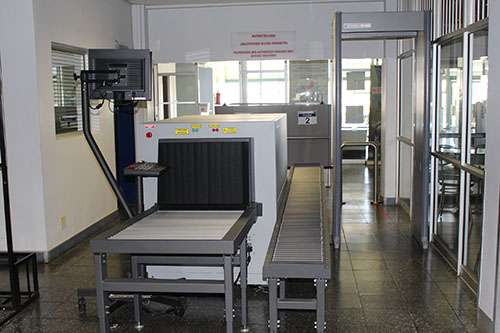
SCANNERS installed at all Namibian airports cannot detect any metal objects that are less than 300g as per aviation requirements.
About 20 scanners costing N$48 million have been installed at Eros, Hosea Kutako, Walvis Bay and Ondangwa airport checkpoints in the past four months.
The explosives detective system (EDS) enables airport authorities to guard against passengers boarding planes or landing with explosives and any dangerous objects.
The company, IBB Military Services and Accessories Supplies which supplied the scanners, confirmed on Monday that their scanners cannot detect metal that is less than 300g.
According to IBB director Muhamed Omar, the problem was that the Namibia Airports Company (NAC) did not give specifications when they advertised the tender.
IBB Military Services and Accessories Suppliers is an agent of a United States company, Astrophysics.
Omar also said the international standard requirements are that scanners should detect 500g of explosives, saying the Directorate of Civil Aviation (DCA) in the Ministry of Works and Transport had applauded them for providing the scanners that cannot detect less than 300g.
He denied that failure to detect less than 300g of metal is risky and accused those providing information to The Namibian of trying to sabotage their tender, maybe because they lost out.
“They are trying to find mistakes because as from next year, all government institutions including prisons and police as well as banks should have these scanners,” he said adding that their supply might increase when the new ICAO law comes into effect.
“It was tested in America by a team from NAC and it is according to specifications. If the machine does not comply, you have the right to reject it,” he said, adding that NAC took seven months to find a suitable supplier.
The Namibian reported last year that airports are likely going to install scanners that cannot detect dangerous metal objects and explosives.
A reliable source told the paper that the scanners can only detect objects weighing more than 300g and cannot detect objects weighing 299g or less.
Findings of the weight the scanners can detect are said to have been confirmed by the Namibian Police Explosives Unit.
The police have also been carrying out the inspections of the airports since last year when officers were sent to America for training to operate the scanners.
Police spokesperson deputy commissioner Edwin Kanguatjivi yesterday declined to comment on the matter and referred The Namibian to NAC.
The NAC spokesperson spokesperson Dan Kamati said: “NAC will not be in a position to answer your questions as they all relate to state security and information thereof is highly classified.”
Last year, NAC chief executive officer Tamer El-Kallawi admitted to The Namibian when the story first broke that the IBB system did not have EDS.
DCA director Angeline Simana suggested in her letter dated 19 September 2013 that the NAC should buy equipment that meets the present and future needs of each airport including EDS.
The Namibian has learnt that NAC defied her directive that the company buys equipment that meets the present and future needs of each airport including EDS.
– tuyeimo@namibian.com.na
In an age of information overload, Sunrise is The Namibian’s morning briefing, delivered at 6h00 from Monday to Friday. It offers a curated rundown of the most important stories from the past 24 hours – occasionally with a light, witty touch. It’s an essential way to stay informed. Subscribe and join our newsletter community.

The Namibian uses AI tools to assist with improved quality, accuracy and efficiency, while maintaining editorial oversight and journalistic integrity.
Stay informed with The Namibian – your source for credible journalism. Get in-depth reporting and opinions for
only N$85 a month. Invest in journalism, invest in democracy –
Subscribe Now!