


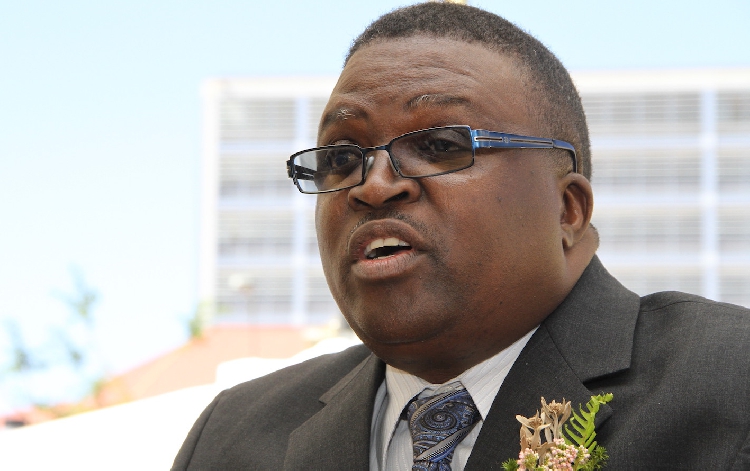
The auditor general, Junias Kandjeke, has provided a disclaimer opinion on the audited financial statements of the //Kharas Regional Council for the financial year ended 31 March 2020.
A disclaimer of opinion report implies that the auditor cannot tell whether the information he has been provided is reliable.
The auditor’s report noted that the general ledger and financial statements submitted do not materially agree as there is an “aggregate accumulated misstatement amounting to N$25 646 037”.
Consequently the auditors could not state that the financial statements were fairly represented, Kandjeke says.
Inventories are stated as amounting to N$155 862, but the auditors say they could not observe the counting of physical inventories and could not satisfy themselves as to the existence, completeness and valuation of the inventory quantities by alternative audit measures.
The cash-flow statement revealed a difference of N$98 093 386 between the amount disclosed and amounts recalculated for cash paid to purchase plant and equipment, and a difference of N$47 610 785 for total cash received.
Total cash paid on expenditures did not add up either, as a difference of N$29 764 513 was noted.
“The //Kharas Regional Council completed capital projects amounting to N$15 334 293, but they were not capitalised, while the work in progress account was credited with the completed capital projects amounting to N$7 819 660.
“However, these were also not capitalised to the respective property, plant and equipment accounts, resulting in the property, plant and equipment accounts to be understated by the same amount,” the report states.
Leave days and their value are also a bone of contention as the auditors could reportedly not obtain the leave provision reconciliation of N$11 917 380.
//Kharas Regional Council chairperson Josef Isaak says the report has not been tabled at the council for discussion yet.
“It will be premature to make any comments now, as the full council is yet to discuss this document,” he says.
“The auditors have not been able to obtain sufficient appropriate audit evidence to form a basis for an audit opinion, and therefore do not express an opinion on the financial statements,” Kandjeke says.
“In preparing the financial statements, management is responsible for assessing the entity’s ability to continue as a going concern, disclosing, as applicable, matters related to a going concern and using the going concern basis of accounting . . .
“Those charged with governance are responsible for overseeing the entity’s financial reporting process,” he says.
Acting chief regional officer Bennie Diergaardt attributes the disclaimer of opinion to a lack of training on the new standard of accounting in complying with international standards.
“We received instructions from the Ministry of Urban and Rural Development to migrate to the International Standards for Supreme Audit Institutions (Issai) . . .
“This was our first attempt to compile our financial standards as per the Issai standards, and we made a lot of mistakes,” he says.
Diergaardt says the finance executives have, however, rectified those mistakes in the 2020/21 financial statements, which are waiting to be audited.
“We are sending people next week for Issai training, but at that time we did not have any training,” he says.
In an age of information overload, Sunrise is The Namibian’s morning briefing, delivered at 6h00 from Monday to Friday. It offers a curated rundown of the most important stories from the past 24 hours – occasionally with a light, witty touch. It’s an essential way to stay informed. Subscribe and join our newsletter community.

The Namibian uses AI tools to assist with improved quality, accuracy and efficiency, while maintaining editorial oversight and journalistic integrity.
Stay informed with The Namibian – your source for credible journalism. Get in-depth reporting and opinions for
only N$85 a month. Invest in journalism, invest in democracy –
Subscribe Now!