



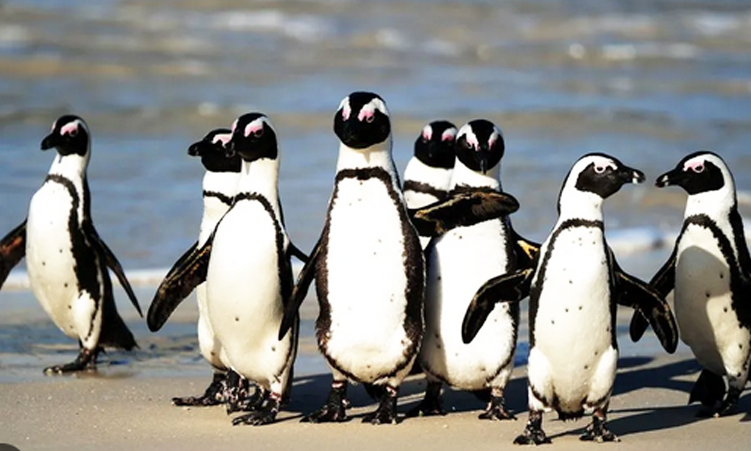
The population of the African penguin, mainly found in Namibia’s marine protected islands, has dropped by 97%, leaving only 1 200 breeding pairs.
They have been uplisted to critically endangered on the International Union for Conservation of Nature (IUCN) red list.
“African Penguin is assessed as critically endangered because it is undergoing an extremely rapid population decline, probably principally because of the impacts of competition with commercial fisheries and climate-mediated shifts in prey populations,” IUCN recently explained.
It said that recent, near-complete count data for the number of breeding pairs shows an alarming rise in the rate of decline, with the current and projected population losses exceeding 80% over three generations.
“This trend currently shows no sign of reversing, and immediate conservation action is required,” said the IUCN.
According to Rob Martin, the senior red list officer at BirdLife International, new data across the African penguin’s range confirms the growing decline.
“Listing a species as critically endangered means it has an extremely high risk of extinction.
Urgent conservation work must be done to prevent the very real chance of losing African Penguins from the wild,” he said.
There are 26 breeding localities in Namibia and South Africa.
According to a study by marine ecologist and conservation biologist Rachael Sherly in 2024, the penguin population in Namibia had been stable at around 5 000 breeding pairs between 1997 and 2017 but had significantly reduced to an estimated 1 200 pairs in 2023.
Namibian Foundation for the Conservation of Seabirds (Namcob) says the decline means the penguins are one step away from being extinct, joining other critically endangered species such as the black rhinos.
Namcob chairperson Angus Middleton warns that the plight of penguins signals a wider ecosystem concern.
“The penguins are in a very perilous state. As one of the sentinels of our oceans they are signaling that we are not managing our local marine environment holistically enough and we need to change this in order to arrest the situation,” he says.
The penguin population’s rapid decline is attributed to a combination of human activities, climate change and food shortages.
Middleton says Namcob and the minister of agriculture, fisheries, water and land reform are collaborating in conservation initiatives to halt the decline of the species.
He says they are monitoring populations and transporting injured or sick seabirds to the rehabilitation centre.
Together with researchers and tertiary institutions, they are also collecting data to better understand and possibly address threats, he adds.
The fisheries ministry has implemented a moratorium on the commercial fishing of sardines to allow for their recovery, Middleton says.
“To date, two oiled wildlife response containers are strategically located at Lüderitz and Oranjemund as part of Namibia’s tier one preparedness in the event of an oil spill.
Careful monitoring of African penguins is achieved by the deployment of dedicated penguin and seabird rangers, based on penguin colonies,” he says.
Desmond Tom, senior fisheries biologist at the ministry emphasises the urgent need to enhance efforts in African penguin conservation.
“As the government, we have to strengthen our efforts by working with NGOs and experts in the field like never before.”
In an age of information overload, Sunrise is The Namibian’s morning briefing, delivered at 6h00 from Monday to Friday. It offers a curated rundown of the most important stories from the past 24 hours – occasionally with a light, witty touch. It’s an essential way to stay informed. Subscribe and join our newsletter community.

The Namibian uses AI tools to assist with improved quality, accuracy and efficiency, while maintaining editorial oversight and journalistic integrity.
Stay informed with The Namibian – your source for credible journalism. Get in-depth reporting and opinions for
only N$85 a month. Invest in journalism, invest in democracy –
Subscribe Now!