






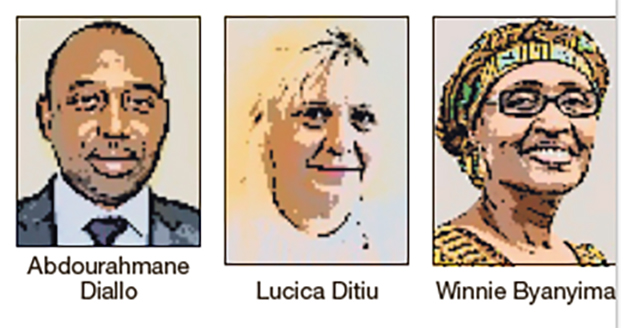
ABDOURAHMANE DIALLO, LUCICA DITIU and WINNIE BYANYIMAAS THE NUMBER of confirmed Covid-19 cases in Africa surpasses 500 000, the new coronavirus is at the forefront of public consciousness. But the continent was beset by infectious disease long before the current pandemic began. And, as long as governments and donors remain preoccupied with curbing Covid-19, killers like HIV-AIDS, malaria and tuberculosis (TB) will only grow stronger.
Of 38 million people worldwide living with HIV, the virus that causes AIDS, 25,6 million live in sub-Saharan Africa. Africa accounted for 380 000 malaria deaths – 94% of the global total – in 2018. And 2,6 million people in Africa develop TB every year, resulting in 630 000 deaths.
Over the last two decades, considerable progress has been made in fighting these diseases. AIDS-related deaths have been reduced by more than half since 2004, thanks largely to the availability of antiretroviral therapy. The TB mortality rate fell by 42% between 2000 and 2017. And malaria deaths decreased by 60% between 2000 and 2015; a child who contracts malaria today has a better chance of survival than ever before.
But the Covid-19 crisis threatens to stall or even reverse this progress, not least by inundating already fragile health systems.
Italy has one doctor for every 243 residents and yet, in some regions, its health system buckled under the weight of Covid-19 cases. Imagine what a similar outbreak would do in African countries, which have an average of one doctor for every 5 000 residents.
The World Health Organisation warns that the outbreak could stretch out over a few years. If so, the continent’s under-resourced health systems will be under severe strain for a long time to come.
Supply-chain disruptions caused by containment measures elsewhere compound the risks by threatening access to the preventive-health resources, diagnostics, and treatments needed to combat HIV, TB and malaria.
Already, some African countries have paused programmes providing TB and HIV treatments and diagnostics, and suspended distribution of insecticide-treated mosquito nets – essential to protect against malaria.
The WHO forecasts that in the worst-case scenario, the Covid-19 crisis could lead to a doubling of malaria deaths this year in sub-Saharan Africa. Such high malaria mortality levels were last recorded 20 years ago.
Moreover, a six-month disruption of antiretroviral therapy could lead to more than 500 000 additional deaths from AIDS-related illnesses (including TB) in sub-Saharan Africa in 2020/21.
In 2019, an estimated 440 000 people died of AIDS-related illnesses in the region.
Such outcomes are not inevitable. What is needed is a global collective response focused on delivering life-saving services, reducing the burden on already overstretched health systems, and protecting Africa’s most vulnerable. Success will depend on innovative solutions, a holistic perspective (rather than disjointed single-disease programmes), and an equity-first approach.
For starters, diagnostic tests – for Covid-19 and many other common diseases – must be accessible to all – especially to high-risk populations. Africa has well-established testing services for several common diseases, including multidisease testing for HIV and TB. These programmes are now at risk.
But there is promising news: Some countries have introduced joint testing for TB and Covid-19 and for malaria and Covid-19 (and immediate malaria treatment if required). Joint testing makes all the more sense, because HIV, TB and malaria may all cause symptoms consistent with Covid-19, such as high fevers.
Such programmes must be scaled up so that diagnostics and treatments – often expensive and difficult to access – are available to all.
This is entirely achievable. African countries, which have plenty of experience with health emergencies, have responded quickly and effectively to the threat of Covid-19. Such efforts must be advanced and deepened, both to contain Covid-19 and to sustain progress in the fight against HIV, TB and malaria.
Past experience shows that engaging affected communities and empowering civil society will be vital to success.
The rest of the world must also contribute. Above all, this means agreeing that any Covid-19 vaccine or treatment will be made available to all countries free of charge. During the HIV epidemic, millions died unnecessarily, because they could not access life-saving drugs. Even today, some nine million people in sub-Saharan Africa are awaiting life-saving treatment. Everyone has a right to health, regardless of where they live or how much money they have.
For Covid-19, we need a people’s vaccine.
But saving lives from Covid-19 will mean little if it also means allowing the number of lives lost to HIV, TB and malaria to rise.
Even as we work together to stop a new killer disease, we must resolve to sustain progress towards eliminating those we already know.
* Abdourahmane Diallo is the chief executive officer of the RBM Partnership to End Malaria. Lucica Ditiu is the executive director of the Stop TB Partnership. Winnie Byanyima is the executive director of UNAIDS.
– Copyright: Project Syndicate, 2020.