



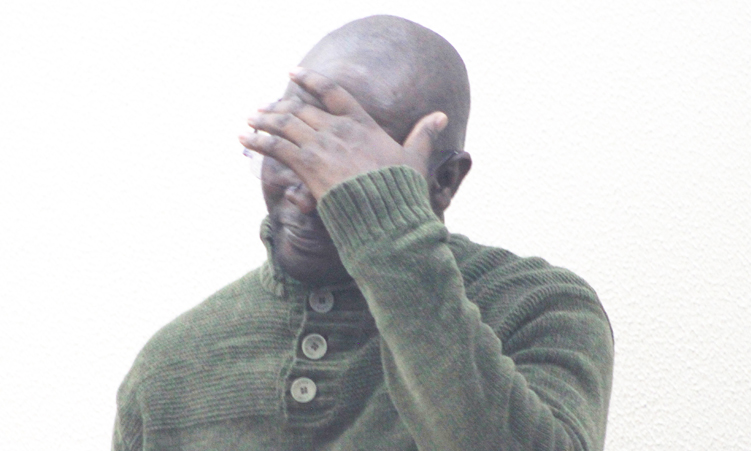
A man accused of raping two women after he had broken into their house nearly five years ago has been found not guilty on all of the charges on which he stood trial in the Windhoek High Court.
Judge Philanda Christiaan acquitted Moses Salele on three counts of rape and a charge of housebreaking and rape in a judgement delivered on Wednesday.
Christiaan found that evidence about the identification of Salele by one of the women he was accused of raping was unreliable, that forensic evidence did not support the allegations against him, and that he presented an alibi as a defence to the charges that he faced.
Salele was accused of breaking into a house in the Goreangab area of Windhoek on 5 June 2020 and raping two women in the house.
The state alleged that the two complainants in the case were raped by two men, and that Salele was one of the men.
Salele denied guilt when his trial started in August 2023.
Only one of the two complainants testified during the trial. The complainant who did not testify has moved to the United Kingdom, the court was informed.
Salele’s defence to the charges was that he was at Osona Village near Okahandja during the whole of June 2020, when travel restrictions were in force during the first year of the Covid-19 pandemic, and that he was not at the scene where the two women were raped.
His fiancée supported his alibi when she testified as a defence witness during the trial.
According to the complainant who testified, she recognised Salele’s voice and his scent when two male intruders in her house raped her and another woman.
She told the court she recognised his voice as he had previously been involved in a relationship with a relative of hers.
Salele told the court he had been introduced to the complainant once, and that was also the only occasion that he had spoken to her.
DNA samples collected from the complainant proved to be inconclusive when they were analysed, the court heard. The DNA samples indicated the presence of three persons’ DNA profiles, with the complainant accounting for one profile while the other two profiles could not be linked to any specific individual, Christiaan recounted in her judgement.
“The identification evidence relied primarily on the complainant’s recognition of the accused’s voice and scent,” she noted.
“The police investigation established that a crime had occurred and corroborated aspects of the complainant’s narrative, but did not recover any physical evidence directly linking the accused to the scene,” Christiaan stated.
“Forensic DNA analysis confirmed the presence of male DNA, but the profiles of the contributors, other than the complainant, could not be identified. Similarly, the medical evidence confirmed signs of sexual assault consistent with the complainant’s version, but did not attribute the injuries to any specific individual,” the judge said when summarising the prosecution’s evidence.
Christiaan said she had significant concerns about the complainant’s claim that she could identify Salele by his voice, as the identification was made in the dark, under the stress of a traumatic event and without visual confirmation and independent corroboration.
“Stress can significantly impair a person’s ability to accurately perceive and recall details such as a person’s voice,” she remarked.
Christiaan concluded that the state’s evidence failed to establish that Salele had been one of the persons who broke into the house and raped the two women.
Defence lawyers Mbanga Siyomunji and Enos Mwakondange represented Salele, who was free on bail, during different stages of his trial.
State advocate Palmer Kumalo represented the prosecution.
In an age of information overload, Sunrise is The Namibian’s morning briefing, delivered at 6h00 from Monday to Friday. It offers a curated rundown of the most important stories from the past 24 hours – occasionally with a light, witty touch. It’s an essential way to stay informed. Subscribe and join our newsletter community.

The Namibian uses AI tools to assist with improved quality, accuracy and efficiency, while maintaining editorial oversight and journalistic integrity.
Stay informed with The Namibian – your source for credible journalism. Get in-depth reporting and opinions for
only N$85 a month. Invest in journalism, invest in democracy –
Subscribe Now!